Florida Gives You Two Years to Sue. The 911 Recording May Last 30 Days.
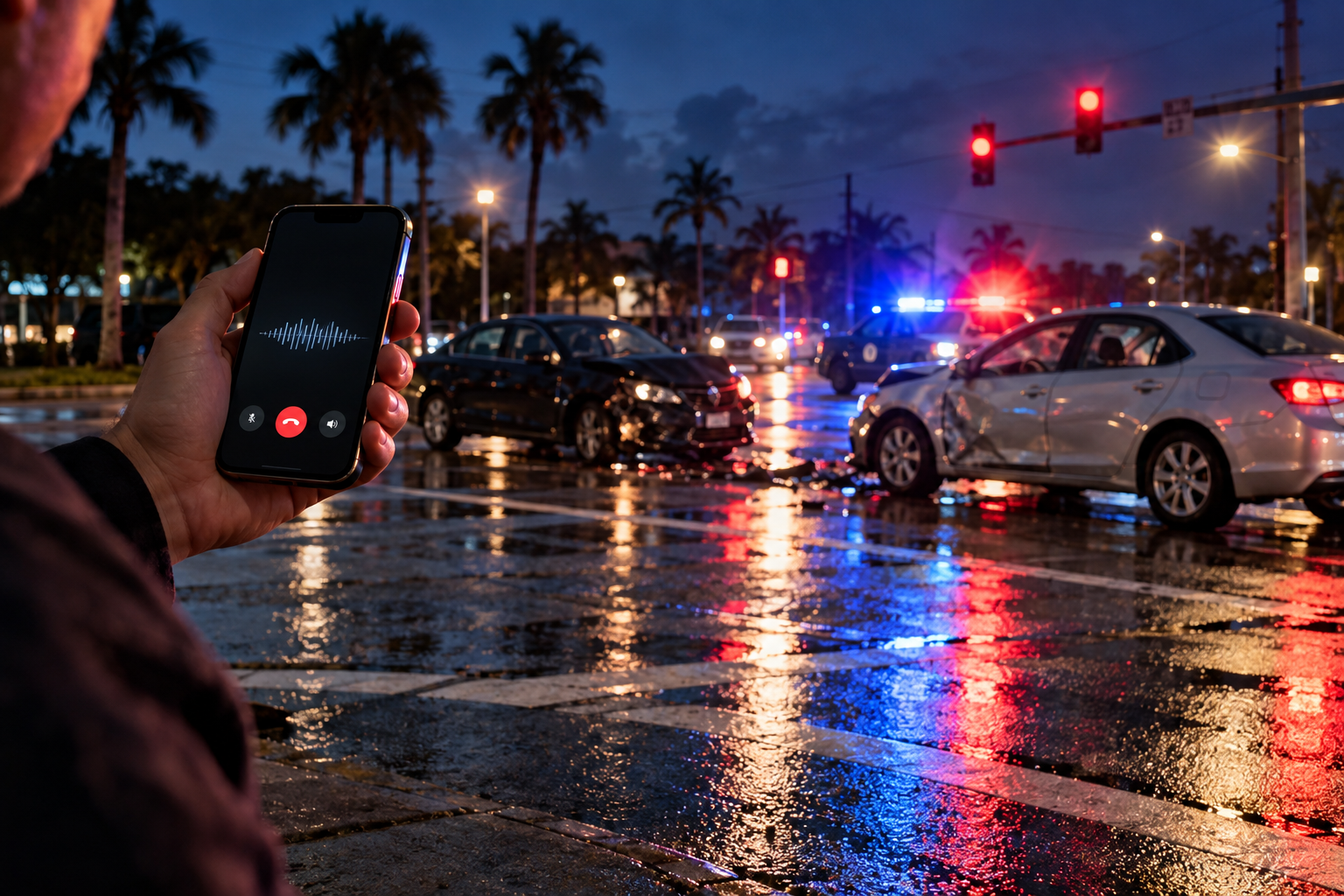
A serious crash happens at 8:17 p.m. A driver calls 911 while the vehicles are still blocking the intersection. In the background, someone says the light was red. The caller describes where each vehicle came to rest. The dispatcher’s questions establish when the first report was made, whether anyone complained of pain, and whether another car left the scene.
Two months later, the written crash report remains available. The recording may not.
Florida generally gives a person two years to file an action founded on negligence. But the state’s records schedule sets a much shorter minimum retention period for many dispatch communications: 30 days. That gap matters after a Florida car accident, pedestrian collision, fall, assault, or other emergency in which the first call may preserve details no later document can recreate.
The point is not that every 911 recording vanishes on day 31. It is that a record may become eligible for lawful disposition long before a personal injury claim must be filed. Evidence preservation and lawsuit filing run on different clocks.
The first clock may be only 30 days
Florida’s Department of State publishes retention schedules for public agencies. The current General Records Schedule GS1-SL classifies communications to and from a dispatch office—including recorded telephone calls, text messages, and other formats—as “Dispatch Communications Records.” Item 434 assigns those records a minimum retention of 30 days.
“Minimum” is important. The schedule does not require an agency to erase a recording on the thirty-first day. An agency may keep records longer under its own policy, because the communication was flagged for further investigation, or because another law or legal hold applies. But after the applicable minimum and any other requirements have been satisfied, the record can become eligible for disposition. A person investigating an injury should not assume that a police report, incident number, or pending insurance claim automatically protects the underlying audio.
The schedule also addresses general communications audio, including radio and telephone communications and complaint calls, with a 30-day minimum. That means the vulnerable evidence may include more than the caller’s side of the 911 conversation. Depending on the agency and event, related radio traffic or other recorded communications may be stored under a short retention rule too.
The audio and the dispatch log are not the same record
A request for the “911 report” can produce an incomplete answer because dispatch systems create several records. The audio captures voices, pauses, background sounds, and the dispatcher’s questions. The computer-aided dispatch record—often called a CAD log or event history—usually captures structured information about the call.
Under Item 377 of the same Florida schedule, a dispatch log may identify the time, address, complaint, responding officer, handling time, caller number, remarks, and reference signal. Its minimum retention is one anniversary year after the call. The schedule specifically warns that the log may or may not contain a verbatim transcript of the audio.
That distinction can rescue part of an investigation after the sound file is gone, but it is not a substitute. A short entry such as “two vehicles, possible injuries” does not preserve a caller’s spontaneous description, the sound of a horn or impact, an admission in the background, or the uncertainty in a statement. Conversely, the audio may not contain later time stamps showing when units were dispatched, arrived, or cleared. A complete request therefore identifies both the recording and the related dispatch data rather than treating them as interchangeable.
A 911 call can preserve the scene before accounts harden
The first call is not automatically admissible at trial, and it does not automatically prove fault. Authentication, hearsay rules, completeness, relevance, and other evidentiary questions still matter. The recording may also contain mistakes made during a stressful event.
Still, a contemporaneous call can become an unusually valuable investigative source. It may identify an eyewitness who left before an officer arrived. It may establish the location of debris or vehicles before they were moved. In a negligent-security case, it may capture prior calls, delayed response, or what the caller reported about lighting and access. After a fall, it may record an employee acknowledging a spill or hazard before the scene was cleaned. In a hit-and-run, it may preserve a partial plate number, direction of travel, or description that never made it into the final report.
This is also why a written report should be treated as a map, not the entire case. Tucker Law’s analysis of the Florida accident-report privilege explains that a report, statements collected to prepare it, and an officer’s independent observations are legally different evidence. The 911 caller may be a bystander rather than a person compelled to report a crash. Whether any particular statement can later be used depends on who spoke, why, and under which evidence rule. Preserving the source is the first step; admissibility is a separate analysis.
Public record does not mean unredacted record
Florida’s Public Records Act generally requires a custodian to allow public records to be inspected and copied. Section 119.07 also requires a custodian who asserts an exemption to redact the protected part and produce the remainder when possible, stating the statutory basis for withholding material.
Emergency calls have specific privacy protections. Section 365.171(12) makes confidential the name, address, telephone number, personal information, and other information that may identify a person who requests emergency service or reports an emergency while that information remains in the emergency agency’s custody. The exemption does not necessarily make the entire recording confidential, but it can require redaction of identifying content.
Medical information can create another limit. Under section 401.30, emergency-call records containing patient examination or treatment information are confidential, subject to specified exceptions and legal process. A 911 audio request and a request for an EMS patient care report therefore may produce different results. The patient’s consent, legal representative, or a properly noticed subpoena may be required for medical material even when other dispatch information can be released.
Redaction can take time and may generate fees. It does not change the practical need to identify the record while it still exists.
A records request and a preservation notice perform different jobs
A public-records request asks the government to inspect or copy an existing record. A preservation notice alerts a custodian that identified information may be relevant to reasonably anticipated litigation and should not be disposed of. They overlap, but they are not synonyms.
The Department of State schedule tells agencies to place an immediate hold on related records when the agency has been notified of, or can reasonably anticipate, a potential cause of action. It also says that legally discoverable electronic files should be maintained in native format when litigation is pending or reasonably anticipated. That guidance is especially important for audio, CAD exports, text-to-911 messages, and metadata that may lose useful information when converted to a paper printout.
A precise request should identify the incident date, a reasonable time window, location, involved names if known, agency incident number, and the types of records sought. Depending on the event, that can include the original 911 audio, text-to-911 communications, CAD event chronology, dispatch notes, radio traffic, unit-status history, and available metadata. If several agencies participated—such as a county communications center, municipal police department, fire-rescue agency, or highway patrol—each may hold a different part of the record.
A request should also ask the custodian to identify the legal basis for any redaction or withholding. If litigation is reasonably anticipated, a separate preservation notice can identify the claim and ask that responsive electronic records be retained in native form. Neither step guarantees that every requested item exists or will be publicly releasable, but a prompt and specific request is far more effective than a general demand made months later.
The dispatch center is only one evidence custodian
The 911 recording may lead to other evidence with its own retention clock. An officer’s body camera can show vehicle positions, lighting, weather, visible injuries, or physical conditions. A patrol vehicle may hold dash-camera footage. Traffic-management centers, buses, apartment complexes, stores, homes, and nearby vehicles may have video. Phones and vehicles may contain location or event data. Private systems can overwrite recordings in days.
Tucker Law’s guide to dash-camera evidence addresses how video may be authenticated and used. The firm’s article on vanishing collision evidence explains why the actual custodian must be identified quickly. A preservation effort built around the 911 call should follow every lead the call reveals rather than stopping when the audio is obtained.
The evidence clock is not the lawsuit clock
Florida Statutes section 95.11 generally provides two years for an action founded on negligence. Different claims can have different deadlines, accrual rules, notice requirements, or statutes of repose. Claims involving a government entity, medical negligence, wrongful death, or a minor require their own deadline analysis.
Even when two years applies, waiting close to two years to investigate can be disastrous. A limitations period determines when a lawsuit must be filed. It does not order a dispatcher, business, homeowner, vehicle owner, or technology provider to keep every potentially relevant record until then.
The useful question after a serious incident is not simply, “How long do I have to sue?” It is also, “Who holds evidence today, and when can each custodian lawfully or routinely erase it?”
If a Florida accident caused significant injury, Tucker Law can identify the agencies and private custodians that may possess time-sensitive evidence. The firm’s Personal Injury Information Center provides additional guidance, or you can contact Tucker Law to discuss the specific event. A 911 call may be one of the earliest and most candid records of what happened. The safest time to protect it is before anyone has to ask whether it still exists.
This article provides general information and is not legal advice for any particular incident or claim.