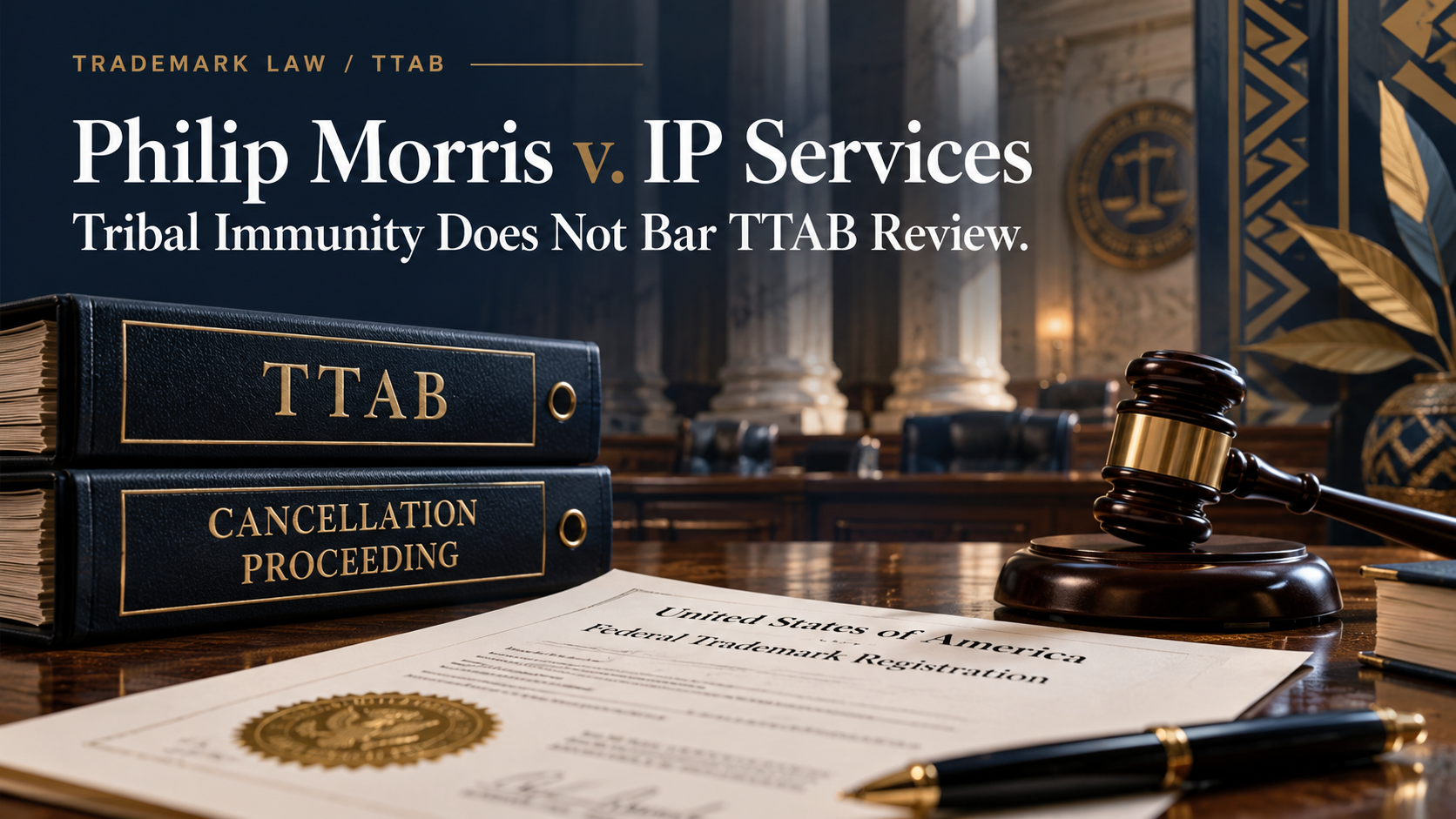
Philip Morris v. IP Services: Tribal Immunity Does Not Bar TTAB Review
A precedential TTAB order holds that tribal sovereign immunity cannot stop opposition or cancellation proceedings over federal trademark rights.
A precedential TTAB order holds that tribal sovereign immunity cannot stop opposition or cancellation proceedings over federal trademark rights.
A federal registration does not monitor or enforce itself. This 2026 trademark monitoring playbook explains how to watch USPTO records, the Trademark Official Gazette, marketplaces, social media, domains, maintenance deadlines, and potential TTAB conflicts.
The USPTO expanded TTAB Center on August 18, 2026 to accept summary-judgment motions, motions to strike, review requests, and appeal-related filings. Here is what trademark litigants should change in their filing workflow.
Every U.S. trademark application must identify the goods or services connected with the mark. Those goods and services are organized using the international Nice Classification system. The classes do not determine whether a mark is protectable, but they shape filing fees, search strategy, examination, and the scope of a registration. On August 26, 2026, the U.S. Patent and Trademark Office published a final rule adopting the Thirteenth Edition, version 2027, of the Nice Classification. The rule takes effect January 1, 2027. The announced textual changes are modest. That is precisely why applicants should not mistake the update for a reason to postpone careful drafting. Classification and identification are related, but they solve different problems. What changes on January 1, 2027? The Nice system will continue to contain 34 classes for goods and 11 classes for services. The final rule makes limited revisions to the class headings in the USPTO’s regulations. For Class 6, the USPTO will add punctuation after “alloys.” For Class 9, it will modernize several diving-related terms: “divers’ masks” becomes “diving masks”; “ear plugs for divers, nose clips for divers” becomes “ear plugs for diving, nose clips for diving”; and “gloves for divers” becomes “diving gloves.” The USPTO characterized the rule as procedural and interpretive. It does not change the substantive standards for obtaining trademark protection. Class headings are not a filing shortcut A common misunderstanding is that selecting a class number adequately describes the applicant’s rights. It does not. The application must identify the actual goods or services with enough clarity and specificity for the USPTO and the public to understand the claimed use. Two businesses may file in the same class while offering materially different products. Conversely, one brand may require [...]
If you’re building a business, your name is more than a label; it’s the sign on the front door, the way customers find you, and the reputation you’re building day by day. And that’s why the timing question matters: When Should I Trademark My Business Name? The question is running circles around your head because you're not sure what point you are supposed to know that you should get your name trademarked. Here’s the honest attorney answer: sooner than most people think, but not always on day one. The right timing depends on what you’ve built so far, how confident you are in the name, and how exposed you are to someone else claiming it first. What a trademark actually does: A trademark helps protect your brand identity, your business name, logo, or slogan, so customers don’t get confused by another company using something too similar. Think of it like putting a fence around your brand. The fence doesn’t build the house for you, but it makes it harder for someone to move in next door and pretend it’s theirs. A trademark is different from: Registering an LLC or corporation (that’s a business entity, not brand protection) Buying a domain name (helpful, but doesn’t stop others) Creating social media handles (same story) You can do all three and still have zero trademark protection. The best time to trademark your business name: the “committed and visible” moment Most business owners should seriously consider trademarking when these three things are true: 1) You’re committed to the name. If you’re still brainstorming names every weekend, don’t rush to spend money filing paperwork. But once you’re past the “maybe” phase—and you’ve put the name on your website, packaging, or [...]

Don’t just lawyer up.
Tucker Up.®