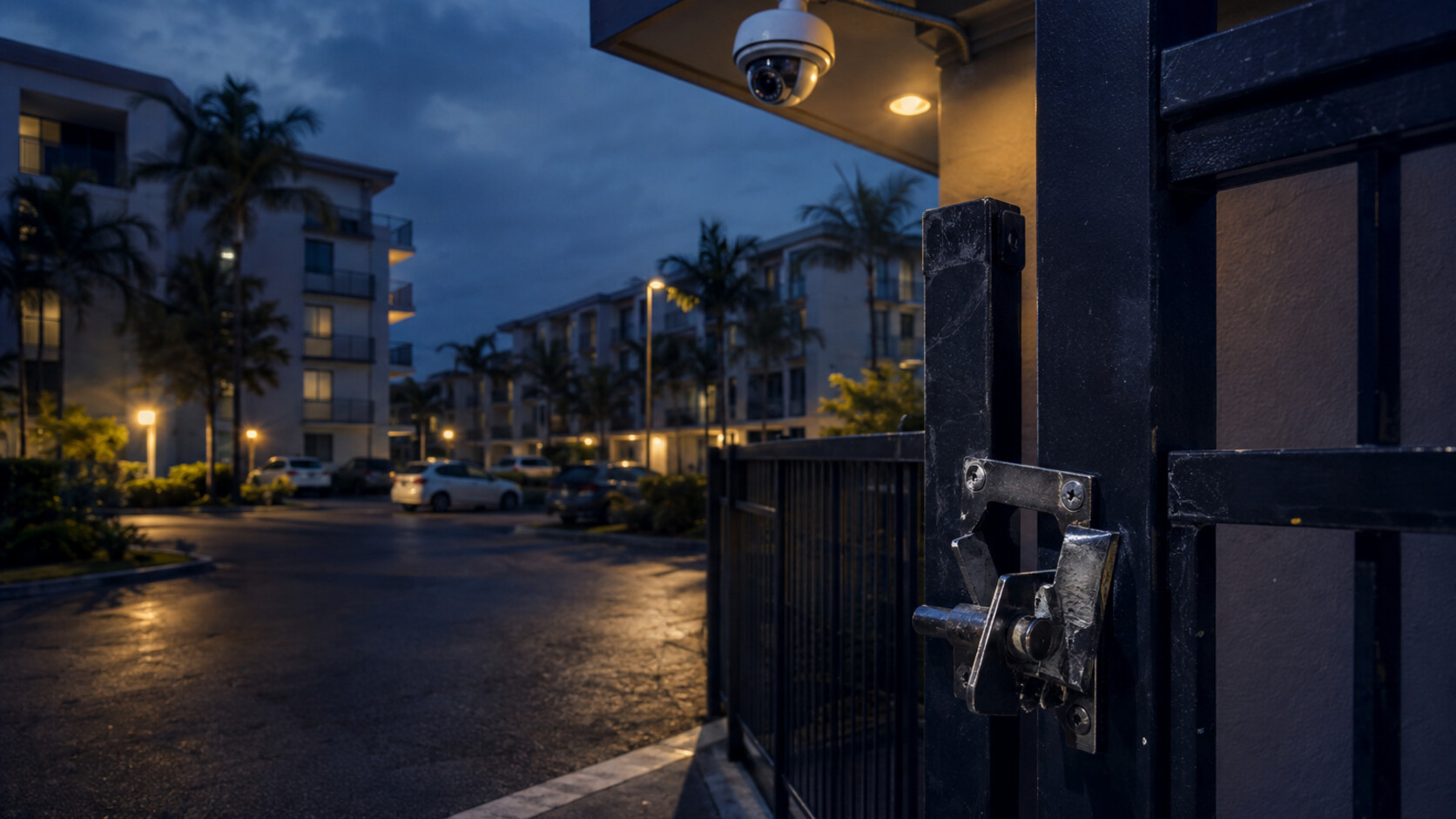
After an Assault at a Florida Apartment Complex: The Security Evidence That Can Decide a Claim
After a violent incident at an apartment complex, two investigations may begin at the same time. Police focus on identifying and prosecuting the person who committed the crime. A civil negligent-security investigation asks a different question: did a property owner or operator fail to take reasonable security measures, and did that failure contribute to the injury?
That second question is rarely answered by the police report alone. The most important proof may be stored in a camera system, gate-repair log, lighting survey, employee training file, or crime-prevention assessment controlled by the property. Under Florida’s current statutory framework, those records can also determine whether a qualifying multifamily property receives a legal presumption against liability.
For an injured tenant, guest, delivery worker, or other person lawfully on the property, the practical lesson is urgent: preserve the security evidence before ordinary business systems overwrite or discard it. Tucker Law handles Florida personal injury claims involving unsafe property conditions, catastrophic harm, and disputed responsibility.
The criminal case and the negligent-security claim ask different questions
The person who carried out an assault, shooting, robbery, or other violent act bears responsibility for that crime. A civil claim against a property owner is not an attempt to transfer the assailant’s conduct to someone else. It examines whether the owner, lessor, operator, or manager had a legally recognized duty, failed to use reasonable care under the circumstances, and caused or contributed to the victim’s injuries.
A crime occurring on the property does not automatically make the property owner liable. The investigation must connect a security failure to the event. A gate that had been broken for months may be important if it allowed the assailant to enter. It may be far less important if the assailant was an authorized resident and the gate played no role. The same is true of a dark parking lot, missing camera, untrained employee, or ignored complaint: the evidence matters because of what it proves about notice, breach, causation, and damages—not merely because it sounds unsafe.
Florida Statutes section 768.0701 also requires the factfinder in covered premises-liability actions to consider the fault of every person who contributed to an injury caused by a third party’s criminal act. That includes the criminal actor. The allocation rule makes careful proof of the property owner’s own conduct especially important.
Florida’s apartment-security statute creates a presumption, not automatic immunity
Section 768.0706 of the 2026 Florida Statutes applies to a “multifamily residential property,” defined as a residential building or group of residential buildings—such as apartments, townhouses, or condominiums—with at least five dwelling units on a particular parcel.
An owner or principal operator that substantially implements the statute’s security measures receives a presumption against liability for criminal acts committed on the premises by third parties who are not its employees or agents. That is a significant defense, but it is not blanket immunity. The statute puts the burden on the owner or principal operator to show substantial implementation.
The statute also says that it does not create a new private cause of action or expand an existing duty. In practical terms, failing one item on the statutory list does not by itself decide negligence, just as checking every box does not erase the need to examine whether the presumption actually applies. The type of property, identity of the assailant, condition of the security measures, age of the assessment, employee training, and causal connection all remain important.
The camera system has a built-in evidence clock
One statutory measure is a security-camera system at points of entry and exit that records and keeps footage retrievable for at least 30 days so it can assist in identifying and apprehending an offender. That retention period gives an injured person a concrete reason to act quickly.
Useful video may show when a gate was left open, whether a person followed a vehicle through an entrance, how long someone waited in a common area, whether security personnel made rounds, or what happened immediately before and after an attack. Entry cameras are not the only possible source. Elevators, mailrooms, garages, doorbell cameras, neighboring businesses, traffic cameras, and police body-worn cameras may preserve different parts of the timeline.
A preservation request should identify the date, time range, location, entrances, exits, common areas, and the types of electronically stored information involved. Asking only for “the video of the incident” may miss footage showing how the assailant entered or whether a security problem existed earlier. Tucker Law has discussed why relying on a manager’s promise to “take care of everything” can be dangerous when surveillance and other premises evidence may disappear.
Parking-lot lighting can be measured
The statute does not describe adequate parking-lot lighting in subjective terms. For the presumption, the parking lot must be illuminated from dusk until dawn at an average intensity of at least 1.8 foot-candles per square foot, measured 18 inches above the surface, or controlled by a photocell or similar device providing dusk-to-dawn lighting. Walkways, laundry rooms, common areas, and porches must also have dusk-to-dawn lighting or comparable electronic control.
That specificity changes how the scene should be documented. A bright photograph taken with a phone’s night mode does not reliably establish how the area appeared to the human eye. A daytime inspection cannot show which fixtures worked at the time of the incident. A proper investigation may require photographs at a comparable hour, fixture and maintenance records, complaints about outages, work orders, power or timer information, and measurements by a qualified professional.
Weather, foliage, parked vehicles, building layout, and shadows may also affect visibility. The real question is not merely whether a light was installed, but whether the relevant area was illuminated and whether any deficiency contributed to what occurred.
Gates, locks, and doors leave a maintenance history
Other measures listed in section 768.0706 include at least a one-inch deadbolt on each dwelling-unit door; locking devices on windows, exterior sliding doors, and other noncommunity doors; key- or fob-controlled gates along pool fence areas; and a peephole or door viewer on a unit door that lacks a window or an adjacent window.
Physical inspection matters, but records often tell the fuller story. Access-control logs may show repeated gate failures. Work orders can establish when management first received notice. Vendor invoices, resident emails, inspection reports, and replacement-part orders may reveal whether a defect was temporary or chronic. Lease provisions and resident notices may show how the property represented its security practices.
These materials should be preserved in their original form when possible. A repaired latch or newly replaced bulb may improve safety after an incident, but it can also change the scene before the condition is documented.
The assessment and training files may be as important as the hardware
The statutory presumption requires more than cameras and locks. By January 1, 2025, the owner or principal operator was required to obtain a crime prevention through environmental design assessment for the property, performed by a law-enforcement agency or a Florida Crime Prevention Through Environmental Design Practitioner designated by the Florida Crime Prevention Training Institute. The assessment must be no more than three years old, and the property must remain in substantial compliance with it.
The owner or operator was also required to provide proper crime-deterrence and safety training to current employees by January 1, 2025. Employees hired afterward must receive the training within 60 days. The curriculum must familiarize employees with the statutory security principles and measures, be reviewed at least every three years, and be updated as necessary.
Those requirements create a paper trail. The assessment, the assessor’s qualifications, recommendations, compliance records, training curriculum, attendance records, hire dates, and later updates can show whether the owner qualifies for the presumption. The Florida Attorney General’s Crime Prevention Training Institute explains the state’s practitioner designations and crime-prevention training programs.
Prior incidents matter, but the inquiry should be precise
Negligent-security cases often involve evidence about earlier crimes, suspicious activity, resident complaints, trespass notices, and police calls. The point is not to collect an alarming stack of unrelated reports. The investigation should ask whether prior events were sufficiently connected in location, method, timing, or risk to make a security problem material to the incident at issue.
Public police-call data may be useful, but property-controlled records can be equally important. Incident reports, emails between management and security vendors, requests for additional patrols, resident newsletters, insurance inspections, and minutes from ownership or association meetings may reveal what the responsible parties actually knew and when they knew it.
Witnesses can add context that a spreadsheet cannot. Residents may know that a pedestrian gate never latched, a parking deck light remained out, or strangers regularly entered behind vehicles. Their names and observations should be recorded promptly, before residents move or memories fade.
Causation and damages still have to be proved
Even strong evidence of a security lapse does not replace proof that the lapse contributed to the injury. The sequence of entry, opportunity for intervention, timing of the event, and conduct of the assailant all matter. So do the actions and control of any security company, property manager, owner, lessor, or other entity involved.
Florida’s comparative-fault statute, section 768.81, generally allocates damages according to fault in covered negligence actions. Section 768.0701 specifically ensures that the criminal actor’s fault is considered in covered third-party-crime cases. A property defendant may therefore argue that the assailant bears most or all responsibility. The claimant’s proof must clearly identify the property-related failure and how it changed the risk or outcome.
Damages may include medical expenses, lost income, reduced earning capacity, pain and suffering, psychological treatment, disability, and other losses supported by the evidence. When an attack causes permanent impairment, Tucker Law’s catastrophic-injury practice addresses the long-term needs that may shape a claim. Claims involving sexual violence require particularly sensitive handling; Tucker Law also provides information about civil options after a sexual assault in Florida.
The first days should be used to preserve, not speculate
Medical care and immediate safety come first. Once those needs are addressed, the injured person or family should keep photographs, clothing and damaged belongings, medical paperwork, wage records, communications with management, and the names of witnesses. It is also important to preserve messages or app notifications showing access problems, prior complaints, or management responses.
A prompt legal investigation can send targeted preservation notices, identify the correct owner and operator, obtain public records, inspect the site under comparable conditions, and determine whether an independent security company or vendor controlled relevant evidence. Recorded statements and broad authorizations should not be given casually before the speaker understands who is asking and how the information may be used.
Florida Statutes section 95.11 generally provides two years for an action founded on negligence and two years for wrongful death. The correct deadline can vary with the date of the incident, the parties, and other legal rules. More importantly, a camera’s retention period or a routine records policy may erase useful proof long before the filing deadline arrives.
A security case is built from the property’s own record
The most revealing document in a Florida apartment negligent-security claim may not be the police report. It may be the 31-day-old video that was about to be overwritten, the gate ticket marked “closed” without a repair, a lighting measurement, an outdated crime-prevention assessment, or a training roster that does not include the employee on duty.
Section 768.0706 makes those details central when a qualifying property invokes the statutory presumption. The owner bears the burden of showing substantial implementation, while the injured person still must prove the elements of the civil claim. Early preservation allows both questions to be evaluated from evidence rather than assumptions.
If you or a family member was seriously injured in an assault, robbery, shooting, or other criminal incident at a Florida apartment or condominium property, contact Tucker Law for a confidential case evaluation. If the incident was fatal, the firm also represents families in Florida wrongful-death claims.
Primary sources
Florida Statutes sections 768.0701, 768.0706, 768.81, and 95.11 (2026); Florida Office of the Attorney General, Florida Crime Prevention Training Institute, Crime Prevention Training Courses.
This article provides general information about Florida law and is not legal advice. Duties, defenses, deadlines, insurance coverage, and available claims depend on the facts and law applicable to each matter.