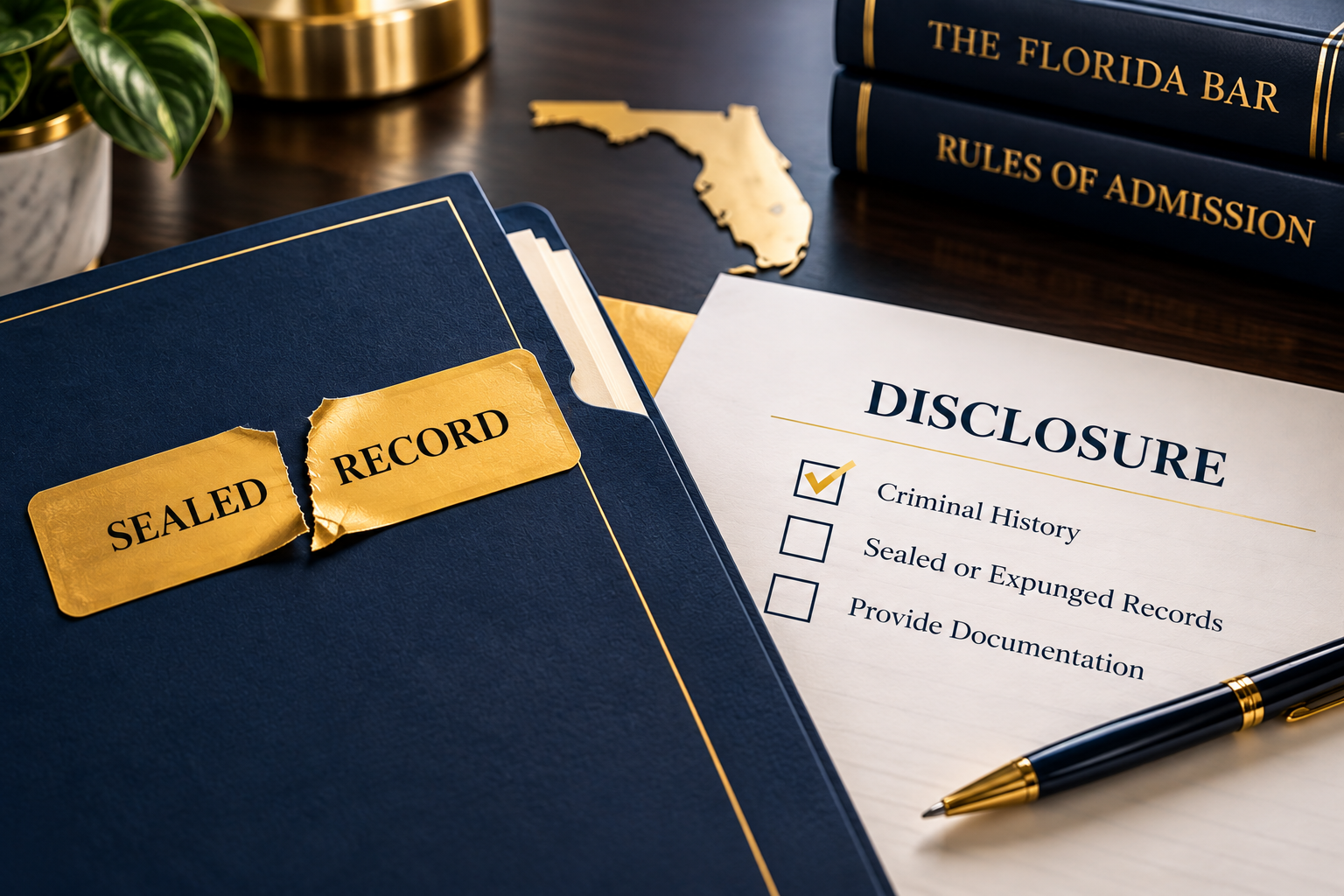
Do You Have to Disclose a Sealed or Expunged Arrest to the Florida Bar?
A sealed or expunged criminal record can disappear from ordinary public view, but it does not disappear from a Florida Bar application. For applicants to The Florida Bar, that distinction is critical.
The Florida Board of Bar Examiners’ current reference copy of the Bar Application specifically warns applicants answering the criminal-history questions that sealed and expunged records must be disclosed. The form further instructs applicants with sealed or expunged records to take appropriate steps to have those records released directly to the Board.
Florida’s current statutes say the same thing. Under section 943.0585, a person with an expunged record may generally deny the arrest, but that general rule contains an express exception for a person who is a candidate for admission to The Florida Bar. Section 943.059 contains the same exception for sealed records.
That means the question is not whether an arrest is still visible on a routine background search. The question is whether the Florida Bar Application calls for the information. If it does, sealing or expunction does not eliminate the disclosure obligation.
Sealed and expunged are not the same as erased for Bar-admission purposes
Applicants often come to the process with an understandable assumption: if a judge sealed or expunged a case, the matter no longer needs to be disclosed. That assumption may be correct in some ordinary contexts, because Florida law generally allows a person to deny or fail to acknowledge an arrest covered by a qualifying sealed or expunged record.
But the statutes themselves carve out exceptions. One of those exceptions is admission to The Florida Bar. In the 2026 statutes, the operative provisions are found in sections 943.0585(6)(b) and 943.059(6)(b). Each identifies a candidate for admission to The Florida Bar as someone who cannot rely on the ordinary right to deny the covered arrest.
The Board’s application goes further by putting applicants on direct notice. For Questions 19 through 23, the application warns that sealing, expunction, withheld adjudication, dismissal, vacatur, or another legal proceeding does not excuse less than full disclosure when the question requires the information. The application also tells applicants to review their law-school application and any other state bar applications to make sure the disclosures are consistent.
The current application and the current statutes should be read together
There is a technical point worth noticing. The reference copy of the Florida Bar Application currently posted by the Board is version 24a and refers applicants to sections 943.0585(4) and 943.059(4). The 2026 Florida Statutes now place the disclosure exception in subsection (6)(b) of each statute. The statutory substance remains clear: a Florida Bar applicant is one of the enumerated exceptions to the ordinary rule permitting denial of a sealed or expunged arrest.
For an applicant, the practical lesson is simple: do not stop after reading an old subsection number on a form. Read the current application question and the current statutory text together. When in doubt about what the application requires, the safer course is to analyze the actual wording of the question rather than relying on a general understanding of what sealing or expunction normally permits.
What must be disclosed depends on the application question
The disclosure obligation is broad, but it is still tied to the questions actually asked. The Board’s criminal-history section asks about different categories of conduct, including criminal charges and certain vehicular offenses. An applicant should answer the precise question presented and provide the responsive information requested.
That ordinarily means identifying the event, the agency or court involved, the charge or accusation, the disposition, and the fact that the record was sealed or expunged where the form asks for that information. The application also calls for a detailed explanation in the relevant sections.
What should not happen is an attempt to rewrite the history of the event based on the later sealing or expunction. If an arrest occurred and the application asks whether the applicant has ever been arrested, the later disposition does not change the historical fact that the arrest occurred. The disposition is important, but it is a separate part of the answer.
A dismissal or withheld adjudication does not necessarily end the analysis
The Florida Bar Application expressly cautions applicants against assuming that a favorable procedural outcome eliminates the need to disclose. That is important because applicants sometimes equate “not convicted” with “not reportable.” Those are different questions.
A case may have been dismissed. The prosecutor may have entered a nolle prosequi. Adjudication may have been withheld. A conviction may have been vacated. The record may later have been sealed or expunged. Each of those facts can be highly relevant to the ultimate evaluation of the event, but none should be used as a substitute for reading what the application actually asks.
For this reason, an applicant reviewing an old criminal matter should gather the underlying records before completing the disclosure. The disposition, docket, charging document, police or arrest information, and sealing or expunction order may all help ensure that the application is factually precise.
The Board may need access to records that are no longer public
Sealing and expunction can create a practical records problem. An applicant may know that an event occurred but no longer have the paperwork. The online docket may be unavailable. A clerk’s public search may return little or nothing. That does not relieve the applicant from answering a question that requires disclosure.
The Board’s application expressly instructs applicants whose records have been sealed or expunged to take appropriate steps to have them unsealed and released directly to the Board. The exact procedure can depend on the court, agency, and type of record involved, so applicants should not assume that one generic request will work in every case.
This is also why waiting until the end of the application process can create unnecessary delay. If you know a sealed or expunged matter will need to be disclosed, begin identifying the court, case number, agency, and available records early.
Candor can become a separate issue from the underlying conduct
The criminal event and the disclosure of that event are not the same character-and-fitness issue.
Under Rule 3-11 of the Rules of the Supreme Court Relating to Admissions to the Bar, unlawful conduct can be a basis for further inquiry. But Rule 3-11 separately identifies a false or misleading statement or omission of relevant information on the Bar Application, an amendment, testimony, or a sworn statement as potential disqualifying conduct.
Rule 3-12 likewise directs the Board to consider, among other factors, the applicant’s candor in the admissions process and the materiality of omissions or misrepresentations when evaluating prior conduct.
That creates a practical distinction. An old arrest that was dismissed and later expunged may present one set of facts. Failing to disclose that arrest after the application expressly required it may create another. Applicants should therefore resist the temptation to decide unilaterally that an event is too old, too minor, too favorable in disposition, or too private to disclose.
Tucker Law’s Florida Bar character and fitness page discusses how prior conduct and candor are evaluated as part of the broader admissions process.
Compare your Florida application with your law-school and other bar applications
The Board’s application specifically advises applicants to compare their answers with law-school applications and applications filed in other jurisdictions. That comparison is especially important for sealed or expunged records because different applications may have been completed at different points in time.
For example, a law-school application may have been filed before an expunction occurred. Another state’s bar application may ask a narrower question. A later Florida application may ask for a broader category of information. The answers do not always need to be identical because the questions may differ, but unexplained factual inconsistencies can create avoidable problems.
The right way to compare them is question by question. Identify what each application asked, what you answered, and whether the factual difference is explained by the wording of the question or by a later change in circumstances.
If you are still preparing your Florida application, Tucker Law’s Florida Bar application review page explains how counsel can review disclosures before submission. If you already filed and discover an omission, our article on the Florida Bar application’s continuing amendment obligation addresses the separate duty to keep the application current, complete, and correct.
What if you already omitted the sealed or expunged matter?
Do not assume the omission cannot be corrected. But do not compound it by continuing to leave the application incomplete after you recognize the problem.
The first step is to review the exact application question, the original answer, the underlying record, and the reason the matter was omitted. A person who misunderstood the effect of an expunction order presents a different factual situation from someone who deliberately withheld a matter after reading the application’s explicit warning. The correction should be accurate and complete, and any explanation should address what actually happened rather than offer a generalized justification.
The Board’s continuing-application rule may require an amendment, and the applicant should preserve a copy of the correction and any supporting documents submitted. If the Board later requests clarification or additional records, Tucker Law’s article on responding to Florida Bar status letters and requests for information explains how to approach that stage.
A sealed record can still become part of a broader character-and-fitness review
Disclosure does not mean automatic denial. The Board evaluates prior conduct using the factors identified in Rule 3-12, including age at the time of the conduct, recency, seriousness, surrounding circumstances, rehabilitation, positive social contributions, candor, and the materiality of any omission or misrepresentation.
Some criminal-history disclosures are resolved through the ordinary background investigation. Other matters may lead to additional requests or, depending on the circumstances, an investigative hearing. The procedural posture depends on the applicant’s complete record and the Board’s concerns; there is no rule that every sealed or expunged matter automatically results in a hearing.
The practical rule: disclose based on the Florida Bar Application, not on what a routine background check shows
A sealed or expunged record may be hidden from employers, landlords, internet searches, or members of the general public. Florida Bar admission is different because both the application and the statutes specifically address candidates for admission.
If you have a sealed or expunged arrest, do not decide the disclosure question based on whether the case appears online. Read the current Florida Bar Application, read the current statutory exception, obtain the available records, compare prior applications, and make the disclosure the form requires.
If you are unsure how a sealed, expunged, dismissed, or withheld-adjudication matter should be disclosed, Tucker Law can review the application language and underlying records before you submit or amend your application. Visit our Florida Bar Admissions practice hub for information about application review, character and fitness, investigative hearings, and formal hearings.