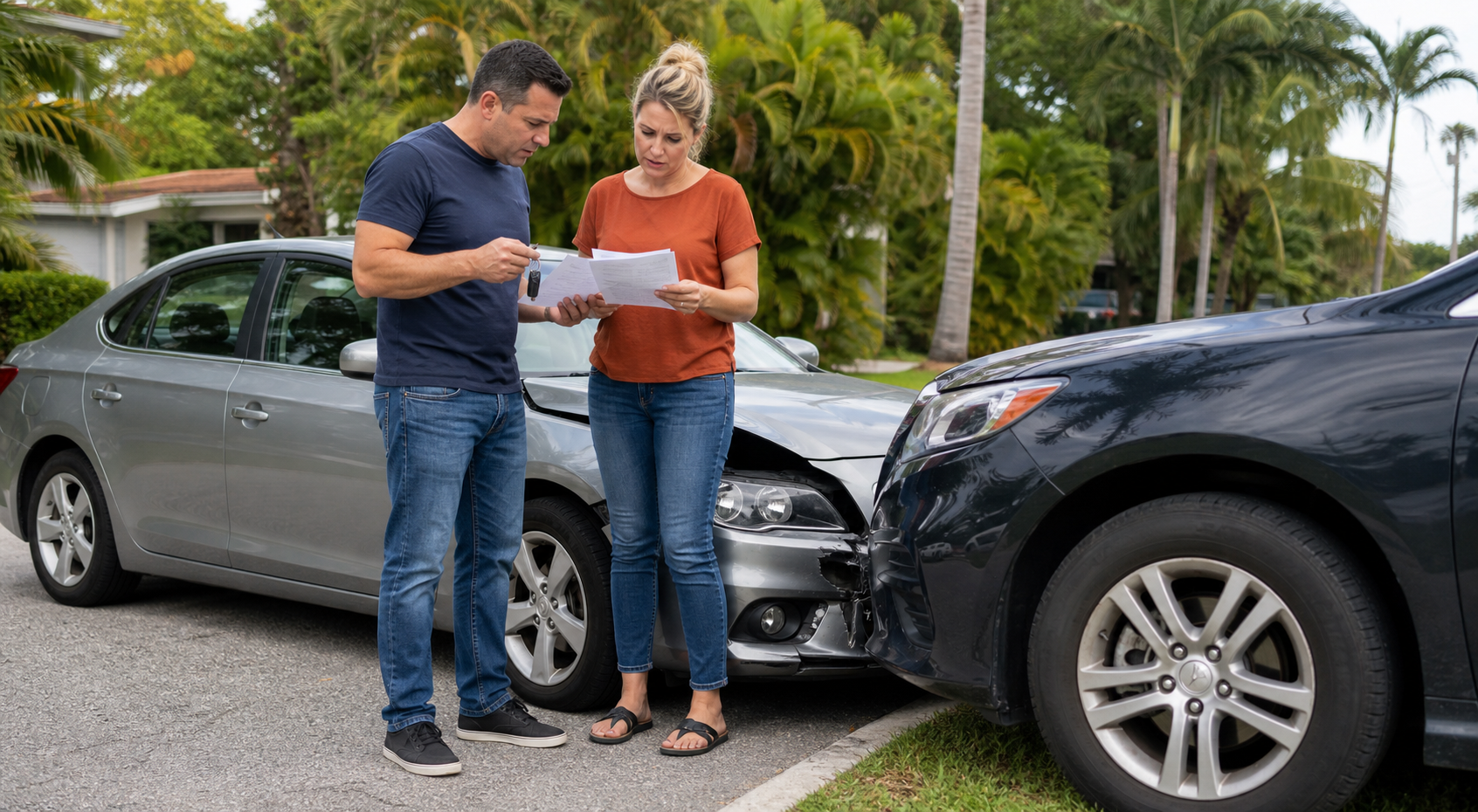
Who Is Responsible When a Borrowed Car Causes an Accident in Florida?
A borrowed car accident claim can involve both the person driving and the person who owns the vehicle. Insurance coverage may depend on permission, policy language, household relationships, exclusions, and whether the driver was using the car for personal or business purposes.
The driver’s negligence remains important, but it may not be the only issue. These seven questions can help identify the people, policies, and evidence that should be reviewed after a Florida crash involving a borrowed vehicle.
1. Did the owner give permission?
Start with whether the driver had express or implied permission to use the car. Permission may be shown by messages, prior use, household practice, key access, or testimony. A driver who took a vehicle without consent creates a different situation from a friend or family member who was allowed to borrow it.
Preserve texts, emails, and call records about the loan. Do not delete messages simply because they feel informal.
2. Who was negligent?
The borrowed-car issue does not replace the ordinary fault analysis. Investigators still examine speed, following distance, distraction, traffic controls, right-of-way, impairment, vehicle condition, and other conduct. Photos, witness statements, video, crash reports, and vehicle data may help establish what happened.
If no officer prepared a report, follow the documentation steps in our guide to a Florida car accident with no police report.
3. Can the vehicle owner share responsibility?
Florida law may make a vehicle owner responsible in some circumstances when a permissive user causes a crash. Current Florida Statute § 324.021 defines ownership for financial-responsibility purposes and includes specific provisions concerning natural-person owners who loan a vehicle to permissive users.
The statute contains limits, exceptions, and special rules. The result can change when a vehicle is used commercially, leased, rented, or owned by a business. A lawyer should apply the current law to the specific ownership and use arrangement.
4. Which insurance policy applies first?
A borrowed car accident claim may involve the vehicle owner’s policy, the driver’s personal policy, household coverage, or a commercial policy. Auto policies differ. Some cover permissive users, while others contain exclusions or restrictions for household members, named drivers, business use, rideshare work, or regular access to a vehicle.
Obtain complete policy documents rather than relying on an insurance card or a short coverage summary. Notice should be given to every potentially applicable carrier according to the policy requirements.
5. Was the car borrowed for work?
If the driver was making deliveries, visiting a customer, running an employer’s errand, or performing another work task, a business may have relevant insurance or responsibility. The driver’s personal policy may also address business use differently from ordinary personal use.
Save route information, work messages, receipts, uniforms, and business identifiers. For related issues, see our article on a delivery driver accident claim in Florida.
6. Did the owner know the driver was unsafe?
Separate questions may arise if an owner knowingly entrusted the vehicle to someone who was unlicensed, impaired, inexperienced, medically unable to drive safely, or known to have a dangerous driving history. This is a fact-intensive issue, and it should not be assumed without evidence.
Relevant information may include driver-license status, prior warnings, messages, witness testimony, and the owner’s own statements. An owner’s direct negligence is different from responsibility based only on vehicle ownership.
7. What evidence should be preserved?
- Insurance cards and complete policy information for the car and driver
- Vehicle registration, title, lease, or rental records
- Messages showing permission and the reason for the trip
- Photos of damage, the scene, and every involved vehicle
- Names and contact details for passengers and witnesses
- Dash-camera, doorbell, business, and traffic video
- Medical records, bills, wage documents, and repair estimates
How do Florida PIP benefits fit in?
Personal injury protection coverage may pay certain initial medical and disability benefits regardless of fault, subject to statutory and policy rules. Current Florida Statute § 627.736 generally requires initial services and care within 14 days for PIP medical benefits.
Coverage priority can differ for drivers and passengers. Our article explains how passenger injury claims may work after a Florida car accident.
Common mistakes after a borrowed-car crash
Do not assume the driver’s insurance is the only coverage, accept a verbal statement that the vehicle was uninsured, or sign a release before all policies are identified. Do not conceal who had permission to drive. Accurate information helps determine the correct coverage and potential responsibility.
Talk with Tucker Law
A borrowed car accident claim may require review of ownership records, permission evidence, insurance policies, and the driver’s purpose. Tucker Law can examine those issues and the evidence of injury and loss. Visit our personal injury practice areas or contact Tucker Law to discuss the facts.
This article provides general information, not legal advice. Liability, insurance coverage, and damages depend on the evidence, policy language, and current law.