Florida Farm-Equipment Collisions: Answers to the Questions the Scene Leaves Behind
A farm equipment accident claim can involve a large speed difference, unfamiliar vehicle shape, limited shoulders, and evidence that disappears when equipment returns to work. These answers explain the practical questions that commonly arise after a tractor, implement, or other agricultural vehicle is involved in a Florida roadway collision.
Can farm equipment lawfully use a public road?
Agricultural equipment may use roads in appropriate circumstances, but lawful presence does not eliminate duties concerning operation, visibility, lighting, and traffic. The precise rules can depend on the equipment, time, location, and use. Avoid assuming that either the tractor or passenger-car driver is automatically responsible.
Florida Statute section 316.2295 addresses lamps and warning devices on certain farm tractors and implements. Investigators should document what equipment and warnings were actually present rather than relying on a generic description.
Which scene details matter most?
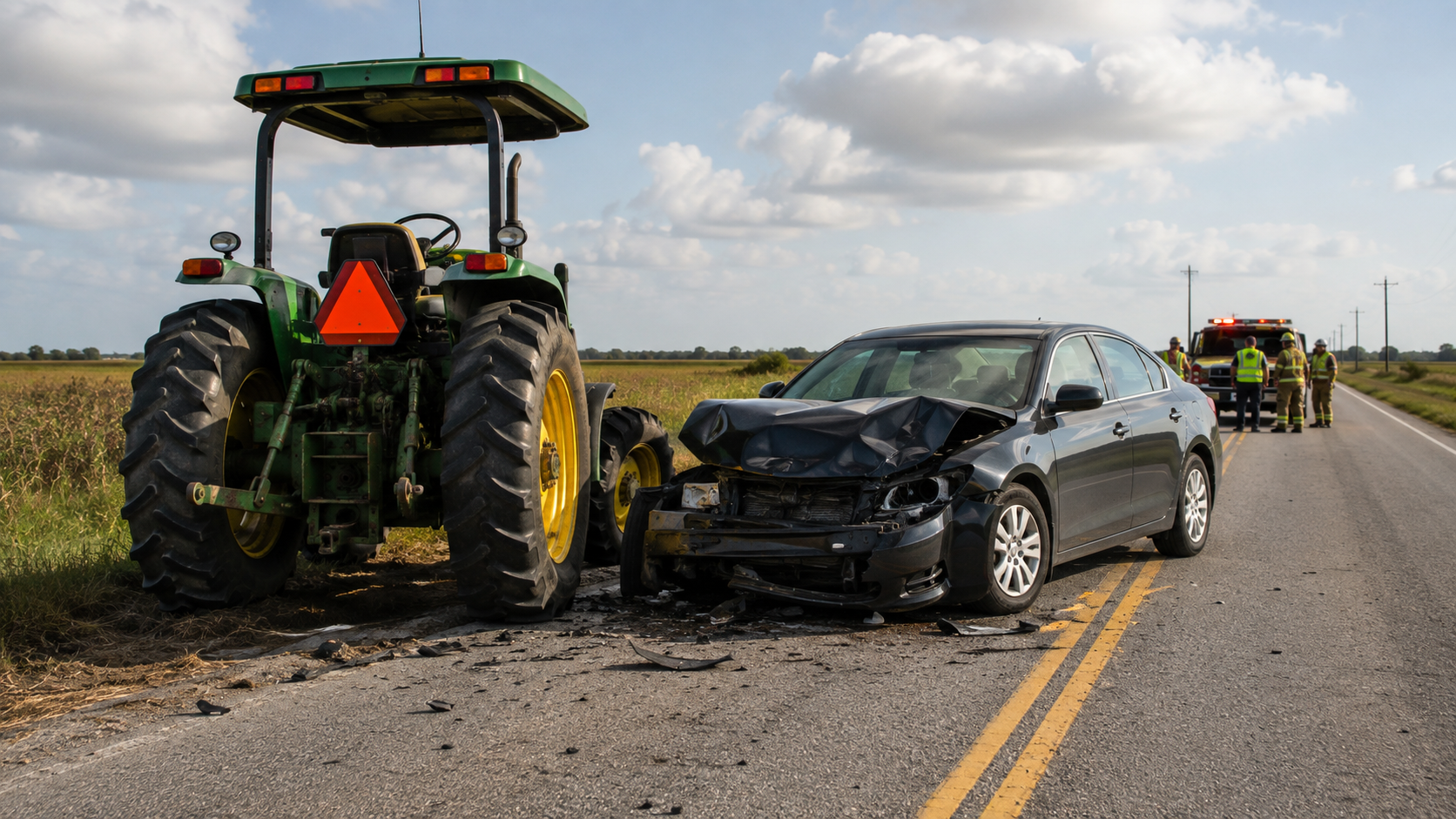
Photograph vehicle positions, attached implements, debris, tire marks, road width, shoulder condition, hills, curves, vegetation, driveways, signs, lane markings, and lighting. Capture both drivers’ approaches. Measure or reliably document the equipment’s overall width and whether any part extended beyond the tractor.
Record sunrise or sunset conditions, weather, and artificial lighting. A wide photograph showing the horizon can explain visibility better than close damage images alone.
What should be preserved from the equipment?
Preserve lamps, reflectors, warning triangles, turn signals, mirrors, brakes, tires, hitch points, and any attached implement. Obtain maintenance, inspection, ownership, operating, and work records. If the farm equipment is repaired quickly, photographs and written preservation notice may be critical.
The same principle applies to the passenger vehicle. TuckerUp’s brake-failure evidence guide explains how physical components and maintenance records can test competing accounts.
Does a rear-end impact decide fault?
No single impact pattern answers every case. Investigators examine following distance, speed, lighting, visibility, lane position, signals, turns, roadway obstructions, and whether the passenger car had time and space to react. A tractor entering from a field or turning left presents different facts from equipment moving steadily in the lane.
Florida Statute section 316.183 requires speed that is reasonable and prudent under existing conditions. Posted speed is part of the analysis, not always the end of it.
Who may have relevant insurance?
Potential coverage may involve the equipment owner, operator, farm business, contractor, passenger vehicle, and household policies. Commercial, farm, umbrella, bodily injury, personal injury protection, collision, and uninsured or underinsured motorist coverages may address different losses. Obtain complete policies and endorsements before drawing conclusions.
Ownership and work relationships should be confirmed with records. Do not assume that the operator, titled owner, and business directing the work are the same person or entity.
What if another vehicle caused the evasive movement?
A passing car may force a driver toward wide equipment and leave without contact. Preserve dash-camera footage, witness details, paint transfer, debris, 911 recordings, and traffic-camera video. TuckerUp’s no-contact accident guide discusses identification and coverage issues.
How should injuries be documented?
Report the full mechanism, including underride, intrusion, rollover, ejection risk, multiple impacts, or contact with an implement. Keep emergency, specialist, diagnostic, therapy, medication, wage, and travel records. Save damaged helmets, child restraints, or other safety equipment when relevant.
If the crash produced several impacts, TuckerUp’s chain-reaction article offers a method for organizing the sequence and injuries.
When should legal help be considered?
Early review can be useful when equipment may return to service, a commercial owner is involved, or coverage is unclear. Tucker Law Group’s practice-area overview describes its injury services. An injured driver, passenger, cyclist, or equipment operator may contact the firm for a case-specific discussion.
What deadlines can arise before a filing deadline?
Video may be overwritten, equipment repaired, crops harvested, shoulder marks graded, and witnesses dispersed within days. Public-record requests, preservation letters, inspections, and insurer notices can therefore matter immediately even when the formal limitations period is much longer.
If a government road condition is suspected, special notice and procedural rules may apply. If an employee was working, business records and commercial coverage should be identified. These issues deserve fact-specific legal analysis rather than a generic calendar calculation.
What should an injured person avoid?
Do not enter private fields, climb on equipment, or interfere with farm operations to gather proof. Do not post accusations or selective photographs online. Avoid repairing or surrendering a damaged vehicle without documenting it, and read authorizations and releases before signing.
Careful review of a farm equipment accident claim should connect the physical evidence, witness accounts, coverage, and medical documentation before conclusions are drawn.
This FAQ is general information, not legal advice. The outcome of a farm equipment accident claim depends on the evidence, policies, parties, and governing law.