The Crash Report Says You Were at Fault. Will a Florida Jury See It?
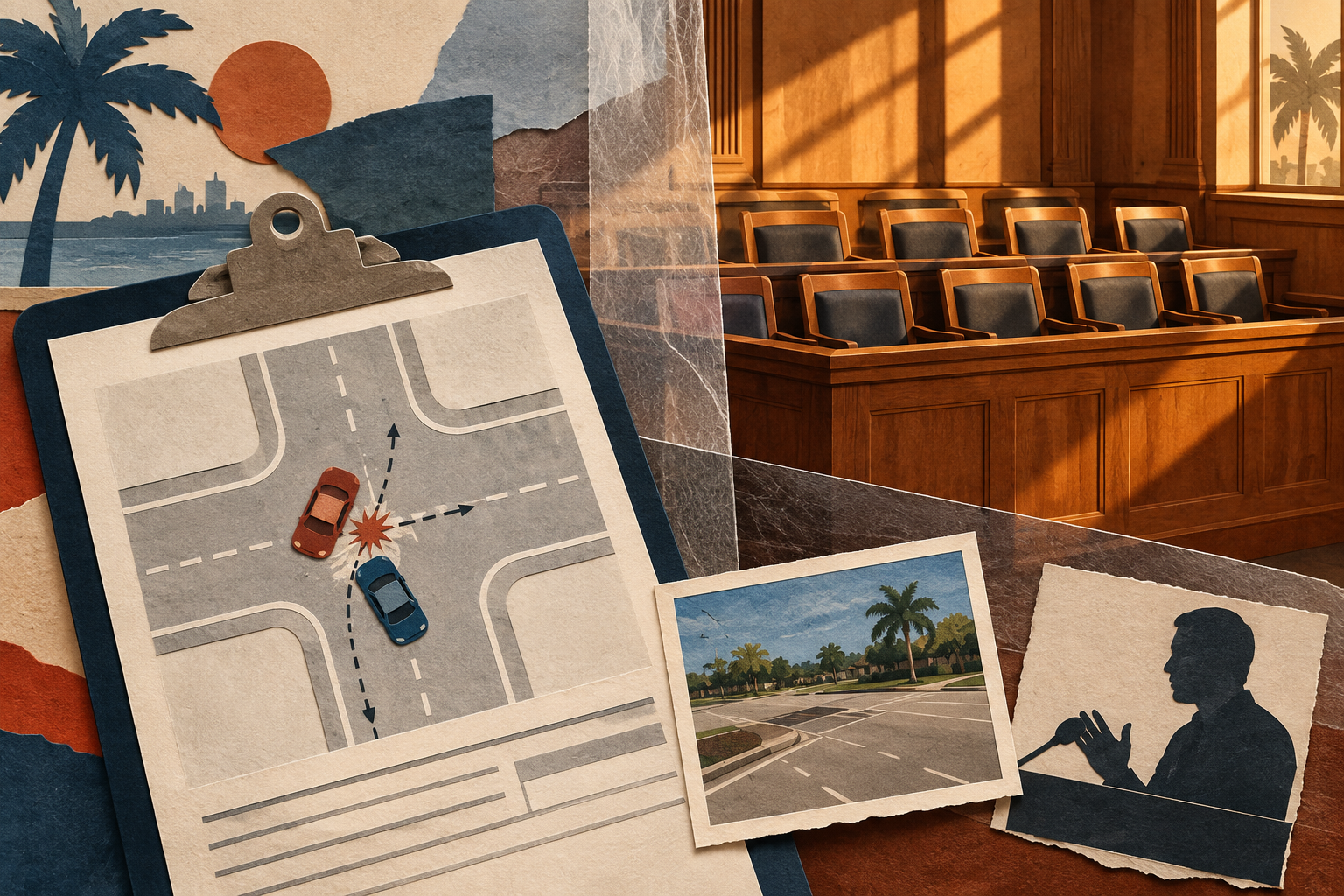
Two drivers leave the same Florida intersection with different versions of what happened. Days later, the crash report appears to place one driver at fault. The insurance adjuster treats that conclusion as if the case has already been decided.
It has not.
A Florida traffic crash report can be enormously useful. It may identify drivers, passengers, witnesses, insurers, vehicles, and the investigating agency. But usefulness during an investigation is not the same as admissibility at trial. Florida law draws important lines between the report itself, statements made to prepare it, and evidence an officer observed independently.
Those lines matter when an insurer relies on a diagram, narrative, or apparent fault assessment to deny a claim. They also matter when a report seems favorable. A person pursuing a Florida car accident claim should not assume that the report will prove the case—or that an unfavorable report will defeat it.
A crash report can guide a case without deciding it
Florida Statutes section 316.066 tells officers when to complete a long-form crash report. Among other circumstances, a long form is required when a crash involves death, injury, a complaint of pain or discomfort, an inoperable vehicle that must be towed, or a commercial motor vehicle. The report must include basic information such as the date, time and location; descriptions of the vehicles; the parties and witnesses; the investigating officer; and the insurers.
That makes the report a valuable map. It can point counsel toward a witness who saw the light cycle, an insurer that issued a policy, or an agency that may hold photographs and video. Yet the report is not a judicial finding. The investigating officer often arrives after the impact, did not see the collision occur, and must reconstruct an initial account from a fast-moving scene.
Florida’s existing guidance on what to do when no police report exists explains why independent documentation matters. The same principle applies when a report does exist: the report is a starting point, not a substitute for the evidence behind it.
Florida protects compelled crash-report statements from use at trial
Section 316.066(4) is commonly called Florida’s accident-report privilege. The statutory text is more precise than that label. It provides that a crash report made by a person involved in a crash, and a statement made by that person to a law-enforcement officer for the purpose of completing a required report, cannot be used as evidence in a civil or criminal trial.
The purpose is practical. Florida requires people involved in crashes to supply information needed for official reporting. The law prevents that compelled reporting process from automatically becoming trial testimony against the person who complied.
The protection is not unlimited. It turns on who made the statement and why it was made. A driver’s statement to an officer for completion of the statutory report is different from a later statement to an insurance adjuster. The crash-report rule does not automatically protect an insurer interview, recorded call, social-media post, or casual admission to another person. Anyone asked to give a separate insurer interview should understand the risks discussed in Tucker Law’s guide to recorded statements after an accident.
Whether a particular statement falls within section 316.066 can depend on the facts, including whether the speaker was involved in the crash and whether the officer was gathering information for the required report. A bystander’s statement, for example, does not become protected merely because an officer later mentions it in a report. Ordinary evidence rules—including the hearsay rules—still determine whether and how that witness’s account can be used.
The report, the statement, and the officer’s observations are different evidence
The easiest way to understand the rule is to separate three layers that may appear together on the same page.
The report itself
A party generally cannot place the crash report before the jury as proof that the accident happened exactly as its narrative or diagram says. The prohibition also cannot be avoided simply by asking an officer to repeat at trial a protected driver’s statement that was collected to complete the report.
This is especially important when a report contains an apparent fault assessment. The box checked on a form, a contributing-cause code, or a diagram based on secondhand accounts does not establish civil liability. Negligence is decided from admissible evidence under the applicable law, not from an insurer’s reading of the report.
Statements used to complete the report
A protected statement remains subject to section 316.066 even if it was recorded on body-camera audio. Changing the storage format does not change the content. If the officer asked a driver what happened for the purpose of preparing the required report, the resulting statement cannot be played to the jury merely because a camera captured it.
That does not mean every second of body-camera footage disappears. The video may depict the physical scene, vehicle locations, weather, lighting, visible injuries, or conduct occurring independently of a protected communication. Lawyers must evaluate and, when necessary, separate the protected audio from other potentially admissible material.
Independent observations and tangible evidence
Florida’s Supreme Court explained in Brackin v. Boles that the statute protects compelled communications, not every piece of evidence obtained during a crash investigation. An officer’s independent observations and tangible evidence do not become inadmissible merely because the officer was also preparing a report. The current statute likewise states that qualifying breath, urine, and blood-test results are not confidential and may be admitted subject to the governing law.
In a civil case, that distinction may preserve testimony about skid marks, debris, damage patterns, roadway conditions, vehicle positions, or what an officer personally saw when arriving. Photographs and dash-camera footage may tell the story directly. Each item must still satisfy the normal requirements for relevance, authenticity, expert opinion, and hearsay, but section 316.066 does not place a blanket over the entire investigation.
Discoverable does not always mean admissible
One of the most misunderstood features of the rule is that information may be discoverable during a lawsuit even though it cannot be shown to the jury.
In Anderson v. Mitchell, the Second District Court of Appeal addressed deposition questions about statements made at the scene for completion of a crash report. The court held that section 316.066(4) is a rule of admissibility, not a true evidentiary privilege that blocks disclosure. The statements could be explored in discovery even though the statute prohibited their use as evidence at trial.
That distinction gives accident lawyers an investigative path. A protected statement may identify a witness, reveal that another camera existed, or lead to nonprotected evidence. The statement itself does not become admissible simply because it led somewhere useful. Instead, the case must be built with evidence that can stand on its own.
The evidence behind the report can be stronger than the report
Imagine that a report says Driver A changed lanes into Driver B. If that conclusion came only from Driver B’s protected statement, the report cannot do the work at trial. But a nearby business camera may show the lane change. Vehicle event data may record steering and braking inputs. Damage geometry may support an expert’s reconstruction. A neutral witness may testify from personal knowledge.
That is why early preservation is so important. Body-camera and dash-camera files may be subject to agency retention schedules. Private surveillance can be overwritten in days. Vehicles may be repaired, sold, or destroyed. Phones may lose location and application data. Tucker Law’s discussion of vanishing evidence after a Florida collision explains why requests should be directed to the actual custodians quickly.
A careful investigation may seek the report and its supplements, the complete photo set, body-camera and patrol-car video, 911 audio, dispatch records, citations, roadway-camera footage, nearby private surveillance, event-data-recorder information, vehicle inspections, and testimony from witnesses. Not every item will exist or be admissible. The goal is to preserve the sources before anyone is forced to argue about them from memory.
The 60-day confidentiality period answers a different question
Florida’s 60-day crash-report confidentiality provision is often confused with the trial rule. They are separate parts of section 316.066.
For 60 days after a report is filed, a report containing personal information is confidential from the general public. The statute allows immediate access to specified people and entities, including parties involved in the crash, their legal representatives, and qualifying insurers. After 60 days, access broadens as the statute permits.
That access period does not determine what a jury may hear. A report does not become admissible on day 61. Conversely, independent evidence is not made inadmissible simply because it was collected while the report was still confidential. One rule controls access; the other controls trial use.
An unfavorable report is a reason to investigate, not surrender
A crash report can influence an insurance claim long before a lawsuit begins. Adjusters may quote its narrative, point to a diagram, or insist that an officer “found” someone at fault. The right response is not to ignore the report. It is to ask what supports it.
Was the officer an eyewitness? Which statements were made for the statutory reporting process? Did the conclusion rest on physical evidence, a neutral witness, or one driver’s account? Are the photographs complete? Is there video? Do the vehicle-damage patterns fit the diagram? Those questions move the analysis from paperwork to proof.
If a serious Florida collision left you injured, Tucker Law can assess the report, obtain the underlying records, and identify evidence that may disappear. The firm’s Personal Injury Information Center provides additional guidance, or you can contact Tucker Law to discuss the specific facts. A report may frame the first version of a crash. It does not get the final word.