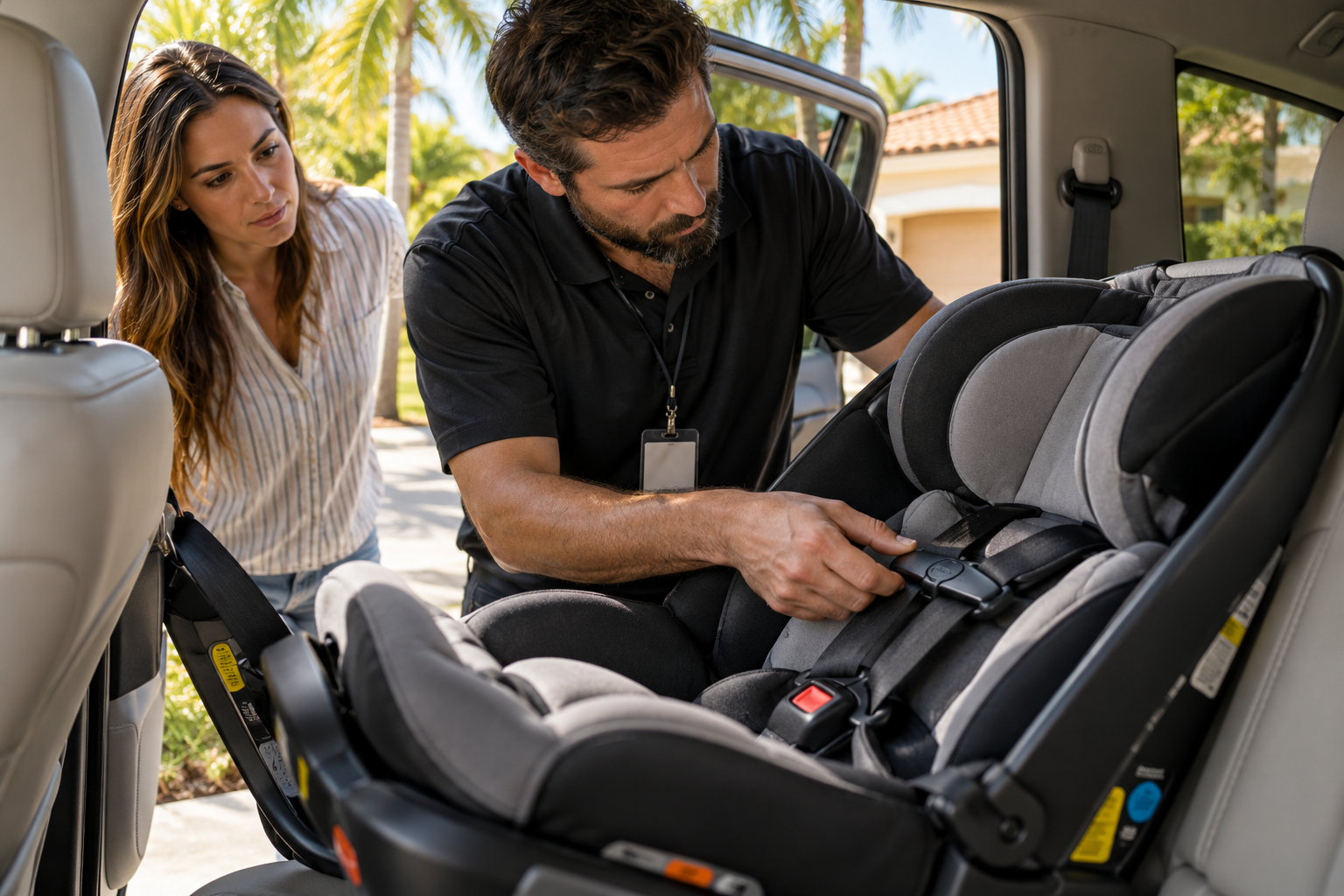
The Car Seat Was Installed Wrong. Can That Reduce a Florida Child’s Injury Claim?
The other driver runs a red light. A child in the back seat is injured. Then the insurance adjuster learns that the car seat straps may have been loose, the booster may have been the wrong size, or the seat may not have been installed exactly as the manufacturer directed.
That discovery raises two very different questions. The first is a safety question: was the child properly protected? The second is a legal question: can the driver who caused the collision use the restraint issue to reduce the child’s Florida injury claim?
Florida law does not give the same answer for every passenger. For a child covered by Florida’s child-restraint statute, the Legislature wrote an unusually direct evidentiary rule. For a passenger governed by the general safety-belt statute, the analysis is different. Age, the type of restraint, the vehicle, and the evidence connecting nonuse to a particular injury can all matter.
A current safety warning, followed by a legal distinction
On September 21, 2026, the National Highway Traffic Safety Administration issued a Child Passenger Safety Week alert reporting that about half of car seats are installed incorrectly. NHTSA also reported that, in 2024, an estimated 160,850 children age 14 and younger were injured in traffic crashes and 677 were killed. The agency says correctly installed car seats can reduce fatal-injury risk in passenger-car crashes by 71% for infants and 54% for toddlers.
Those figures make correct installation a serious safety issue. They do not, however, answer what evidence is admissible in a Florida negligence case. Safety guidance and civil-liability rules serve related but different purposes.
Florida’s child-restraint law covers children five and younger
Florida Statutes section 316.613 generally requires a motor-vehicle operator transporting a child age five or younger on Florida roads to protect the child with a properly used, crash-tested, federally approved child-restraint device.
For children through age three, the statute requires a separate carrier or a vehicle manufacturer’s integrated child seat. For children ages four and five, a separate carrier, integrated seat, or booster may be used. The statute contains limited exceptions, including provisions for certain medical emergencies, documented medical conditions, and some gratuitous transportation by a person outside the child’s immediate family. It also treats certain vehicles and transportation-for-compensation situations separately.
A violation can carry a traffic penalty and driver-license points. But the statute draws a sharp line between that enforcement consequence and a later civil lawsuit.
The citation rule and the injury-claim rule are not the same
Section 316.613(3) states that failure to provide and use a child passenger restraint “shall not be considered comparative negligence.” It also says the failure is not admissible at trial in a civil action with regard to negligence.
That language matters when an at-fault driver or insurer argues, “The parent installed the seat incorrectly, so we should pay less.” For a child within the statute, the text does not merely say a restraint violation is inconclusive. It expressly excludes the failure from comparative-negligence treatment and from trial evidence concerning negligence.
The driver responsible for restraining the child may still face a traffic citation. The family should still take NHTSA’s safety recommendations seriously. But a traffic enforcement issue does not automatically become a percentage of fault that can be assigned against the child’s negligence claim.
This distinction is especially important because a young child generally has no control over which seat an adult buys, where the seat is installed, or how tightly the harness is fastened. A claim involving a child passenger should not be evaluated as though the child made those decisions.
After age five, the statutory framework changes
Florida’s general safety-belt law, section 316.614, requires the operator to ensure that passengers under age 18 are restrained by a safety belt or an applicable child-restraint device. Its civil-evidence provision differs from the rule for children five and younger.
Under section 316.614(10), a safety-belt violation is not negligence per se, is not prima facie evidence of negligence, and may not be treated as mitigation of damages. The statute nevertheless permits the violation to be considered as evidence of comparative negligence in a civil action.
That does not mean an insurer can point to an unbuckled belt and automatically reduce a claim. In Ridley v. Safety Kleen Corp., the Florida Supreme Court explained the evidentiary burden behind the seat-belt defense. The defense must be properly raised, and there must be competent evidence that an available, operational restraint was not used and that the nonuse produced or substantially contributed to at least part of the claimed damages. Speculation is not enough.
The contrast is the heart of the issue: Florida’s child-restraint statute expressly bars comparative-negligence use, while the general safety-belt statute may permit it if the necessary proof exists. A lawyer evaluating the case must identify which provision governed the passenger on the date of the crash rather than relying on a generic “seat-belt defense.”
Who caused the crash remains a separate question
A restraint usually does not cause one vehicle to run a red light, rear-end another car, or cross the center line. It concerns the forces experienced inside the vehicle after the collision begins—sometimes called the second collision between the occupant and the vehicle interior or restraint system.
That separation helps organize the evidence. Traffic-camera footage, vehicle event data, scene photographs, witnesses, and the crash report may establish who caused the initial collision. Medical testimony, crash reconstruction, occupant position, restraint geometry, and vehicle damage may address how the child was injured.
An insurer may try to blend those issues together and suggest that a restraint concern excuses the driver who caused the wreck. It does not. Even where the general safety-belt defense is legally available, the defendant still must prove the required connection between nonuse and a measurable part of the injuries.
Tucker Law’s discussion of shared fault after a Florida crash explains the broader comparative-negligence framework. A child-restraint case requires the added step of determining whether section 316.613 prevents the restraint issue from entering that framework at all.
Do not throw away the car seat before documenting it
After a frightening crash, families understandably want the damaged vehicle and car seat gone. That can eliminate important evidence. The restraint’s manufacturer, model number, date of manufacture, serial number, recall history, harness position, chest-clip position, anchor path, tether use, and visible damage may all matter. The vehicle’s seat belt, lower anchors, tether anchor, seatback, and interior contact marks may matter too.
Photographs should show the restraint before it is removed if that can be done safely, along with the entire rear-seat area and the damage to the vehicle. The instruction manual, registration information, purchase record, and any installation-check documentation should be saved. Emergency personnel or witnesses may remember whether they unbuckled the child, cut a strap, or moved the seat during rescue.
NHTSA’s post-crash car-seat guidance recommends replacement after a moderate or severe crash. A seat does not automatically require replacement after a minor crash only when all of NHTSA’s minor-crash criteria are satisfied and the manufacturer’s instructions allow continued use. Evidence preservation does not mean placing a child back into a seat that should be replaced. It means documenting and safely retaining the seat long enough for appropriate inspection before disposal, when feasible.
The vehicle deserves similar attention. A total-loss carrier may move it to a salvage facility quickly. A prompt preservation request can protect the restraint system, event data, interior measurements, and crash damage before the vehicle is sold or destroyed.
Misuse, product defect, and crash forces are different theories
A serious child injury does not prove that the car seat was defective. Likewise, an installation mistake does not prove that it caused the injury. The analysis may involve three separate possibilities.
The collision forces may have caused the injury despite a properly functioning restraint. An adult may have used the seat inconsistently with its instructions. Or the restraint, buckle, harness, anchor, vehicle seat, or warning may have had a design or manufacturing defect. More than one factor may be investigated, but each theory requires evidence.
If a defect is suspected, the seat and vehicle components should not be altered for informal testing. Manufacturer notices, recall records, photographs, expert inspection, and chain of custody become important. The family’s immediate priority remains medical care and a safe replacement restraint—not proving a technical theory without qualified help.
The child may have access to several layers of insurance
A child passenger claim is not limited to the policy shown by the driver who caused the collision. Florida’s PIP statute, section 627.736, extends required benefits to categories that include household relatives and passengers, subject to the statute’s priority rules, exclusions, policy terms, and claim requirements.
The investigation may also include bodily-injury liability coverage for the at-fault driver, coverage for the owner of a different vehicle, and uninsured or underinsured motorist coverage available through the child’s household. Tucker Law’s Florida passenger-injury guidance explains why an injured passenger should not assume that only one policy applies.
The family’s economic and noneconomic losses must then be documented. Medical treatment, future care, disability, pain, and changes in the child’s development or activities can require long-term evaluation. Tucker Law’s article on damages after a Florida car crash describes the principal categories, but a child’s future losses may require different medical, educational, and vocational evidence than an adult’s claim.
Minor status does not justify waiting
Florida Statutes section 95.11 generally establishes a two-year limitations period for negligence actions. Florida’s tolling statute, section 95.051, recognizes minority only in specified circumstances, including certain periods when no parent or guardian exists or when the representative has an adverse interest. Families should not assume that every deadline waits until the child turns 18.
Other deadlines may be even shorter. PIP treatment and notice requirements, insurance-policy conditions, claims involving government vehicles or entities, and preservation of vehicle data can all require prompt attention. A separate court-approval process may apply when a child’s claim is eventually settled.
The evidence clock moves fastest. The car seat may be discarded, the vehicle may enter salvage, camera footage may be overwritten, and a child’s immediate symptoms may become harder to reconstruct. Early investigation protects both the child’s safety and the accuracy of the claim.
The right question is not simply whether the seat was perfect
Florida law asks more precise questions. How old was the child? Which restraint statute applied? Who caused the collision? Is the restraint issue legally admissible? Is there competent evidence connecting nonuse to a particular injury? Which policy covers the child? What physical evidence still exists?
If a child was injured in a Florida collision and an insurer is focusing on the car seat or booster, Tucker Law can evaluate the governing statute, preserve the restraint and vehicle evidence, and identify the available coverage. Learn more about Tucker Law’s Florida car-accident practice or contact the firm before the seat or vehicle is discarded.