It Looks Like a Golf Cart. Florida Insurance Law May Call It Something Else.
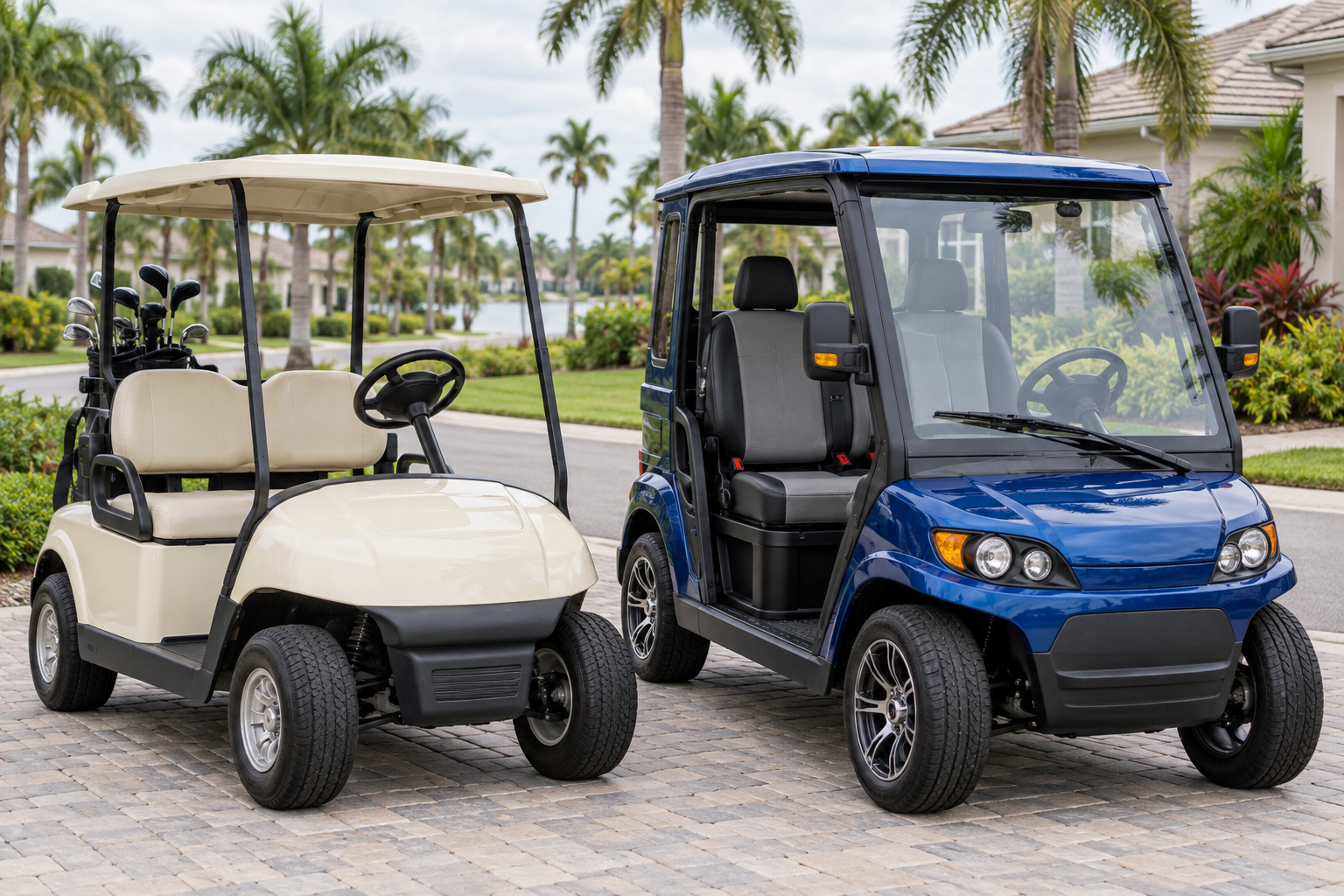
Two open vehicles roll through the same Florida neighborhood. Both have four wheels, bench seats, a roof, and space for golf bags. One is a golf cart. The other is a low-speed vehicle. To a witness—and sometimes even to the people who own them—they look interchangeable.
Florida law does not treat them that way.
The difference can turn on how the vehicle was designed, whether it can exceed 20 miles per hour, and whether a converted cart completed the state’s inspection, titling, registration, and insurance process. After a collision, that classification can affect where the vehicle was allowed to travel, what safety equipment it was required to have, whether PIP and property-damage liability coverage should exist, and which insurance policies need immediate review.
That makes “Was it a golf cart?” a poor stopping point. The better question is: What was this particular vehicle under Florida law at the time of the crash?
The 20-mph line separates two legal categories
Florida’s definitions focus on more than appearance. Under section 320.01, Florida Statutes, a golf cart is designed and manufactured for operation on a golf course for sporting or recreational purposes and is not capable of exceeding 20 miles per hour. A low-speed vehicle, often called an LSV or neighborhood electric vehicle, is a four-wheeled vehicle with a top speed greater than 20 but not greater than 25 miles per hour.
That narrow speed range creates a significant legal divide. Adding equipment or changing a speed controller may make a cart faster, but it does not automatically complete the legal conversion into a street-ready LSV. The Florida Department of Highway Safety and Motor Vehicles requires a converted cart to be inspected and assigned a vehicle identification number before it can be titled and registered as a low-speed vehicle.
After a serious crash, the actual classification may require evidence beyond a driver’s description. The manufacturer’s label, original specifications, speed-controller settings, mechanical modifications, VIN, title, registration, and prior inspection documents may matter. A plate can be important evidence, but the physical vehicle and its history may tell a fuller story.
A true golf cart has a narrow path onto public roads
Florida does not generally authorize golf carts to travel wherever ordinary automobiles may go. Section 316.212 begins with a prohibition on operating them on public roads and streets, then creates specific exceptions.
A local government may designate certain county roads, municipal streets, qualifying two-lane county roads, or water-control-district roads for golf-cart use after making a safety determination. Designated routes should be marked. The statute also allows limited crossings and certain uses in mobile-home parks and state parks. Local ordinances can impose more restrictive operational and equipment rules, so the statewide statute is only part of the analysis.
Time of day matters as well. Golf-cart operation is generally limited to the period between sunrise and sunset. Night operation requires local authorization and a cart equipped with headlights, brake lights, turn signals, and a windshield. Even during daylight, a cart must have efficient brakes, reliable steering, safe tires, a rearview mirror, and red reflectorized warning devices at the front and rear.
Since October 1, 2023, age and identification rules also apply on public roads. An operator younger than 18 must possess a valid learner’s license or driver license. An adult operator must possess valid government-issued photographic identification.
These rules can become part of a negligence investigation, but a traffic violation does not answer every civil-liability question automatically. The inquiry still includes how the crash occurred, whether the violation contributed to it, what each person could see, and whether another driver, property owner, business, or governmental entity also failed to use reasonable care.
A low-speed vehicle operates under a different regime
A qualifying LSV may generally operate on streets with posted speed limits of 35 miles per hour or less, subject to local or state restrictions. It may cross a faster road at an intersection. Under section 316.2122, Florida Statutes, the operator must possess a valid driver license, and the vehicle must be titled, registered, and insured.
The required equipment is more automobile-like than the basic golf-cart list. An LSV must have headlamps, stop lamps, turn signals, taillamps, reflectors, a parking brake, rearview mirrors, a windshield, a VIN, and a seat belt for each designated seat.
The Florida Department of Highway Safety and Motor Vehicles states that LSVs must carry at least $10,000 in personal injury protection and $10,000 in property-damage liability coverage. Those minimum coverages serve different purposes. PIP addresses qualifying medical expenses and lost income under Florida’s no-fault law. Property-damage liability pays for damage the insured vehicle causes to someone else’s property. Neither should be mistaken for bodily-injury liability coverage that compensates another person for physical injury.
Florida does not require every ordinary private vehicle owner to maintain bodily-injury liability coverage in all circumstances. As a result, a properly registered and insured LSV may still have no bodily-injury liability coverage available for the person it hurts—or limits far below the losses caused by a catastrophic collision.
The insurance investigation starts with the vehicle, not the nickname
Calling the vehicle a “cart” in a crash report, medical history, or insurance notice does not decide coverage. Insurance policies use defined terms, and those definitions do not always match casual speech. Coverage may also depend on who owned the vehicle, where it was being used, why it was being operated, and who was injured.
For a registered LSV, investigators should identify the automobile policy required for registration and determine whether it includes bodily-injury liability, medical-payments, collision, or uninsured/underinsured motorist coverage in addition to PIP and property-damage liability. Florida’s UM statute, section 627.727, makes this coverage important when a legally responsible owner or operator has no bodily-injury insurance or not enough insurance, but the policy language, insured’s status, rejections, exclusions, and stacking elections must be reviewed.
A true, unregistered golf cart does not carry the same statewide PIP and property-damage insurance mandate as an LSV. That does not mean there is never coverage. A separate golf-cart or recreational-vehicle policy may apply. Depending on the facts and wording, homeowners, renters, umbrella, commercial-general-liability, resort, golf-course, condominium, homeowners-association, or employer policies may need to be examined. They may also contain motor-vehicle, off-premises, business-use, entrustment, or permissive-use limitations.
The location can matter as much as ownership. A personal cart used only at a residence presents a different coverage picture from a cart supplied by a hotel, golf course, apartment complex, university, security company, delivery service, or employer. If a business put the vehicle into service, questions may extend beyond the operator’s driving to training, maintenance, passenger capacity, route selection, lighting, supervision, and whether the vehicle was suitable for the work assigned.
Converting a cart can create an evidence problem
Suppose an owner installs a more powerful motor or changes the controller so a golf cart can travel 23 miles per hour. The owner adds headlights and seat belts but never obtains a VIN, title, registration, or Florida insurance. After a collision, the vehicle may no longer fit the statutory definition of a golf cart because it can exceed 20 miles per hour. Yet it was not lawfully completed and documented as an LSV.
That does not allow an insurer or defendant to make the vehicle disappear between categories. It does make early technical evidence critical. Photographs alone may not show the controller setting, motor, gearing, software, tires, or other changes affecting maximum speed. Repairs, resale, or another modification can erase the condition that existed on the crash date.
A preservation request should therefore identify the entire vehicle and its electronic and mechanical components, not merely ask for pictures. Purchase documents, parts receipts, service records, inspection paperwork, mobile-app settings, onboard data, charging records, title history, and communications about the conversion may reveal what the owner knew and when. If the cart was rented or supplied by a business, rental agreements, waivers, maintenance schedules, and employee training materials may also be important.
A road violation is only one piece of fault
Consider a golf cart traveling after dark on a designated neighborhood road without locally required lighting. Now add an automobile driver looking at a phone, speeding, or failing to yield. Or consider a pedestrian struck by an LSV whose brakes had not been maintained by a resort. The vehicle’s classification and legal compliance matter, but neither ends the fault analysis.
Florida’s modified comparative-negligence rule can make allocation especially consequential. Under section 768.81, Florida Statutes, fault generally reduces a negligence claimant’s damages, and a claimant found more than 50 percent at fault may not recover damages in an ordinary negligence action. The statute contains exceptions and does not apply identically to every cause of action.
Evidence may point to several responsible actors: the vehicle operator, its owner, a person who entrusted it to an unsafe driver, the entity responsible for maintenance, a business directing its use, or another motorist. Road design, missing signs, sight obstructions, and local authorization can also require investigation. A complete claim should not be reduced to whether the injured person was sitting in something everyone happened to call a golf cart.
What to preserve immediately after a Florida golf-cart crash
The first photographs should capture the whole scene and the vehicle from every side, including the plate, VIN plate or manufacturer label, controls, tires, lights, seats, restraints, damage, roadway signs, lane markings, and sight lines. Video from homes, businesses, gates, security systems, dashboards, and phones can disappear quickly. Witnesses may remember the vehicle’s speed, lighting, passenger load, or route more clearly than its make and model.
Insurance identification should be collected from the operator and owner, but the search should not stop with the card presented at the scene. Request the title, registration, all policies that may cover the household or business, and documents showing whether the vehicle was personal, rented, borrowed, or used for work. Tucker Law’s Personal Injury Information Center explains other issues that arise as evidence and insurance claims develop.
Medical evaluation should not be delayed simply because a low-speed collision sounds minor. Open vehicles provide little protection from ejection or direct contact with pavement, automobiles, curbs, and fixed objects. Head, spinal, orthopedic, and internal injuries can require the same serious evaluation involved in other catastrophic-injury claims. A fatal collision may also implicate Florida’s wrongful-death law.
The correct answer may be hidden in the vehicle itself
Florida’s distinction between a golf cart and an LSV is not semantic. It changes lawful routes, operator requirements, required equipment, registration, and baseline insurance. Yet a crash investigation cannot rely on appearance or a label in the police report. Designed speed, modifications, government records, local ordinances, ownership, use, and the exact insurance contracts all matter.
That is why a golf-cart collision can require elements of both a recreational-vehicle investigation and a conventional car-accident claim. The earlier the actual vehicle and its records are preserved, the less room there is for its legal identity—and the available coverage—to become an argument based on missing evidence.
If you were injured by a golf cart or low-speed vehicle in Florida, contact Tucker Law. We can investigate how the vehicle was built and used, identify the policies that may apply, and evaluate the full chain of responsibility.