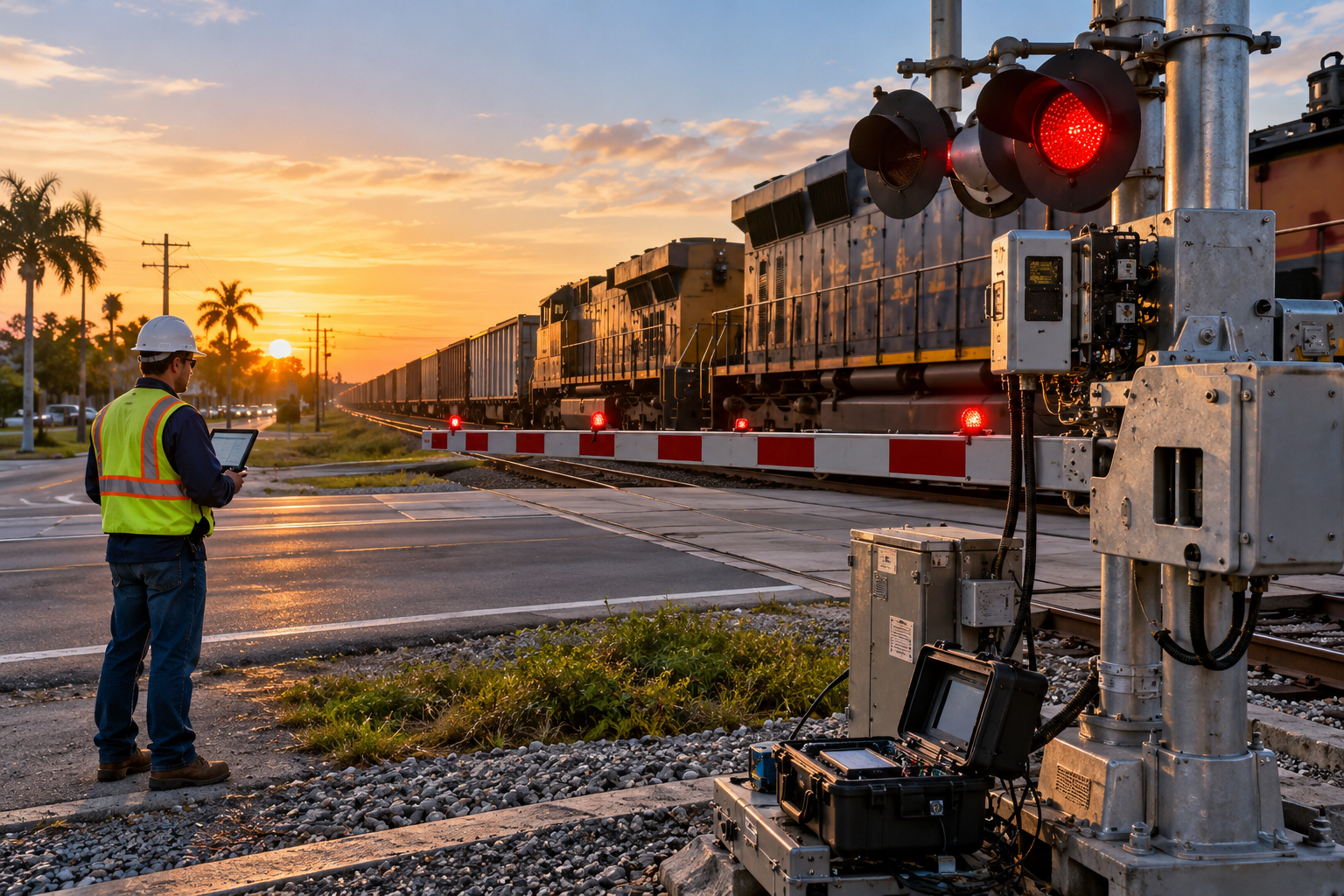
The Gate Dropped Too Late. What Records Decide a Florida Railroad-Crossing Crash?
The warning lights begin flashing. A gate starts down. A car is already committed to the crossing. Seconds later, the train arrives.
After a Florida railroad-crossing crash, the central dispute may be compressed into less than half a minute: When was the train detected? When did the lights activate? When did the gate move? How fast was the train traveling? Did the engineer sound the horn or apply the brakes? Could the driver or pedestrian see and hear the warning in time?
Witnesses may sincerely remember that sequence differently. The crossing and locomotive, however, may have created separate electronic timelines. A meaningful investigation compares those timelines instead of accepting a single conclusion that “the driver went around the gate” or “the signal failed.”
A crossing collision is several investigations happening at once
An ordinary two-vehicle crash usually begins with the drivers, their vehicles, and the roadway. A highway-rail collision adds a regulated warning system, railroad operating records, locomotive data, a train crew, dispatch communications, and potentially several public and private entities responsible for different parts of the crossing.
The railroad may operate the train but share crossing responsibilities with a state or local road authority. A signal contractor may have performed recent work. The locomotive may belong to one entity and be operated by another. The road, pavement markings, vegetation, traffic signals, warning gates, and track equipment may not have the same owner or maintenance history.
That division of control is why the name painted on the locomotive is only the beginning. Responsibility depends on the conduct alleged, who controlled the relevant system, and what the records show.
Florida law begins with what the road user could see and hear
Florida Statute section 316.1575 requires a person walking, cycling, or driving toward a railroad-highway grade crossing to stop between 15 and 50 feet from the nearest rail when specified warnings or hazards are present. Those circumstances include an active warning signal, a lowered gate, a flagger or officer’s direction, an audible train signal, or a train that is plainly visible and dangerously close. The statute also prohibits driving through, around, or under a gate while it is closed or moving.
A separate provision, section 316.159, imposes additional stop-or-slow duties on school buses, certain passenger-for-hire and hazardous-cargo vehicles, and other commercial vehicles.
Those statutes matter, but they do not replace the factual reconstruction. A photograph showing a gate down after impact does not establish when it started moving. A witness who heard a horn does not establish the exact location or duration of the horn sequence. A driver’s mistake also does not erase evidence that a warning system malfunctioned, visibility was obstructed, a traffic queue trapped a vehicle, or another party failed to follow an applicable safety rule.
Florida’s comparative-fault law may divide responsibility based on proven conduct. The investigation therefore asks what each participant knew, saw, controlled, and did during the same short interval.
The crossing has its own clock
Federal regulations define an “activation failure” as the failure of an active warning system to indicate a train’s approach at least 20 seconds before the train arrives at the crossing, or to indicate that a train is occupying the crossing, unless an alternative active warning is provided. That definition appears in 49 C.F.R. Part 234, which governs grade-crossing signal systems.
If a railroad with maintenance responsibility receives a credible report of an activation failure, section 234.105 requires a response that can include notifying train crews and law enforcement and providing alternative warnings to road users. Depending on the available flagging protection, a train may have to slow substantially or stop before entering the crossing.
The relevant crossing evidence can include:
- processor or diagnostic logs showing train detection and warning-system events;
- the timing sequence for lights, bells, and gate descent;
- inspection, testing, repair, and adjustment records;
- credible malfunction reports and the railroad’s response;
- battery and standby-power information;
- traffic-signal preemption records where a nearby highway signal interacts with the crossing; and
- the crossing’s unique U.S. DOT inventory number and historical inventory data.
Federal rules require records of warning-system tests and repairs, and they require railroads to keep specified information about credible malfunction reports. Not every crossing uses the same equipment, and not every system retains the same diagnostic detail. The demand should identify the particular crossing, controller, warning devices, inspection cycle, and time window rather than requesting generic “signal records.”
The locomotive records a different clock
The locomotive event recorder is sometimes compared to an airplane’s black box, but its value is more specific. Under 49 C.F.R. section 229.135, required data can include train speed, direction, time, distance, throttle position, brake applications, headlight and auxiliary-light controls, and horn-control activation. The precise data set depends on the locomotive and applicable equipment requirements.
When a locomotive with recording equipment is involved in an accident or incident that must be reported to the Federal Railroad Administration, the railroad must preserve the recorded data to the extent possible and consistent with safety. The current regulation requires retention of the original downloaded file, or an unanalyzed exact copy, in secure custody and keeps that preservation obligation in place for one year unless the FRA or National Transportation Safety Board requests it longer.
That federal obligation is important, but it is not a reason to wait. A civil preservation notice should also identify forward-facing and inward-facing video if present, radio traffic, dispatch records, positive train control data where relevant, crew schedules, consist information, horn and brake inspections, and downloads from every recording device involved. Different records may be held by different railroad departments or vendors.
The locomotive file can answer whether the engineer activated the horn control or applied the brakes. It does not, by itself, prove what a motorist could hear inside a vehicle, whether vegetation blocked the approaching train, or whether the crossing lights were visible from the driver’s approach. The event-recorder timeline must be synchronized with the warning-system timeline, vehicle data, video, and scene measurements.
A “quiet zone” does not mean no warning was required
People often treat the absence of a horn as conclusive proof of railroad negligence. Federal law is more nuanced. 49 C.F.R. Part 222 generally regulates locomotive-horn use at public highway-rail grade crossings and permits qualifying quiet zones with approved safety measures.
The first questions are whether the crossing was public or private, whether it was inside a valid quiet zone, whether the train was subject to the routine-horn rule, and whether an emergency required a warning despite the ordinary quiet-zone restriction. Wayside horns, supplemental safety measures, pedestrian crossings, and private crossings can involve different rules.
A resident’s statement that “trains never use their horns here” is useful background, not the complete legal answer. The crossing inventory, quiet-zone documentation, locomotive event record, onboard audio or video, and applicable operating rule provide a more reliable answer.
Florida’s enhanced standards add context—but not a shortcut to liability
FDOT’s enhanced Rail Crossing Standards were rolled out in September 2025. FDOT states that the heightened requirements apply to at-grade crossings on state and local roads installed or improved after January 1, 2026. The features can include upgraded pedestrian warnings, Dynamic Envelope pavement markings, overhead signals, improved lighting, LED-enhanced signs, “ANOTHER TRAIN COMING” warnings at multi-track locations, and physical barriers such as double gates.
The date and scope language matter. The announcement does not mean every older Florida crossing was automatically rebuilt on January 1, 2026. After a crash, investigators should determine when the crossing was installed or last improved, which road authority controlled the project, what plans and standards applied, and whether the installed features matched the approved design.
A standards document can identify useful records and design questions. It does not automatically establish negligence or identify the responsible party. Compliance, causation, notice, control, and federal law still have to be analyzed.
Federal preemption can change the legal theory
Railroad-crossing cases are unusually sensitive to federal preemption. Congress directed railroad-safety laws and regulations to be nationally uniform where practicable. Under 49 U.S.C. section 20106, a federal regulation covering a subject can displace some state-law requirements.
But preemption does not mean that every injury claim against a railroad is barred. The same statute preserves specified state-law damages claims alleging a failure to comply with a federal standard of care, a railroad’s own plan or rule created under federal requirements, or a compatible state requirement.
The wording of the claim therefore matters. A broad allegation that a crossing should have had different warning devices may face a different federal issue than an allegation that installed gates malfunctioned, required inspections were not performed, a credible failure report was mishandled, or the train crew violated an applicable operating rule. The evidence should be gathered before the theory is reduced to a slogan.
Public databases can test the story at the crossing
The FRA Safety Data system provides highway-rail crossing incident reports, crossing inventory information, historical datasets, and tools addressing activation failures and predicted collision risk. The FRA explains that railroads report highway-rail crossing accidents and incidents and that the agency may conduct an in-depth investigation when credible evidence suggests an active warning device contributed to a collision.
Historical data can show prior crashes, reported warning-system failures, crossing configuration, train frequency, road traffic, and changes over time. A prior incident does not prove fault in a new crash, and a clean database does not prove that every device worked correctly on the day at issue. The data helps identify what should be compared with maintenance files, witness accounts, and the physical scene.
Preserve the scene before it becomes a different crossing
Rail crossings change. Vegetation is cut, pavement markings are refreshed, gate arms are replaced, software is updated, and damaged equipment is repaired. Nearby businesses overwrite surveillance video. Vehicles are salvaged. Witnesses remember the sound of the impact but lose the sequence that preceded it.
An early investigation should document each approach to the crossing at driver and pedestrian eye level, including signs, signals, lighting, sight distance, roadway grade, traffic queues, escape space, and any nearby traffic signal. Original photographs and video should retain metadata. The involved vehicle may contain event-data-recorder, infotainment, navigation, or camera information that can be aligned with railroad time sources.
Tucker Law’s article on vanishing collision evidence explains why prompt preservation matters. The firm’s car-accident and pedestrian-accident pages discuss the related duties and injuries on the road-user side.
The decisive question is whether the clocks agree
A railroad-crossing collision should not be reduced to a photograph of a damaged gate or a single statement about who “beat the train.” The crossing controller, locomotive recorder, traffic system, vehicle, cameras, dispatch records, and witnesses may each describe a piece of the same seconds-long event.
When those sources agree, they can resolve the sequence with unusual precision. When they conflict, the disagreement may reveal a timing error, malfunction, missing record, or mistaken assumption that deserves closer examination.
Rail collisions frequently cause catastrophic injuries or death. Tucker Law’s wrongful-death practice addresses the separate damages and estate issues that arise after a fatal event. For a review of a Florida railroad-crossing injury, visit the Personal Injury Information Center or contact Tucker Law.
This article provides general information and is not legal advice. Railroad duties, federal preemption, insurance, deadlines, and potential defendants depend on the crossing, equipment, governing standards, and facts of the collision.