The Signs Were There. What Does a Florida Work-Zone Truck Crash Prove?
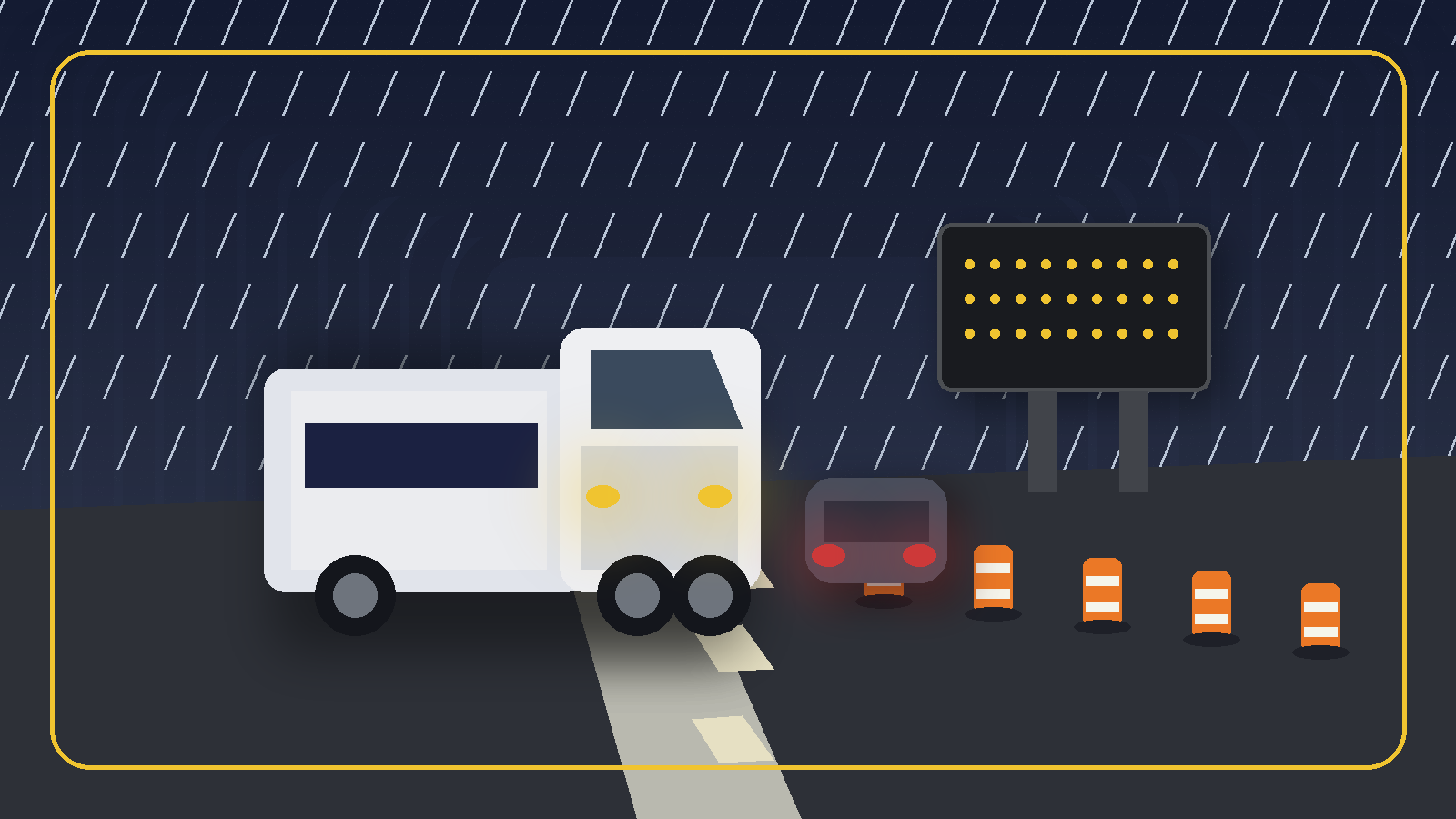
A tractor-trailer approaches Jacksonville on Interstate 95. Rain is falling. The pavement is wet. Ahead, traffic is compressing near a construction zone.
From the truck’s cab, the roadway presents a sequence of warnings: electronic message boards, orange road-work signs, lane-closure notices, uneven-lane notices, a closed-shoulder warning, and rows of construction barrels. The car ahead slows with its brake lights illuminated. The truck does not stop in time.
That sequence is not a hypothetical. It comes from the dissent in Gresham v. FEC Highway Services, LLC, a Florida Fifth District Court of Appeal decision issued September 25, 2026. The semi struck a concrete median, ricocheted across traffic, crushed a Kia, and dragged it roughly 160 feet. Two young people died.
The new opinion addressed a particular procedural question: whether the plaintiffs had shown enough to amend their complaint to seek punitive damages against the truck driver. The majority affirmed the trial court’s denial. Chief Judge Jay dissented and described the plaintiffs’ evidence in detail.
That distinction matters. The majority did not decide that the driver was careful, that the warnings were irrelevant, or that no ordinary negligence claim existed. It decided only that no reversible error had been shown on the request to add punitive damages. For families trying to understand a Florida work-zone truck accident, the opinion is valuable for a different reason: it shows how a crash can be reconstructed from warnings, weather, vehicle data, driver qualifications, and split-second decisions made long before impact.
A speed-limit sign answers only one question
Drivers often equate safe speed with the posted number. Florida law does not. Florida Statutes section 316.183 requires a speed that is reasonable and prudent under the conditions and existing hazards. It also calls for an appropriately reduced speed when weather, highway conditions, a curve, or other traffic creates a special hazard. A driver may therefore be traveling below the posted limit and still be moving too fast to stop safely.
Commercial trucks operate under an additional rule. 49 C.F.R. § 392.14 requires “extreme caution” when rain or other hazardous conditions adversely affect visibility or traction. Speed must be reduced, and operation must stop if conditions become sufficiently dangerous. Florida generally makes federal motor-carrier safety rules applicable to commercial vehicles through section 316.302, subject to the statute’s distinctions and exceptions.
In Gresham, the dissent recounted a trucking-safety expert’s opinion that the truck was moving 20 miles per hour too fast for the conditions. The proffer also described the truck as being on cruise control on a wet road as it approached a construction zone, a curve, a bridge, and slowed or stopped traffic. Those were assertions in the plaintiffs’ evidentiary proffer—not factual findings by the appellate majority. But they illustrate the right inquiry. The real question is not simply, “Was the truck speeding?” It is, “At the speed selected, did the driver leave enough time and distance to react to the hazards the road was announcing?”
Work-zone signs can become a timeline of notice
A single warning sign may be missed. A series of signs creates a different evidentiary picture. Each message board, orange panel, taper of barrels, and lane-closure notice can mark another opportunity to slow, increase following distance, disengage cruise control, or change lanes safely.
That is why photographs taken after a Florida work-zone truck accident are important but may be incomplete. Construction traffic control changes. Barrels move. Message boards display new text. Crews open and close lanes. The most useful reconstruction may combine the truck’s forward-facing dashcam with maintenance-of-traffic plans, contractor daily reports, sign-placement records, FDOT or local-agency records, traffic-camera footage, 911 timestamps, and weather data.
The dashcam described in Gresham allegedly showed traffic backing up, the Kia’s brake lights, and signs visible from the cab. That kind of video does more than capture the final seconds. It may show when the hazard first became visible and how long the driver had to respond. For a Florida truck accident claim, the approach to the work zone can matter as much as the point of impact.
Cruise control is a clue, not a conclusion
Saying that a truck was using cruise control does not by itself establish negligence. The meaning depends on the conditions, the system, and what the driver did when the risk changed. On a wet roadway approaching stopped traffic, however, cruise-control status can become part of a much larger story about speed selection and attention.
Modern commercial vehicles may retain engine-control-module data showing vehicle speed, throttle position, braking, engine revolutions, and other values around a triggering event. Telematics can reveal location, hard-braking alerts, speed history, and communications with dispatch. A truck’s camera system may preserve forward, inward, or side views, but preservation windows vary and footage can be overwritten.
These sources must be read together. A dashcam timestamp can be compared with GPS coordinates. Brake-light activation can be compared with vehicle speed. Dispatch instructions can be compared with the route and delivery schedule. Inspection records may reveal tire or brake issues that affected stopping distance. Evidence from the passenger vehicle can also matter, including event-data-recorder information and photographs of the crush pattern.
Tucker Law’s semi-truck accident page explains why evidence preservation is especially urgent after a commercial crash. A prompt preservation demand can identify relevant vehicles, electronic systems, custodians, and date ranges before routine retention practices erase important data.
Could the driver understand the warnings?
The most unusual issue in Gresham involved the driver’s ability to read English. The dissent recounted testimony that Russian was the only language he could understand when reading and that he had obtained an earlier commercial license without an English written test. It also described questions he declined to answer by invoking the Fifth Amendment, including whether he understood the English traffic signs on the day of the crash.
Federal law makes this a functional safety issue, not a question about nationality or accent. Under 49 C.F.R. § 391.11(b)(2), a commercial driver must be able to read and speak English sufficiently to understand highway traffic signs and signals, respond to official inquiries, communicate with the public, and make required record entries. The same regulation also requires sufficient experience or training to operate the vehicle safely.
A valid commercial driver’s license is important, but it does not necessarily answer every qualification question in a civil case. Relevant records may include the carrier’s application and road-test materials, training records, orientation documents, safety evaluations, prior inspection reports, and communications showing how the company assessed the driver’s ability to understand signs and instructions. Tucker Law’s discussion of truck-driver negligence addresses the broader evidence used to evaluate a commercial driver’s conduct.
The driver, carrier, and road contractor present different questions
A work-zone crash can involve several actors, but their responsibilities should not be blended together.
The driver’s conduct may be evaluated through speed, following distance, lookout, braking, lane choice, and compliance with commercial-driving rules. The motor carrier may face separate questions about qualification, training, supervision, maintenance, dispatch pressure, and whether it required or permitted unsafe operation. A road contractor may have responsibilities under its contract and maintenance-of-traffic plan for sign placement, lane closures, barriers, and inspection of the work zone. Government entities can raise separate notice, duty, and sovereign-immunity issues.
The presence of multiple potential defendants does not mean that every party is legally responsible. Contracts, control, ownership, agency relationships, and the specific cause of the collision must be proved. It does mean that an investigation limited to the police crash report may miss central evidence.
Commercial-truck cases also demand precision about federal rules. Section 392.14 speaks directly to reduced speed in hazardous conditions. Section 391.11 addresses driver qualifications. Florida’s section 316.183 addresses reasonable speed and special hazards. A violation may be relevant evidence, but the effect of a particular rule depends on the claim, the parties, the vehicle’s operation, and the facts. The rule citation is the beginning of the analysis, not the end.
Ordinary negligence and punitive damages are not the same case
Gresham is easy to misread because the facts described in the dissent are severe. The appellate question was not whether the families could pursue compensation for the deaths. It was whether the evidentiary showing permitted a punitive-damages claim against the driver at that stage.
Florida imposes a special gatekeeping procedure for punitive damages. Under section 768.72, a claimant cannot plead punitive damages without a reasonable evidentiary showing that would provide a reasonable basis for recovery. Gross negligence for that purpose means conduct so reckless or wanting in care that it reflects conscious disregard or indifference to others’ safety.
The Gresham majority affirmed the denial in a short opinion. The dissent believed the plaintiffs’ proffer—viewed in their favor—was enough to cross the pleading threshold. That disagreement does not turn ordinary negligence into gross negligence automatically, and it does not erase an ordinary negligence or Florida wrongful-death claim when punitive damages are unavailable.
For injured people and families, the practical lesson is to separate the questions. What caused the crash? Who had a duty to prevent it? What compensatory losses resulted? And only then: does the evidence meet Florida’s distinct punitive-damages standard?
The first preservation letter should look beyond the truck
A thorough work-zone investigation should identify the tractor, trailer, passenger vehicles, camera vendors, telematics providers, motor carrier, broker or shipper where relevant, roadway contractor, subcontractors, and public agencies that may hold records. It should account for dashcam footage, electronic control data, ELD and GPS records, driver-qualification materials, dispatch communications, maintenance files, traffic-control plans, project diaries, lane-closure logs, and post-crash inspection material.
Not every item will exist in every case, and not every record will be admissible. The goal is to preserve the original sources so that later analysis is based on data rather than memory. The Personal Injury Information Center offers additional guidance on how evidence and procedure shape Florida injury cases.
A work zone is designed to warn drivers that ordinary roadway expectations have changed. When a commercial truck crashes after passing those warnings, the investigation should begin well before the impact point—at the first sign, the first change in traffic, and the first moment a safer speed should have been chosen.
If you or your family was affected by a serious commercial-truck crash in a Florida construction zone, contact Tucker Law for a confidential consultation. The firm can evaluate which companies and agencies controlled the relevant evidence and take steps to preserve it before the work zone changes or electronic records are overwritten.