A Teen Driver Caused the Crash. Which Adult Is Responsible in Florida?
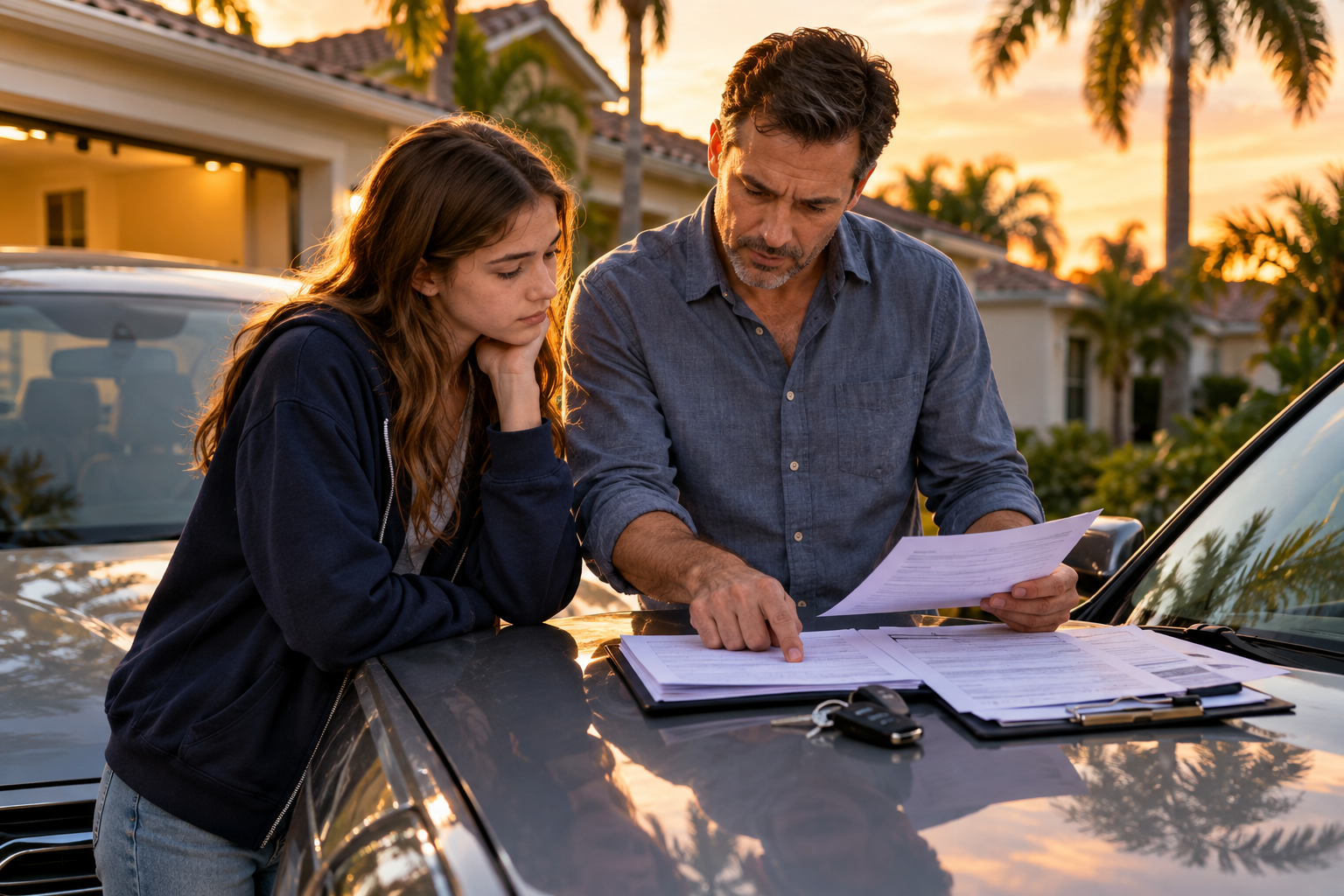
A 17-year-old runs a red light while driving the family SUV. Her mother signed the application for her learner’s permit. Her father holds title to the SUV. A grandparent pays the insurance premium.
After the collision, it is tempting to reduce the case to one question: “Are the parents responsible?” Florida law asks several more precise questions. Who was driving? Who signed the minor’s license application? Who owned the vehicle? Who gave permission to use it? And which policies actually cover the loss?
Those answers may point to different people. They also may create more than one route to compensation for someone injured by a teen driver.
The teen driver remains the starting point
A minor who negligently causes a collision is not excused simply because of age. The evidence used to evaluate the driving itself is familiar: traffic-control devices, witness accounts, photographs, vehicle damage, video, electronic vehicle data, phone records when distraction is genuinely at issue, and the investigating officer’s measurements and observations.
Florida’s comparative-fault rules can also matter. If another driver contributed to the crash, fault may be divided. For most negligence claims arising after March 24, 2023, a claimant found more than 50% at fault generally cannot recover, while a claimant who is 50% or less at fault may have damages reduced by that percentage. Our discussion of shared fault after a Florida crash explains that separate issue.
But proving that the teen drove negligently is only the first layer. The next task is identifying which adults have a legal connection to that driving.
The signature on the license application can create liability
Florida Statutes section 322.09 requires most driver-license applications by people under 18 to be signed by a parent, guardian, or, when there is no parent or guardian, another responsible adult willing to assume the statute’s obligation. The statute then provides that a minor’s negligence or willful misconduct while driving a motor vehicle on a highway is imputed to the person who signed the application. It expressly makes the signer jointly and severally liable with the minor for the resulting damages.
That is not the same as saying every parent is automatically liable whenever a child crashes. The operative fact under section 322.09 is the signature. In a separated household, for example, the parent who signed the application may not be the parent who owns the car involved in the crash. A grandparent or guardian may be the signer in another family. The statute follows the person who accepted that particular obligation.
The 1983 decision in Ruiz v. Ruiz illustrates how seriously Florida courts treat the signature. A mother had signed her minor daughter’s license application and later was injured while riding as a passenger as the daughter drove. The Third District applied the statutory imputation of the daughter’s negligence to the mother. The opinion described the law as a legislative decision to fix responsibility for otherwise judgment-proof minors.
Age and cancellation can change the statutory analysis
Section 322.09 speaks specifically about negligence or willful misconduct by a driver who is under 18. If the driver had already turned 18 when the crash occurred, this license-signer provision does not supply the same route to liability. Other theories involving the driver, vehicle owner, or insurance may still apply.
Florida also provides a formal way for a signer to end future liability under this chapter. Under section 322.10, the signer may file a verified written request asking the Department of Highway Safety and Motor Vehicles to cancel the minor’s license. Once the department cancels it, the signer is relieved from the chapter’s signature-based liability for the minor’s subsequent negligent or willful driving. A family rule such as “you are no longer allowed to drive” is not the same thing as the statutory cancellation process.
The Legislature has also created exceptions for certain people who sign for minors in out-of-home or foster care. Section 322.09 specifies circumstances in which a caregiver, group-home representative, caseworker, or guardian ad litem does not assume liability merely by signing. Those provisions should be checked against the precise placement and licensing facts rather than treated as a general exception for all guardians.
The vehicle owner presents a separate question
The adult who signed the license application may not own the vehicle. Florida generally treats a motor vehicle as a dangerous instrumentality, which can make an owner vicariously liable when the vehicle is operated with the owner’s consent. This owner-liability analysis is distinct from section 322.09. It turns on ownership, consent, and the circumstances under which control of the vehicle was entrusted to the driver.
For a natural-person owner who loans a vehicle to a permissive user, section 324.021(9)(b)3 sets limits on vicarious liability: up to $100,000 per person and $300,000 per incident for bodily injury, plus $50,000 for property damage. When the permissive user is uninsured or carries less than $500,000 in combined bodily-injury and property-damage coverage, the statute permits up to an additional $500,000 in economic damages, reduced by amounts recovered from the user and applicable insurance.
Those statutory limits are not a universal damages chart. They apply to a defined category—a natural person who loans a vehicle to a permissive user—and the statute says they do not affect liability for the owner’s own negligence. Commercial ownership, leasing arrangements, disputed permission, and direct-negligence allegations can require different analysis.
That distinction matters in the opening example. The mother’s possible liability may arise from signing the license application. The father’s possible liability may arise from owning the SUV and permitting its use. One adult might occupy both roles, but the law does not require the roles to match.
Direct negligence depends on what the adult knew and did
Some cases raise more than vicarious responsibility. An injured person may allege that an adult was directly negligent in entrusting a vehicle to a teen known to be unfit to drive—for example, because the adult knew of serious driving restrictions, impairment, or a pattern of dangerous conduct. This is not established merely by proving that a parent taught a teenager to drive or that the teenager made a mistake.
Direct-negligence claims require evidence about the adult’s knowledge and conduct before the collision. Prior incidents, license restrictions, household rules, text messages about use of the car, access to keys, and testimony about permission may become important. The issues are fact-specific, and an insurer’s early description of the crash should not substitute for the documents and testimony.
Insurance may not follow the family tree
Legal responsibility and available insurance are related, but they are not identical. The policy on the vehicle may cover permissive drivers, yet its declarations and endorsements still need to be read. Another household policy may matter. A driver could be expressly excluded. The injured person’s uninsured or underinsured motorist coverage may become important if liability insurance is absent or insufficient.
Florida’s registration requirements do not guarantee that meaningful bodily-injury coverage will be available. The Florida Department of Highway Safety and Motor Vehicles states that a four-wheel vehicle registered in Florida generally must carry at least $10,000 in Personal Injury Protection and $10,000 in property-damage liability coverage. PIP pays specified benefits to covered injured people regardless of fault; property-damage liability is not bodily-injury liability.
A complete coverage investigation should therefore obtain the policy, declarations pages, endorsements, coverage-selection forms, and any exclusion documents. Tucker Law’s article on Florida named-driver exclusions explains why the name of an excluded household driver can change the insurance analysis. When the responsible parties lack adequate coverage, stacked and non-stacked uninsured motorist coverage may also affect the injured person’s options.
The decisive records often come from different places
A police report may identify the driver and registered owner, but it ordinarily will not answer every responsibility question. The minor’s licensing record can identify the application signer. The title and registration establish important ownership facts. The insurance policy shows the named insured, listed drivers, exclusions, and coverage limits. Family testimony and communications may address permission and access to the vehicle.
These records should be compared, not assumed to match. A demand sent only to the teen’s insurer may miss the license signer. A claim focused only on the signer may overlook a different titled owner. And a policy card found in the glove box may not reveal an exclusion or a separate UM policy available to an injured household member.
Evidence from the collision itself can disappear just as quickly. Nearby business video may be overwritten, a damaged vehicle may be repaired or sold, and phone or app data may be lost. Early preservation can protect both the proof of how the crash happened and the proof of who may be responsible.
Do not wait for the family’s insurer to map the case
Florida generally imposes a two-year filing period for negligence actions under section 95.11, although different claims and facts can produce different deadlines. Coverage notices, PIP requirements, and evidence-preservation needs may arise much earlier.
If you were injured in a collision involving a driver under 18, Tucker Law can investigate the driver, the adult who signed the license application, the vehicle’s ownership and permission history, and every potentially applicable policy. Visit our Florida car accident practice page or the Personal Injury Information Center for more information. To discuss the specific people, vehicles, and coverage involved in your crash, contact Tucker Law.