What Should You Do After a Parking Lot Accident in Florida?
A parking lot accident claim may look simple at first, but these cases often involve limited sight lines, reversing vehicles, distracted pedestrians, faded markings, and conflicting accounts. Police may not respond to every low-speed incident, while security video can disappear quickly.
Whether the accident involves two vehicles, a car and a pedestrian, or a dangerous property condition, early documentation can make a major difference. These nine steps can help preserve the facts after a Florida parking-lot injury.
1. Stop and check for injuries
Do not leave the scene or assume that a low-speed impact cannot cause harm. Check yourself, passengers, pedestrians, and the occupants of other vehicles. Call 911 when someone is injured, complains of pain, is disoriented, or needs medical help.
Move out of an active travel lane if it is safe, but first take quick wide photos when possible. Follow emergency and law-enforcement directions.
2. Photograph the layout, not just the damage
Parking-lot fault often depends on where people and vehicles were located. Photograph the entire area, including travel lanes, parking spaces, crosswalks, stop signs, arrows, wheel stops, landscaping, lighting, and sight obstructions. Capture each vehicle’s position and all visible damage.
If a pedestrian was involved, document the walking route, curb, ramp, crossing, and nearby parked vehicles. Preserve the original files without filters or edits.
3. Identify every possible camera
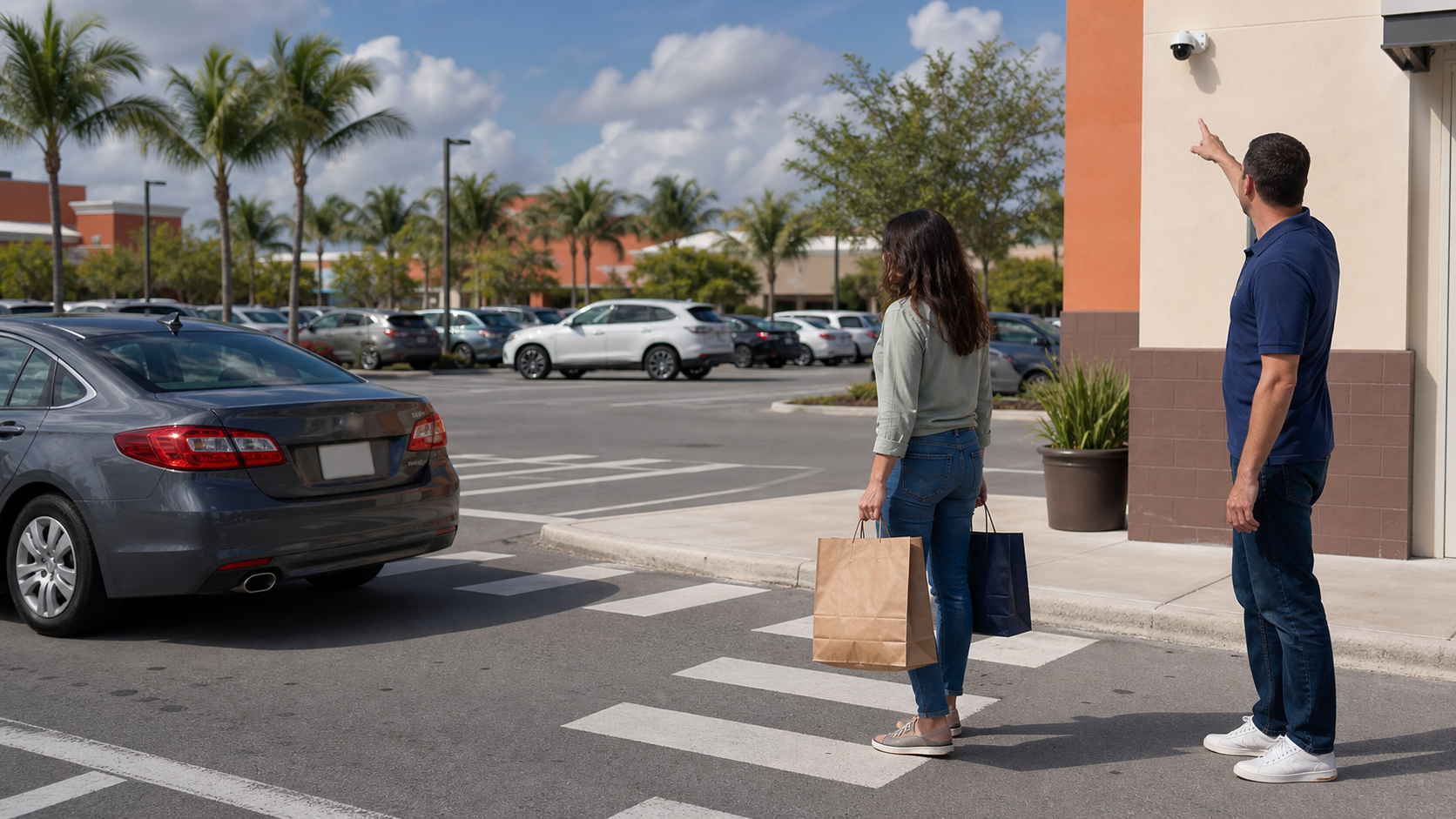
Look for storefront, garage, gate, elevator, security, and traffic cameras. Nearby vehicles may have dashboard or parking-mode systems. Record the camera locations and the businesses or property managers that control them.
Video may be overwritten in days. A prompt preservation request can be critical to a parking lot accident claim. Do not assume the business will keep footage merely because an employee saw the incident.
4. Exchange complete information
- Driver and vehicle-owner names and contact details
- Driver’s-license, license-plate, and insurance information
- Passenger and witness names and phone numbers
- Employer information if a driver was working
- The property owner or manager’s contact information
Photograph documents with permission and confirm that the images are readable. If a driver leaves, note the vehicle description, direction of travel, and any partial plate information.
5. Report the incident to the right people
Notify law enforcement when the circumstances require it and report the event to the appropriate insurers. If the incident occurred at a store, apartment complex, hotel, garage, or workplace, ask management to create an incident report. Request a copy or photograph the completed report if permitted.
Keep the report factual. Do not accept blame or speculate about a speed or distance you did not measure. If no police report is prepared, review our guide to a Florida car accident with no police report.
6. Look beyond driver conduct
A backing driver, speeding motorist, distracted pedestrian, or driver who ignored a stop sign may be responsible. Property conditions may also contribute, such as blocked views, poor lighting, confusing traffic flow, broken pavement, or missing markings. A delivery vehicle, maintenance contractor, or valet operator can add other parties and insurance policies.
The facts determine which issues are relevant. Avoid naming a party as responsible before the evidence is gathered.
7. Obtain appropriate medical care
Parking-lot accidents can cause head, neck, back, shoulder, knee, and soft-tissue injuries. Pedestrians may suffer harm even when a vehicle was moving slowly. Tell providers exactly how the incident occurred and when symptoms began.
For motor-vehicle incidents, Florida personal injury protection coverage may apply to certain initial medical and disability benefits. Current Florida Statute § 627.736 generally requires initial services and care within 14 days for PIP medical benefits.
8. Keep a careful record of losses
Save medical bills, receipts, prescriptions, treatment instructions, repair estimates, rental-car charges, wage records, and correspondence with insurers. Track missed work and assistance you needed with household activities. Our article on writing a pain journal after an accident offers a practical way to record symptoms without exaggeration.
Do not repair a damaged vehicle or discard shoes, clothing, or other relevant items before they are photographed and evaluated.
9. Be careful with statements and releases
An adjuster may describe the event as “minor” before reviewing the medical evidence. Provide accurate notice, but do not guess, minimize symptoms, or sign a release before you understand the injuries and available coverage. A recorded statement or broad medical authorization can have consequences beyond the immediate property-damage issue.
How is fault decided?
Right-of-way rules, driver attention, pedestrian conduct, vehicle movement, markings, visibility, and property conditions may all matter. Florida’s current comparative-fault statute may affect recovery when responsibility is shared. Its application depends on the type of claim and the proven facts.
Passengers should also preserve their own medical and insurance records. Our article explains how passenger injury claims may work after a Florida car accident.
Get help before evidence disappears
A parking lot accident claim can depend on video, witness memory, and physical details that change quickly. Tucker Law can review potential fault, insurance coverage, property conditions, injuries, and preservation needs. Explore our personal injury practice areas or contact Tucker Law to discuss the incident.
This article provides general information, not legal advice. Reporting duties, liability, insurance coverage, damages, and deadlines depend on the facts and current law.