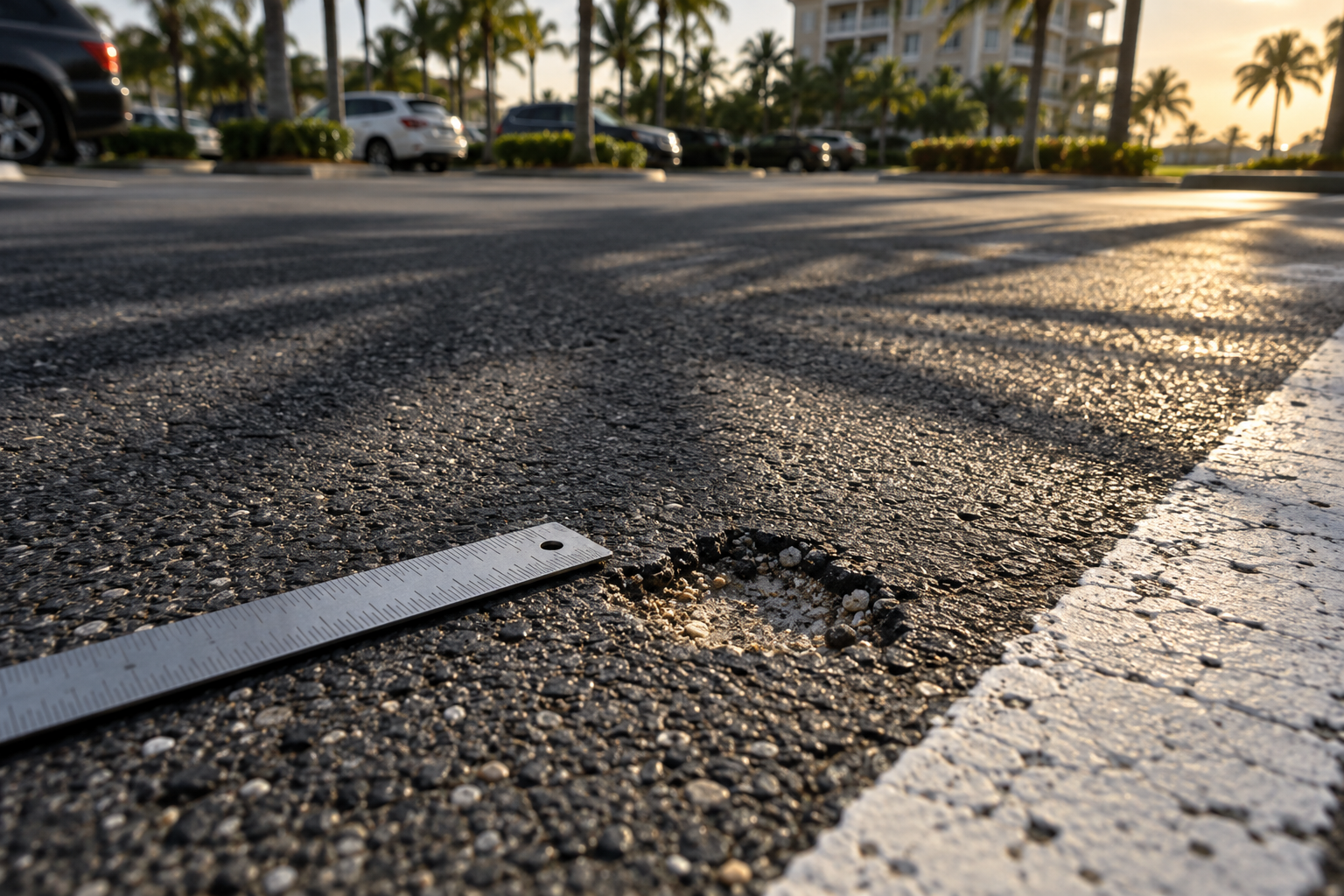
A One-Inch Parking Lot Defect and the Code Mistake That Forced a New Trial
A shallow break in asphalt can look insignificant in a photograph. In a lawsuit, however, the same spot may raise several different questions: Was the surface unreasonably dangerous? Did the property owner have enough time to discover and repair it? Could ordinary lighting make it harder to see? And if a building code is offered as proof, does that code actually govern that location on the date of the fall?
A new Florida appellate decision shows why those questions cannot be collapsed into one. In BSREP III PBG Resort, LLC v. Ginsburg, the Fourth District Court of Appeal considered a guest’s trip-and-fall in a resort parking lot. The jury returned a $603,578.70 verdict for the guest. Yet on September 9, 2026, the appellate court ordered a new trial because the jury heard and was instructed on a building-code provision that the trial court had not first determined was applicable.
The decision does not hold that the parking lot was safe. It does something more instructive: it separates the evidence of the physical condition from the legal standards used to evaluate it. For someone injured in a Florida slip-and-fall or trip-and-fall, that distinction can determine whether a claim survives and whether a verdict lasts.
One parking lot, two different liability theories
The plaintiff in Ginsburg was walking through a guest parking lot at PGA National Resort and Spa when she stepped into an area of missing asphalt and fell, fracturing her right wrist. The depression was described as approximately six to eight inches long, four to six inches wide, and between three-quarters of an inch and one inch deep. There were no sidewalks in the area, so guests walked on the asphalt. According to the evidence, overhead lighting and shadows from palm trees could camouflage the defect.
The claim involved two related but distinct duties: maintaining the premises in a reasonably safe condition and warning invitees about a concealed danger the owner knew or should have known about. At trial, the judge directed a verdict for the resort on the failure-to-warn theory. The maintenance theory went to the jury, which found the resort negligent and assigned no comparative fault to the plaintiff.
That split matters. A warning claim can fail even though a negligent-maintenance claim remains viable. The questions are not interchangeable. A property owner may argue that a condition was visible and required no warning, while the injured person may still contend that the owner should have inspected, repaired, or eliminated the condition. Anyone evaluating a fall should identify which duty the available evidence actually supports instead of treating “premises liability” as a single undifferentiated theory.
The physical evidence was not the appellate problem
The Fourth District affirmed the trial court’s refusal to direct a verdict on negligent maintenance without further discussion. The reversal arose from a separate evidentiary problem: the use of a building-code provision.
On the morning of trial, the plaintiff asked the court to take judicial notice of what was identified as Florida Building Code section 1003.2.7.1. The provision generally limited abrupt changes in elevation along a means of egress to one-quarter inch and required certain changes between one-quarter and one-half inch to be beveled. The resort objected. It argued that the provision governed means of egress rather than an exterior parking lot and that it had not received the written notice ordinarily required for judicial notice.
The trial court admitted the provision without first deciding whether it applied to the parking lot. The plaintiff then used it during cross-examination, closing argument, and the jury instructions. The code became a central measuring stick for the condition.
The appellate court found two fundamental problems. First, the section number appeared only in the 2001 Florida Building Code, which was effective from March 1, 2002, through September 30, 2005. The 2020 edition in effect when the plaintiff fell did not contain that section number, nor did the 2023 edition in effect at trial. Second, the trial court never resolved whether a rule addressing changes in elevation along a means of egress applied to this exterior parking area at all.
A building code is not self-proving
Building codes can be important in a premises case, but identifying a numerical threshold is only the beginning. The proponent must connect the provision to the property, the date, the particular location, and the condition at issue.
Florida’s evidence statutes explain the courtroom mechanism. Courts must take judicial notice of the matters listed in section 90.201. Administrative rules, including the Florida Building Code adopted through the state’s rulemaking process, instead fall within the matters a court may notice under section 90.202(9). When a party requests judicial notice, section 90.203 requires timely written notice and enough information for the other side to prepare. Section 90.204 gives each side an opportunity to be heard on whether notice is proper and on the nature of the matter noticed.
Judicial notice answers a limited evidentiary question: whether the court can accept the existence and contents of an authoritative rule without ordinary proof. It does not establish that the rule governs the accident scene. Applicability remains a separate issue for the judge.
That is why code analysis should start with four anchors. What edition was legally in effect on the incident date? Did a later renovation, permit, or local enactment affect the applicable standard? Does the cited provision cover this type of property and this precise part of it? And can a qualified witness accurately connect the code language to reliable measurements and site conditions? An expert’s opinion is only as sound as those foundations.
Tucker Law’s earlier discussion of Ramsey v. Home Depot illustrates the same broader lesson from another direction: an expert cannot simply invoke “code” or “industry standards” without identifying the actual provision or recognized standard supporting the opinion. Ginsburg now shows the opposite error—identifying a concrete provision that does not govern the time or place in dispute.
A code violation can strengthen proof, but it cannot replace proof
A premises case should not rise or fall on a code citation alone. Some dangerous conditions are actionable even when no code supplies a convenient fraction of an inch. Conversely, exceeding a dimensional threshold does not automatically prove every element of negligence.
The central factual proof usually comes from the scene itself. Close photographs with a scale can show depth and edge shape, while wider images establish the walking route, nearby parking spaces, curbs, drainage, and whether a safer path existed. Video taken at the same time of day may document glare, shadows, or inadequate contrast that a flash photograph erases. Surveillance footage can show how long a defect existed or how other guests encountered it. Inspection records, work orders, resurfacing contracts, prior complaints, and communications may bear on notice and control.
Those materials also change quickly. Asphalt may be patched, parking lots restriped, landscaping trimmed, or camera footage overwritten. A person who can do so safely should photograph the area promptly and preserve the shoes and clothing involved. Serious injuries warrant early legal investigation so preservation requests can reach the property owner and any third-party manager before routine retention periods expire. Our Personal Injury Information Center explains other evidence and claim issues that commonly arise after an accident.
Lighting and the expected walking route can change the analysis
The dimensions of a defect do not tell the entire story. A shallow depression in bright daylight may present differently under patterned shadows at night. A condition outside the expected path of travel may carry a different risk from one located where guests must walk because the property provides no sidewalk.
That context is especially important when the defense argues that the condition was open and obvious or that the injured person shares fault. Florida’s comparative-fault statute, section 768.81, can make the allocation of responsibility consequential. Clear scene evidence helps a jury evaluate what a reasonable guest could perceive and what a reasonable property operator should have discovered.
The best evidence therefore recreates the decision facing the person just before the fall. Where had the person parked? Where were the entrance and the nearest safe route? What objects or people drew ordinary attention? Were vehicles, curbs, shadows, or landscaping obscuring the pavement? Answers gathered days later from memory are rarely as persuasive as contemporaneous photographs, video, and witness accounts.
A new trial is not a finding that the defect was harmless
The resort won a new trial because the code error was not harmless. The Fourth District emphasized that the provision had become a centerpiece of the plaintiff’s case: it appeared in witness questioning, closing argument, and the jury instruction. The appellate court did not erase the maintenance theory or announce that a one-inch depression is categorically safe. It required the parties to retry the dispute without using an inapplicable legal standard unless the proper foundation can be established.
That procedural posture is easy to miss. An appellate reversal may reflect how the jury was allowed to decide a claim, not a final determination of the underlying facts. The opinion was also issued with the customary notice that it is not final until disposition of any timely rehearing motion.
What this means after a Florida parking-lot fall
A well-prepared claim needs two parallel investigations. The first reconstructs the physical event: the defect, route, lighting, visibility, injury, and maintenance history. The second identifies the governing legal standards: ownership and control, applicable code edition, scope of any cited provision, and the evidence rules needed to place it before a jury.
Neither investigation should wait for the other. Medical care documents the injury, while prompt site work preserves a condition that may disappear. If the fall happened while visiting Florida, our guide for people who were injured during a Florida trip addresses practical issues that arise after returning home. For local incidents, our Fort Lauderdale fall guidance covers early reporting and documentation without assuming that a manager or insurer will preserve the evidence voluntarily.
A parking-lot defect may be measured in fractions of an inch, but the legal analysis cannot be reduced to one number. The correct question is whether admissible evidence—physical, documentary, testimonial, and, when appropriate, code-based—shows that the property was not maintained with reasonable care.
If a parking-lot fall caused a fracture, surgery, lasting limitations, or another serious injury, Tucker Law can evaluate the site evidence and the standards that actually apply. Contact Tucker Law to discuss the circumstances before the property changes or important records are lost.