What Should You Do After a Bicycle Dooring Accident in Florida?
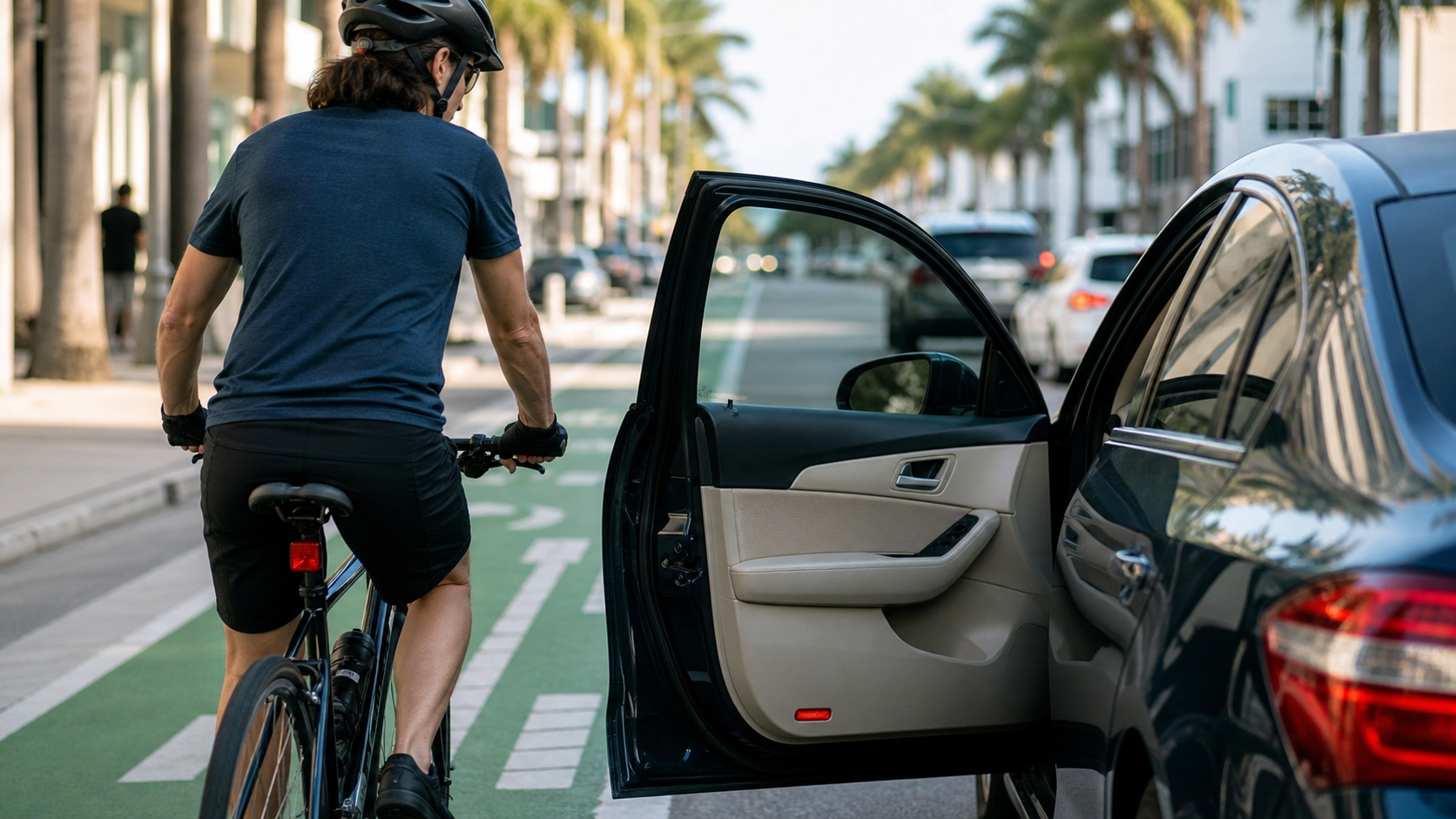
A bicycle dooring accident claim begins when a driver or passenger opens a vehicle door into a cyclist’s path. The cyclist may hit the door, swerve into traffic, fall onto the pavement, or collide with another vehicle. Even at modest speed, the resulting injuries can be serious.
Dooring cases often turn on a few seconds of conduct and evidence that disappears quickly. Florida law, the position of the bicycle, the timing of the door opening, and the available insurance may all matter. These eight steps can help preserve a Florida bicycle dooring accident claim.
1. Move Out of Traffic and Call for Help
If possible, get yourself and the bicycle away from moving vehicles without disturbing more of the scene than safety requires. Call 911 when there is an injury, traffic hazard, or significant damage. Ask for medical assistance if you struck your head, lost consciousness, have severe pain, or cannot move normally.
Do not minimize symptoms because the crash involved a parked vehicle. A sudden stop, fall, or second impact can cause injuries that are not immediately obvious.
2. Document the Door and Bicycle Lane
Photograph the open door before it is closed if you can do so safely. Take wide images showing the parked vehicle, bicycle lane, travel lane, curb, parking lines, and sight distance. Then capture close photographs of damage to the door edge, mirror, bicycle, helmet, clothing, and other equipment.
Measure or visually document how far the door extended into the cyclist’s path. Photograph obstructions such as tinted windows, large vehicles, construction materials, or vegetation.
3. Understand Florida’s Door-Opening Rule
Florida Statute section 316.2005 provides that a person may not open a motor-vehicle door unless it is reasonably safe and can be done without interfering with moving traffic. It also limits how long a door may remain open on the side available to traffic.
A violation can be important evidence, but the civil claim still requires proof about causation, injury, and damages. The defense may dispute the cyclist’s position, speed, visibility, lighting, or opportunity to avoid the door.
4. Identify the Person Who Opened the Door
The person responsible may be the driver or a passenger. Obtain names, contact information, vehicle ownership information, insurance details, and the seating position of everyone in the vehicle. Do not assume the registered owner opened the door.
If the vehicle was used for rideshare, delivery, work, rental, or another business purpose, preserve app screens, trip information, employer details, and receipts. These facts may affect which policies or parties are involved.
5. Find Witnesses and Video
Ask drivers, pedestrians, nearby workers, and other cyclists what they saw. Collect reliable contact information rather than relying on someone to contact you later. Look for storefront cameras, doorbell cameras, parking-garage systems, dashcams, transit cameras, and traffic cameras.
Video may show when the car arrived, whether an occupant looked before opening, the cyclist’s lane position, and the timing of the impact. Request preservation quickly because recordings are often overwritten.
6. Preserve the Bicycle and Safety Equipment
Do not repair the bicycle, discard the helmet, or wash damaged clothing before they are photographed and, when appropriate, inspected. A bent wheel, damaged fork, broken light, or helmet strike can help reconstruct the event. Keep purchase receipts and repair estimates.
If a second vehicle became involved after the cyclist swerved, the case may include several causes and resemble a chain-reaction accident claim.
7. Obtain Medical Care and Keep a Recovery Record
Follow appropriate medical advice and describe the mechanism of the fall accurately. Keep records of appointments, diagnoses, prescriptions, therapy, missed work, travel costs, and help needed at home. Photograph visible injuries over time.
A helmet can reduce risk, but wearing one does not prevent every head or neck injury. Insurance companies should not use the size of vehicle damage as a substitute for medical evidence.
8. Identify Every Available Insurance Policy
Possible coverage may include the vehicle’s liability policy, the door opener’s policy, a commercial or employer policy, and certain coverages available to the cyclist or household. The result depends on the facts and policy language. Give prompt notice and avoid guessing in recorded statements.
Related proof issues appear in our articles on a parking lot accident claim and a crash without a police report.
Preserve the Moment Before the Scene Changes
A bicycle dooring accident claim can be strong when photographs, witnesses, video, vehicle information, and medical records show exactly what happened. Tucker Law can help identify responsible parties, secure evidence, and evaluate insurance coverage.
Explore our practice areas or contact Tucker Law to discuss a Florida injury claim.
Be cautious about a quick settlement before the medical course and insurance picture are understood. A damaged bicycle can be replaced, but treatment, time away from work, and lasting limitations may take longer to evaluate. A careful review should account for both immediate expenses and reasonably supported future effects.
This article provides general information, not legal advice. Every matter depends on its facts, insurance policies, and current Florida law.