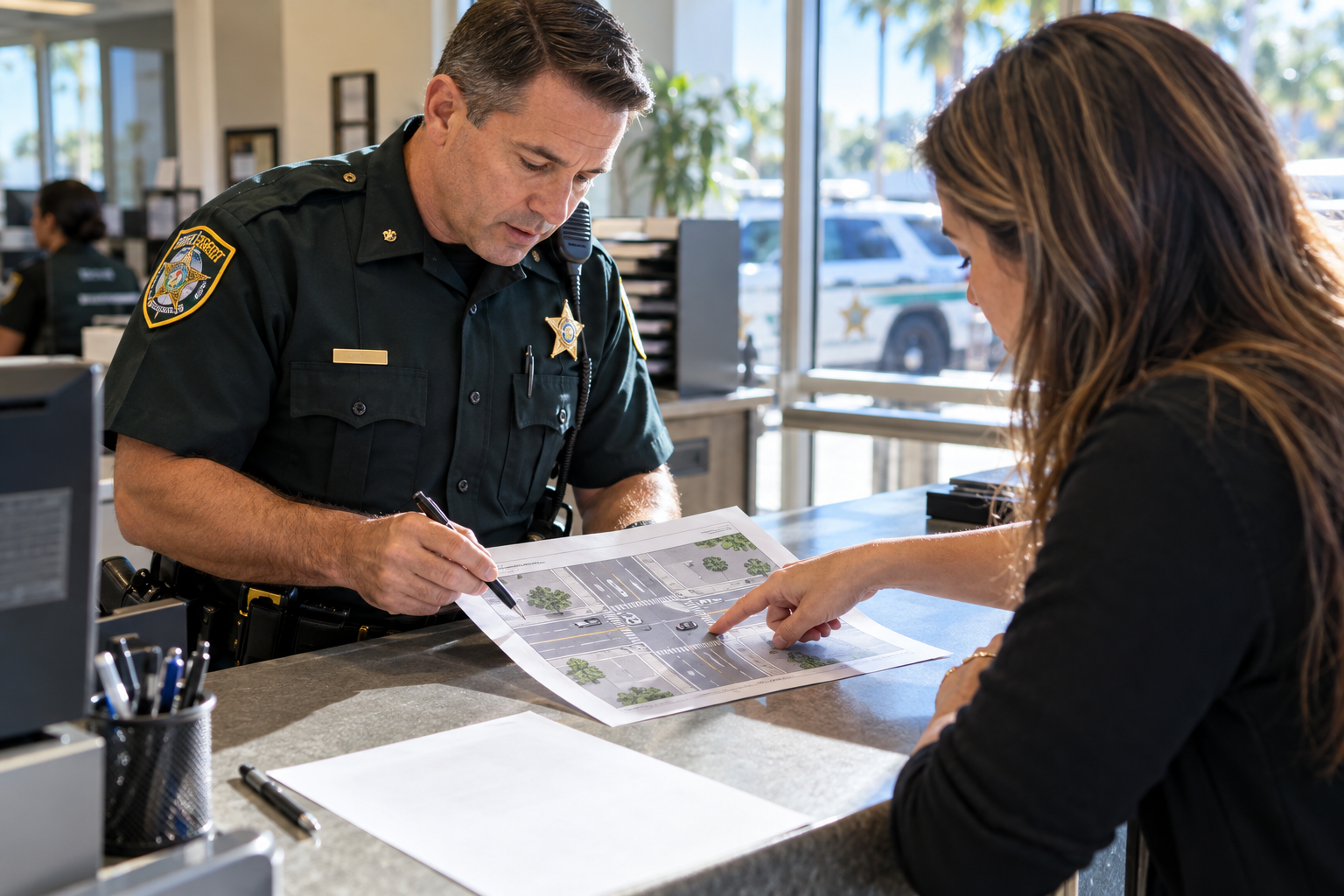
Can You Amend a Police Report in Florida?
Can you amend a police report in Florida? Sometimes—but the practical answer depends on what is wrong, what kind of report it is, and whether the investigating agency agrees that a correction or supplement is appropriate. A person generally cannot rewrite an officer’s report simply because he or she disagrees with the officer’s conclusion. But factual errors can be brought to the agency’s attention, and Florida’s own traffic-crash reporting system expressly provides for updates to information previously recorded on a crash report.
Tucker Law has previously discussed correcting an inaccurate police report in Florida. This expanded guide focuses on the questions people usually mean when they ask whether a police report can be “amended”: what can realistically be changed, what usually cannot, what evidence helps, and what to do if the report affects an injury claim.
Quick Answer: Correction, Supplement, or Disagreement?
| Problem with the report | What may happen | Best next step |
|---|---|---|
| Wrong name, vehicle, insurance, date, location, or other objective fact | An officer or agency may correct or update the report | Provide documentation showing the error |
| New evidence appears after the report | A supplemental or updated report may be appropriate | Preserve and submit the new evidence promptly |
| You disagree with who the officer blamed | The officer may refuse to change the conclusion | Build the evidence independently rather than relying on the report |
| A witness statement was omitted or summarized incorrectly | The agency may add a supplement or note additional information | Identify the witness and preserve the witness’s own account |
Florida Crash Reports Can Be Updated
The Florida Department of Highway Safety and Motor Vehicles publishes a Florida Uniform Traffic Crash Manual. Its crash-report instructions include an “Update Section” specifically used to “update or upgrade information previously recorded on a Florida Traffic Crash Report.” The manual explains how updated information is tied back to the original crash date, agency report number, HSMV crash report number, vehicle or person section, and reporting officer.
That matters because “amending” a crash report does not always mean deleting the original and replacing it with a new document. In practice, corrections may appear through an update or supplemental report that becomes part of the agency’s file.
The Florida Highway Patrol’s reporting policy is even more direct. FHP Policy 13.01 states that if an error is discovered after a report has already been approved, later corrections are made by a crash-report supplement. The policy also states that corrections to reports are to be made by supplemental report. You can review the official policy here.
What Florida Law Requires in a Crash Report
Florida Statutes section 316.066 governs written crash reports. For qualifying crashes, the investigating officer must complete and submit a Florida Traffic Crash Report. The statute identifies information that belongs in the report, including the date, time, and location of the crash; vehicles involved; parties and passengers; witnesses; insurance information; and other required crash data. The current statute is available through the Florida Legislature.
The important distinction
A report can contain an error without the underlying facts of the crash changing. A police report is one piece of the evidence. Photographs, body-camera video, nearby surveillance, vehicle data, 911 calls, witness testimony, physical damage, medical records, and later investigation may tell a more complete story.
What Kinds of Errors Are Most Likely to Be Corrected?
Objective mistakes are usually the strongest candidates for correction because they can be verified independently. Examples include a misspelled name, incorrect vehicle information, wrong insurance carrier, mistaken license plate number, incorrect street, transposed date, or incorrect identity of a passenger.
The same is true when the officer later receives information that was unavailable at the scene. A witness may come forward. A surveillance video may show how the collision occurred. A driver may later produce insurance information. A toxicology result may not have been available when the original report was submitted. Florida’s crash-report system anticipates later updates for precisely this kind of evolving information.
What If the Officer Put the Wrong Person at Fault?
This is harder. Fault is often an opinion based on the information available to the officer. If you simply tell the officer, “I disagree,” the officer may leave the report unchanged. A request is much stronger when it identifies a concrete factual error and attaches evidence that demonstrates why the original information is wrong or incomplete.
For example, “the report is wrong” is weak. “The report states I entered on a red light, but the attached intersection video shows my signal was green when I entered” gives the agency something specific to evaluate.
A Better Way to Request a Correction
Start by obtaining the complete report and reading it closely. Separate objective errors from conclusions you simply disagree with. Then preserve the proof before contacting the agency. Useful evidence can include photographs, dashcam or surveillance video, witness contact information, repair records, vehicle photographs, insurance documents, GPS data, phone records when relevant, and other records that establish a specific fact.
When making the request, identify the agency case number and the exact portion of the report at issue. State what the report says, what you believe is incorrect, and what document or evidence supports the correction. Keep the request focused. A short, evidence-backed correction request is usually more useful than a long argument about every detail of the crash.
Police Report Amendment Decision Map
Is it an objective factual error?
Yes → Gather proof and request a correction or update.Is it new evidence?
Yes → Ask whether the agency will accept a supplemental report or update.Is it only a disagreement about fault?
Then the more important task may be preserving independent evidence for the insurance claim or lawsuit rather than trying to persuade the officer to change an opinion.
Do Not Wait for the Police Report to Preserve Evidence
If the report is connected to a serious Florida crash, correcting it should not become the only focus. Some evidence can disappear quickly. Business surveillance may be overwritten. Vehicle data can be lost when a car is repaired or sold. Witnesses become harder to locate. 911 and dispatch materials may be subject to retention schedules.
That means the evidence-preservation work should move forward even while a correction request is pending.
Does an Incorrect Police Report Decide a Florida Injury Case?
No. A crash report may matter during an insurance investigation, but it does not automatically decide civil liability. Florida law also contains special rules concerning the use of crash reports and statements made for crash-reporting purposes. The admissibility question can depend on exactly what evidence is being offered and for what purpose.
The practical takeaway is simple: if a report is wrong, address it—but also build the case from the underlying evidence. The strongest response to an inaccurate report is often not an argument about the wording of the report. It is better evidence.
What to Do After You Find an Error
Obtain the report, identify the precise mistake, preserve evidence, and contact the investigating agency about its correction or supplemental-report procedure. If the report concerns a crash with significant injuries, consider having counsel handle the communication so that a correction request does not turn into an unnecessary recorded statement about disputed facts.
This article provides general information about Florida law and police-report procedures. It is not legal advice for any particular matter.