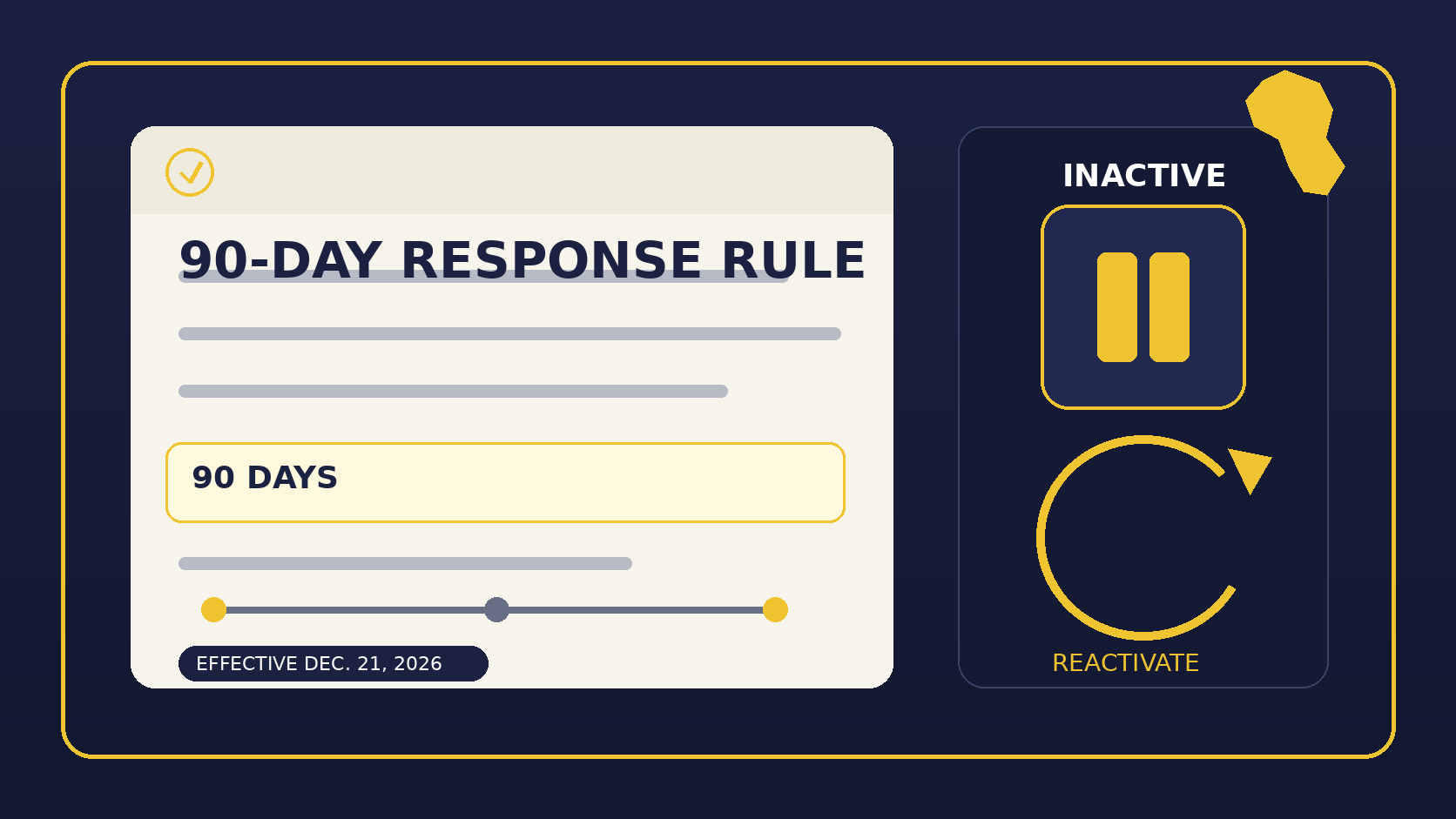
Florida Bar’s 90-Day Noncompliance Rule Changes December 21, 2026
Florida Bar applicants who ignore a request from the Florida Board of Bar Examiners have long faced a severe consequence: under the current version of Rule 3-14.6, failure to respond to a Board inquiry within 90 days may result in termination of the Bar Application and force the applicant to start over and pay the required fees again.
That rule is changing on December 21, 2026.
In In re Petition to Amend the Rules of the Supreme Court Relating to Admissions to the Bar, No. SC2026-0249, the Florida Supreme Court amended Rule 3-14.6 to distinguish between applicants who have not yet passed all portions of the Florida Bar Examination and applicants who have. For the first group, the new rule creates an inactivation-and-reactivation process instead of immediate exposure to termination for 90-day noncompliance.
The change matters because a Board request for records, clarification, or supporting documentation can arrive while an applicant is still taking or awaiting completion of the examination process. Beginning December 21, the consequence of failing to comply for 90 days will depend in part on the applicant’s examination status.
The current rule remains in effect through December 20, 2026
As of November 10, 2026, the Rules of the Supreme Court Relating to Admissions to the Bar currently published by the Florida Board of Bar Examiners still provide that an applicant’s failure to respond to a Board inquiry within 90 days may result in termination of the Bar Application and require reapplication and payment of all fees as though applying for the first time.
That remains the governing rule until the Florida Supreme Court’s October 22 amendments take effect on December 21, 2026. Applicants should therefore be careful not to treat the upcoming amendment as though it is already operative.
More importantly, even after December 21, the 90-day provision should not be treated as a working deadline. Rule 3-14.5 separately requires an applicant or registrant to be responsive to Board requests for further information and to vigorously pursue the application. The Board may also identify a specific response date in its correspondence.
Tucker Law’s article on responding to Florida Bar status letters and requests for information explains why applicants should address Board correspondence promptly and comprehensively rather than waiting for the outer limits of the noncompliance rule.
Beginning December 21, applicants who have not passed all portions of the exam may be inactivated
The new Rule 3-14.6(a) creates a different consequence for an applicant who has not successfully passed all portions of the Florida Bar Examination. If that applicant fails to comply with all outstanding requests and inquiries from the Board within 90 days, the application may be inactivated.
That is materially different from termination.
Under the amended rule, the application remains capable of reactivation once the applicant satisfies two conditions: the applicant must comply with all outstanding requests and inquiries, and the applicant must pay a $200 reactivation fee.
The Florida Supreme Court explained the purpose of the amendment directly. The Court stated that Rule 3-14.6 was being changed to clarify that an application by an applicant who has not passed all portions of the examination may be inactivated, rather than terminated, for failure to comply with Board requests. The Court also expressly recognized that the application may be reactivated once the outstanding requests are satisfied and the required fee is paid.
Applicants who have passed all portions of the exam still face termination
The amendment does not eliminate termination from Rule 3-14.6.
New subsection (b) applies to applicants who have successfully passed all portions of the Florida Bar Examination. If such an applicant fails to comply with all outstanding Board requests and inquiries within 90 days, the application may be terminated, and the applicant may be required to reapply and pay the required fees as though applying for the first time.
That distinction is important. Two applicants can have the same unanswered request from the Board and face different procedural consequences under the amended rule depending on whether they have completed all portions of the examination.
For an applicant who has passed the exam but still has an unresolved character-and-fitness investigation, allowing a Board request to remain outstanding can therefore carry particularly serious consequences.
“Inactivated” does not mean the request can safely be ignored
The new inactivation mechanism should not be read as permission to leave Board correspondence unanswered.
First, the applicant still has to satisfy every outstanding request before the application can be reactivated. Inactivation does not resolve the underlying issue; it merely changes the procedural consequence for a particular class of applicants.
Second, the applicant must pay a $200 reactivation fee. Third, delay can interfere with the timing of the background investigation and ultimately with admission. Passing the examination does not itself result in admission to The Florida Bar if the applicant has not yet received a favorable character-and-fitness recommendation.
Finally, the quality of the response still matters. A request involving an omission, inconsistent disclosure, criminal history, academic discipline, employment misconduct, financial issues, or another character-and-fitness concern may require more than simply uploading a missing document. The applicant should understand what the Board is asking, compare the request with the original application, and determine whether an amendment or explanation is also necessary.
Applicants dealing with a disclosure problem can review Tucker Law’s Florida Bar application omissions and amendments resource and its Florida Bar application review page.
The rule change also clarifies what counts as noncompliance
The amended language is broader and more precise than the current wording. The existing rule refers to an applicant’s failure to “respond to inquiry” from the Board. The new rule focuses on failure to comply with all outstanding requests and inquiries.
That distinction is practical. An applicant should not assume that sending a partial response necessarily satisfies the rule. If the Board requests several records, answers, or clarifications, the safer approach is to identify each outstanding item and confirm that each one has been addressed.
This is especially important when the applicant depends on third parties. Courts, schools, employers, disciplinary agencies, and other institutions may take time to produce records. Starting early provides time to identify missing documents and, where appropriate, communicate with the Board about what has been requested and what remains outstanding.
Student registrants also receive revised language
The December 21 amendments also revise the rule governing registrants. Under new Rule 3-14.6(c), a registrant’s failure to comply with all outstanding requests and inquiries from the Board within 90 days may result in cancellation of the registration application. The amended provision further addresses the fee consequence by requiring payment of the full non-discounted student registrant fee, less the amount of any student registrant fee previously paid.
That is distinct from the inactivation procedure created for applicants who have not passed all portions of the examination.
What should an applicant do with an outstanding Board request now?
If you currently have an unanswered Florida Board of Bar Examiners request, the October 22 rule amendment is not a reason to wait until December 21. The existing rule remains in force, Rule 3-14.5 still requires responsiveness, and any deadline stated in the Board’s correspondence deserves immediate attention.
A useful approach is to review the request against four things: the exact language of the original application question, the answer previously given, any amendments already filed, and the documents the Board is requesting. Then identify what can be supplied immediately and what requires a third-party record.
If the request reveals that an original answer was incomplete or incorrect, consider whether the continuing-application obligation under Rule 3-14.4 also requires an amendment. Tucker Law’s article on the Florida Bar application’s 30-day amendment rule addresses that separate duty.
The practical takeaway from the December 21 change
The new rule is more forgiving in one specific procedural respect: an applicant who has not yet passed all portions of the Florida Bar Examination may have an application inactivated rather than terminated after 90 days of noncompliance, with a path to reactivation for a $200 fee after all outstanding matters are addressed.
But the amendment does not make Board requests optional, and it does not reduce the importance of a complete, candid, timely response. Applicants who have already passed all portions of the exam continue to face possible termination and reapplication if outstanding requests remain unresolved for 90 days.
If you have received a request for information, a status letter, or other correspondence from the Florida Board of Bar Examiners and are uncertain what must be submitted, Tucker Law can review the Board’s request, the underlying application, and the available supporting records. Visit our Florida Bar Admissions hub for information about application review, character and fitness, investigative hearings, and formal hearings.