You Saw the Crash but Were Never Hit. Can Florida Law Recognize the Trauma?
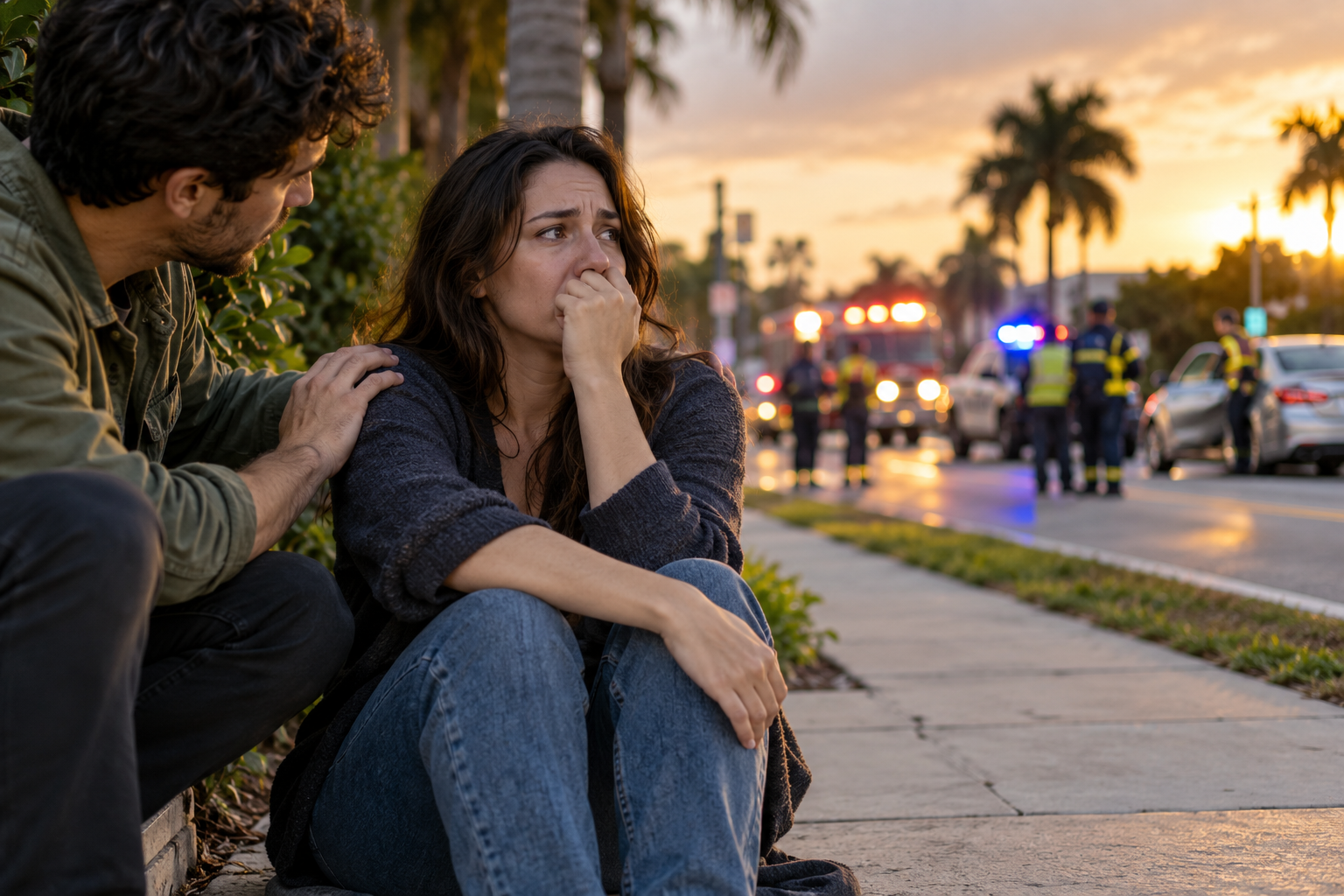
Two people watch the same collision unfold. One is sitting in a car that is struck and feels the seat belt tighten across her chest. The other is standing on the curb and sees a child hit in the crosswalk. Both may experience profound psychological trauma. Yet under Florida law, the few inches separating physical contact from no contact can change the legal analysis.
Florida’s “impact rule” generally limits recovery for emotional distress caused by negligence when the claimant was not physically touched and did not suffer a physical injury. But the rule is not absolute. The Florida Supreme Court created a narrow path for a close family member who is directly involved in witnessing a catastrophic injury to another person and develops a significant physical injury from the resulting psychological trauma.
That exception is demanding. It does not turn every eyewitness’s grief, fear, or post-traumatic stress into a negligence claim. Understanding what Florida courts actually require can help families preserve the right evidence—and avoid confusing a direct emotional-distress claim with a passenger’s injury claim, loss of consortium, or wrongful death damages.
The same trauma can enter through two different legal doors
Start with the claimant who was inside the struck vehicle. In Willis v. Gami Golden Glades, LLC, the Florida Supreme Court explained that the impact rule is stated in the alternative: a claimant ordinarily needs either a physical impact or a discernible physical injury caused by the emotional distress. An impact can be slight. When some external force or substance physically touches the claimant, the impact-rule barrier may be satisfied even if the contact itself does not produce a separate physical wound.
That does not automatically establish liability or damages. The person still must prove a negligent act, causation, and compensable harm. But someone who was jolted, struck by debris, or otherwise physically contacted during a Florida car accident begins in a different position from an uninjured observer across the street.
The observer who was never touched faces Florida’s general prohibition against negligence claims based only on emotional harm. The question then becomes whether the facts fit the narrow bystander exception first recognized in Champion v. Gray.
Champion recognized a claim—but drew a narrow boundary
In Champion v. Gray, a mother heard an automobile impact, immediately went to the scene, saw her daughter’s body, collapsed, and died. The Florida Supreme Court held that the impact rule did not bar a claim when psychological trauma from witnessing a negligently caused injury to a close family member produced a significant, discernible physical injury.
The court did not eliminate the impact rule. It described limits meant to distinguish a legally cognizable injury from the grief and shock that can follow any serious accident. The claimant must have a close personal relationship with the directly injured person. The claimant also must be involved in the event in a meaningful sensory way, such as seeing or hearing the incident or encountering its immediate aftermath while the injured person is still present.
Most importantly, a no-impact claimant must show more than emotional upset standing alone. Florida requires a physical injury or physical impairment caused by the psychological trauma. That requirement is why records describing what happened in the body—not only how the witness felt—can become central to the case.
Zell supplied the elements and rejected a stopwatch
A decade later, the Florida Supreme Court clarified the doctrine in Zell v. Meek. The court identified four core questions: Did the claimant suffer a physical injury? Was that injury caused by psychological trauma? Was the claimant involved in the event that negligently injured another person? Did the claimant have a close personal relationship with that person?
The first two questions are easy to collapse, but they address different links in the chain. A medical condition must exist, and reliable evidence must connect it to the trauma of the event. A diagnosis written months later may be important, but timing alone neither proves nor defeats causation.
Zell expressly rejected a rigid rule requiring a physical manifestation to appear within a fixed number of minutes or days. The interval remains relevant evidence. A condition that appears immediately may present a simpler causation question than one documented much later, but Florida law does not impose an automatic temporal cutoff. In Zell, the court allowed the claim to proceed based on evidence of immediate psychological symptoms, later physical impairment, and medical testimony connecting the two.
The current Florida Standard Jury Instructions in Civil Cases, updated July 6, 2026, reflect that framework. Instruction 420.6 asks jurors whether the claimant suffered a physical injury, condition, or impairment, and whether it resulted from emotional distress arising from the claimant’s involvement in the incident.
“Involved in the event” means more than learning bad news
Florida does not require the witness to occupy a particular number of feet from the collision. It focuses instead on direct sensory involvement. The jury instructions say involvement may include seeing or hearing some or all of the event, including its immediate aftermath.
A parent who sees a vehicle strike a child presents a different case from a parent who receives a telephone call hours later. A spouse who hears a crash outside the home and immediately finds the injured person at the scene may present a different case from a spouse who first sees the person after transport to a hospital. These are not mechanical outcomes; they illustrate why the location, sequence, and sensory details matter.
Evidence that can establish this part of the story may disappear quickly. Body-camera video, nearby surveillance, 911 audio, dispatch timestamps, photographs, witness statements, and emergency-response records can show where the claimant was, what the claimant perceived, and whether the encounter was part of the accident’s immediate aftermath. Tucker Law’s Personal Injury Information Center discusses why early evidence preservation matters across serious injury claims.
The relationship is factual, not merely a label
Champion involved a parent and child, but Florida law does not reduce the close-relationship element to a list on a family tree. In Watters v. Walgreen Co., the First District Court of Appeal held that stepchildren were not automatically excluded merely because no biological or adoptive relationship existed. The nature and quality of the relationship could present a factual question.
That does not mean any friendship or acquaintance will qualify. The inquiry remains narrow and highly dependent on proof. Household records, caregiving responsibilities, communications, photographs, and testimony from people who knew the family may help establish the relationship as it actually existed before the incident.
This fact-specific approach also explains why labels can mislead. “Stepchild” may describe an exceptionally close parent-child bond; “relative” may describe someone the claimant barely knew. Florida courts look beyond the label, but the claimant must still prove the closeness necessary for this exceptional cause of action.
A PTSD diagnosis is not the end of the physical-injury inquiry
Post-traumatic stress disorder, anxiety, depression, and grief can be devastating. For a claimant who was not physically touched, however, a psychological diagnosis by itself does not necessarily establish the physical component required by Florida’s impact-rule exception.
The Zell opinion and the jury-instruction notes discuss evidence such as stomach pain, an esophageal blockage, fibromyalgia, irritable bowel symptoms, and muscle tightness. Those examples are not a mandatory catalog, and similar symptoms are not automatically caused by an accident. They show the kind of distinction Florida law draws between psychological trauma and a resulting bodily injury or impairment.
Medical documentation must do more than repeat the claimant’s legal theory. Clinicians need an accurate history, including prior conditions, the onset and course of symptoms, examination findings, and the treatment provided. The defense may argue that the condition predated the event, arose from another cause, or lacks objective support. Consistent records and qualified medical testimony often determine whether the required causal link can be shown.
When the consequences are disabling, the claim may overlap with the practical concerns addressed in Tucker Law’s catastrophic-injury practice, including future care, lost earning capacity, and the effect of permanent limitations. But the impact-rule question comes first: whether Florida law recognizes the claimant’s injury at all under these facts.
This is a direct claim, not consortium or wrongful death damages
A bystander emotional-distress claim belongs to the witness for the witness’s own physical injury caused by the trauma. It is distinct from loss of consortium, which addresses harm to a marital relationship caused by a spouse’s injury. It is also distinct from a claim under Florida’s Wrongful Death Act, which identifies particular survivors and categories of damages after a death.
The distinctions matter because different claims can have different elements, defenses, and recoverable damages. A spouse might have a consortium claim without having witnessed the accident. A witness might satisfy Champion even though the directly injured person survives. If the event is fatal, the family should evaluate the witness’s potential direct claim separately from any Florida wrongful death claim.
They also should not assume that one claim merely substitutes for another. Florida’s bystander doctrine is not a general remedy for bereavement. It addresses a narrowly defined physical injury to a person directly involved in perceiving a negligently caused injury to someone close.
The event record and the medical record must tell the same story
These cases are built along two timelines. The event timeline identifies the negligent act, the direct victim’s injury, what the witness saw or heard, and how quickly the witness encountered the scene. The medical timeline identifies the witness’s immediate reaction, the onset of physical symptoms, treatment, diagnoses, and functional changes.
Gaps do not automatically destroy a claim—Zell makes that clear—but unexplained gaps give an insurer room to dispute causation. A claimant should report symptoms accurately, preserve scene evidence, identify witnesses, and avoid overstating what was perceived. Social-media posts and recorded insurance statements also may be compared against medical records and later testimony.
Time limits create a separate risk. Florida Statutes section 95.11 generally provides a two-year limitations period for negligence actions, but accrual and the correct legal theory can depend on the facts. A delayed physical manifestation should not be treated as permission to wait. Evidence may disappear long before a filing deadline arrives.
When the person beside the ambulance is also injured
After a catastrophic crash, attention understandably centers on the person transported from the scene. Florida law nevertheless recognizes that, in a narrow class of cases, the family member who directly witnessed the event can suffer a distinct physical injury from the trauma.
The difference between a viable claim and uncompensated suffering often lies in details gathered early: whether there was physical contact, precisely what the claimant perceived, the closeness of the relationship, when bodily symptoms began, and whether medical evidence can connect those symptoms to the event.
If you witnessed a loved one’s catastrophic injury in Florida and developed physical consequences from the trauma, contact Tucker Law to discuss the event while the scene evidence and medical timeline can still be preserved. A careful review can determine whether the claim falls within Florida’s narrow exception or belongs under a different personal-injury theory.