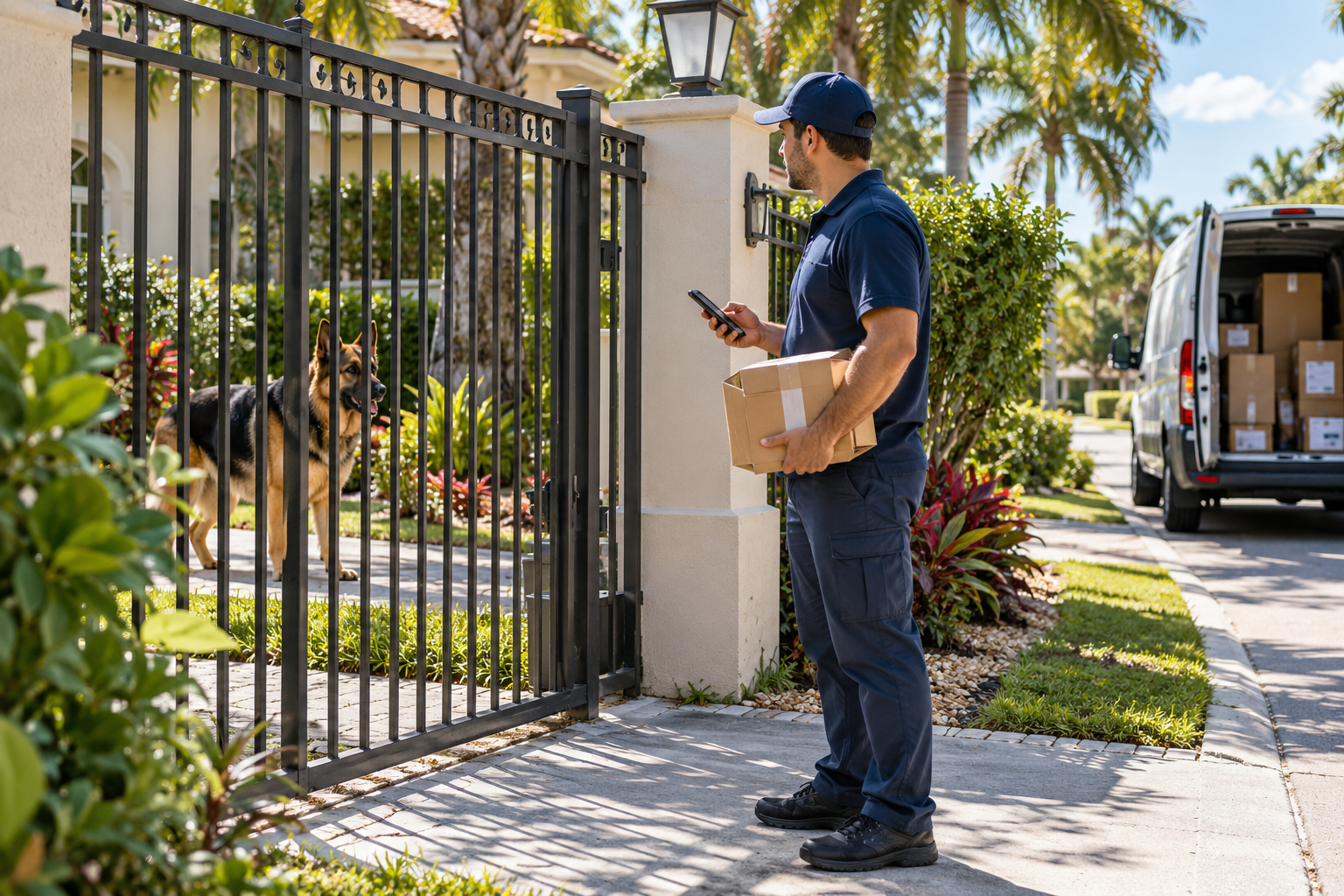
The Dog Bit You on a Delivery Route. Why Florida Law May Open Two Claims
The package is marked delivered. The driver turns toward the gate, a dog comes from the side yard, and the workday becomes an emergency-room visit. By that evening, two insurers may be involved: the employer’s workers’ compensation carrier and the dog owner’s liability insurer.
Those are not duplicate claims. They arise from different legal duties, cover different losses, and remain financially connected. A Florida employee bitten while making a delivery may be entitled to workers’ compensation benefits because the injury happened on the job, while also pursuing the dog owner or another responsible third party. The catch is that the workers’ compensation carrier may have reimbursement rights against the third-party recovery.
Understanding that relationship early can prevent a worker from missing a notice deadline, signing an incomplete release, or treating the dog-owner claim as though it were only a medical-bill dispute.
One bite can enter two legal systems
Florida workers’ compensation generally asks whether an employee suffered an injury arising out of and in the course of employment. A route driver, postal worker, utility employee, home-health worker, maintenance technician, or other employee injured while performing assigned work may have a claim through that system. Benefits can include authorized medical care and disability payments subject to the limits and requirements of Chapter 440.
The civil claim asks a different question: is a person outside the employment relationship legally responsible for the injury? In a delivery-route dog bite, that third party is often the dog owner. Florida Statutes section 767.04 generally makes a dog owner liable when the dog bites a person in a public place or a person who is lawfully on private property, regardless of the dog’s former viciousness or the owner’s prior knowledge.
Workers’ compensation does not ordinarily require proof that the employer caused the attack. The claim against the dog owner does not become a workers’ compensation claim merely because the victim was working. The same incident can therefore support both paths when the facts satisfy each law.
Employee status still matters. Some drivers and app-based workers are labeled independent contractors, and a label in an agreement does not always resolve coverage. The actual working relationship, the applicable policy, statutory exclusions, and any platform-provided benefits must be examined. A worker should not assume either that workers’ compensation exists or that the absence of it defeats the claim against the dog owner.
Why a delivery worker may be lawfully on the property
Section 767.04 addresses this issue directly. It says a person may be lawfully on private property when performing a duty imposed by Florida law or federal law or postal regulations, or when present by the owner’s express or implied invitation.
That language is especially important for a postal employee. It can also matter when a resident orders a package, meal, repair, inspection, or other service that requires a worker to approach the property. An expected delivery can support an implied invitation to use the ordinary route to the door or designated drop point.
But “lawfully present” is not a phrase to take for granted. The owner may dispute whether the worker entered a closed area, ignored a clear delivery instruction, opened a gate, or remained after being asked to leave. Location evidence can answer those arguments: the delivery instructions, route-app screen, scan location, GPS record, photographs, gate position, warning signs, doorbell video, and the exact place where the bite occurred.
A “Bad Dog” sign also does not end every claim. The statute describes a specific premises-based defense, includes exceptions, and preserves liability when the owner’s negligent act or omission proximately caused the injury. The sign’s wording, prominence, readability, location, and the conduct of both parties all matter. Tucker Law’s analysis of fault arguments after a Florida dog bite explains why a warning or allegation of provocation must be tested against the evidence rather than accepted as a complete answer.
The two claims measure losses differently
Workers’ compensation is a benefits system. It can pay for authorized treatment and a portion of qualifying wage loss, among other benefits, but it does not function like a civil damages verdict. A third-party injury claim can address losses that workers’ compensation does not fully pay, including the unpaid portion of earnings, future earning impairment, pain and suffering, scarring, disfigurement, emotional harm, and other proven damages.
That distinction matters in dog-bite cases. A puncture wound may heal quickly while nerve damage, infection, tendon injury, limited hand function, or visible scarring continues. A worker may also fall while retreating and sustain a fracture or head injury that is more disabling than the bite itself. The civil claim should not be valued only by adding the invoices that workers’ compensation paid.
The dog owner can raise comparative-fault arguments. Section 767.04 provides that negligence by the person bitten that proximately caused the incident reduces the owner’s liability by that person’s percentage of fault. Whether the worker teased the dog, disregarded an instruction, entered an unauthorized area, or instead followed the expected delivery route is therefore an evidence question with financial consequences.
The workers’ compensation lien connects the files
The law permits two claims, but it does not permit the same loss to be collected twice without accounting between them. Section 440.39 allows an injured employee to accept workers’ compensation benefits and pursue a remedy against a responsible third party at the same time. It also gives the employer or carrier subrogation and lien rights tied to benefits paid or to be paid.
In practical terms, the workers’ compensation carrier may seek reimbursement from a settlement or judgment against the dog owner. The calculation is not necessarily a dollar-for-dollar repayment of everything the carrier lists. The statute accounts for litigation costs and attorney’s fees and provides a method for reducing the carrier’s recovery when the employee proves that the third-party recovery did not represent the full value of the damages. The carrier, worker, and attorneys may also have notice and cooperation obligations.
This is why a quick liability-insurance settlement can create a problem. A release signed before the workers’ compensation interest is identified may close the claim against the dog owner while leaving an unresolved reimbursement demand. The settlement number should be evaluated only after confirming the workers’ compensation payments, any asserted lien, available liability limits, future treatment, and the value of uncompensated losses.
The clocks do not run together
A worker should report the incident immediately. Under section 440.185, an employee generally must advise the employer of a workplace injury within 30 days, subject to statutory exceptions. The Florida Department of Financial Services likewise advises injured workers to report an accident as soon as possible and no later than 30 days on its official reporting guidance.
The deadline for a civil case is different and can depend on the theory asserted. Florida Statutes section 95.11 generally provides two years for an action founded on negligence and four years for an action founded on statutory liability. A dog-bite complaint may include statutory and common-law theories with different elements. No injured worker should assume that the longer period applies to every possible defendant or every count. Evidence and insurance deadlines arrive much sooner in any event.
The employer’s accident report is not a substitute for an animal-control report, a liability-insurance notice, or preservation letters to people who control video. Each file needs its own attention.
The work phone may contain the best independent evidence
In a residential dog-bite case, the dog owner and the worker may be the only eyewitnesses. The delivery record can supply a neutral timeline. A route app may show the assigned address, customer instructions, arrival time, scan time, photograph, GPS coordinates, messages with dispatch, and when the worker left the route. Those records can prove why the worker was present and whether the delivery had been completed when the dog attacked.
Other proof can disappear quickly. Doorbell and security cameras overwrite footage. A gate can be repaired. A warning sign can be moved. Dispatch messages may become difficult to retrieve after the worker loses access to an app or device. Clothing may carry tears, blood, dirt, or bite marks that help reconstruct the event.
The dog’s history can also matter even though section 767.04 does not require proof of a prior vicious act. Earlier escapes, bites, lunges, complaints, animal-control contacts, or warnings may support separate negligence allegations, undermine a credibility defense, identify other witnesses, or affect insurance coverage. Prompt requests should seek the dog owner’s identifying information, vaccination information, homeowners or renters insurance, property-management records when relevant, and local animal-control records.
Medical documentation should identify every mechanism of injury, not just the most visible wound. If the worker fell, twisted a knee, struck a head, or injured a shoulder while shielding the face, those facts belong in the first medical history. Tucker Law’s guide on what to do after a Florida dog bite discusses immediate health and evidence steps in more detail.
Insurance may come from three different directions
The employer’s workers’ compensation carrier is one potential source. The dog owner’s homeowners, renters, umbrella, or other liability policy may be another. A delivery platform may also provide occupational-accident or other limited coverage, depending on the worker’s status and the terms in effect on the date of injury.
None should be assumed. Some property policies exclude certain animals, prior incidents, business activities, or dog liability altogether. A resident may not be the dog’s legal owner. The person controlling the property may be a tenant, while a landlord or property manager has separate duties involving a known dangerous dog or a defective gate. Each potential defendant requires a separate liability and coverage analysis.
Tucker Law’s Florida dog-bite practice page explains the firm’s work on injuries caused by dogs. The Personal Injury Information Center provides broader guidance on evidence, insurance, and damages.
Do not let one insurer define the whole injury
A delivery-route dog bite is a workplace event, an animal-liability event, and sometimes a premises event at the same time. Treating it as only one of those things can leave medical benefits unclaimed, damages uncompensated, evidence unpreserved, or a reimbursement issue unresolved.
The useful questions begin immediately: Was the worker an employee? Was the route assignment documented? Who owned and controlled the dog? Why was the worker on the property? Which policies were in force? What has workers’ compensation paid? What evidence will disappear first?
If a dog injured you while you were delivering packages, food, mail, supplies, or services in Florida, contact Tucker Law. The firm can evaluate the third-party injury claim, coordinate the insurance evidence, and help identify the workers’ compensation issues that must be addressed before any civil settlement is signed.