A Dog Knocked You Down but Never Bit You: Does Florida Law Still Apply?
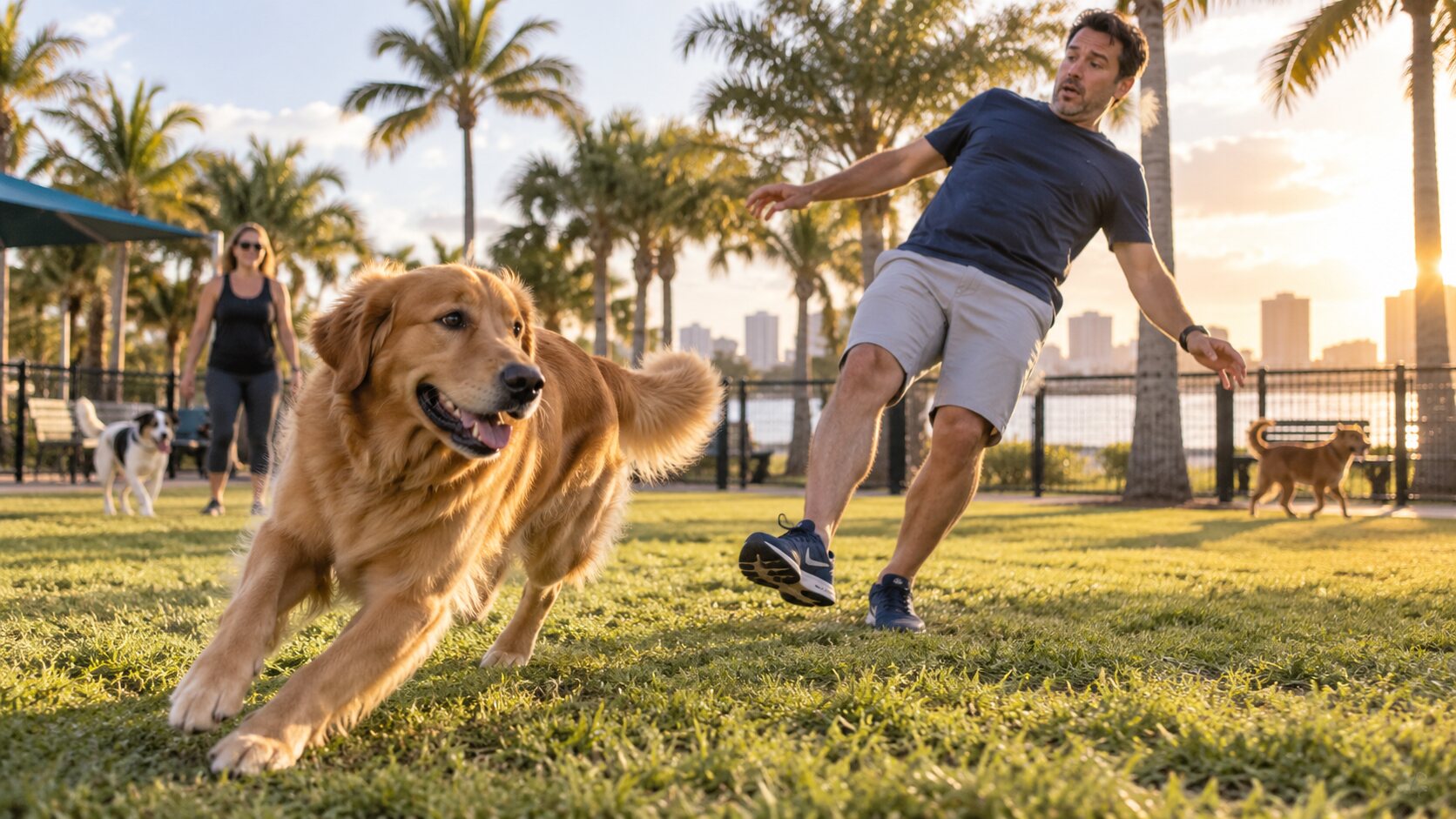
A large dog bolts across a park, clips the back of your knees, and sends you onto the pavement. There are no teeth marks. There may not even be a scratch from the dog. But the fall leaves a broken wrist, torn knee ligament, concussion, or hip fracture.
It is easy to assume that Florida’s dog-injury laws apply only when a dog bites. That assumption can cause an injured person to overlook a valid claim. Florida law uses two different statutes: one specifically addresses bites, while another addresses any damage done by a dog. A Florida appellate court has applied the broader statute to a collision in which a running dog knocked a person down and broke her leg.
The absence of a bite does not end the legal analysis. It changes the questions that must be asked.
Florida law separates dog bites from other dog-caused injuries
Florida Statutes section 767.04 is the familiar dog-bite law. It generally makes an owner liable when the owner’s dog bites someone in a public place or someone lawfully on private property, regardless of the dog’s previous viciousness or the owner’s knowledge of it. The statute also addresses comparative fault and a narrow warning-sign defense.
But a second law matters when no bite occurs. The current version of section 767.01 states that a dog owner is liable for any damage done by the owner’s dog to a person. That language is broader than biting. It can reach injuries caused when a dog jumps, chases, trips, pushes, or collides with someone.
The Florida Supreme Court explained the distinction decades ago in Sweet v. Josephson. The court recognized that the two statutes have separate fields of operation: section 767.04 governs injuries from bites, while section 767.01 reaches other damage caused by dogs. The court even observed that a friendly dog could cause an injury without biting—for example, by getting underfoot or knocking someone on a stairway.
This distinction matters because the central question is not merely, “Did the dog bite?” It is whether the dog caused the injury and what defenses the facts support.
The dog-park collision that tested the rule
Davison v. Berg shows how the broader statute works. Deborah Davison volunteered at a Humane Society dog park. While one dog chased other dogs, it collided with her. She suffered a broken leg and required extensive medical treatment. She sued the dog’s owner under section 767.01.
The trial court entered summary judgment for the owner, relying on dog-park rules, an “enter at your own risk” warning, and evidence that Davison understood the danger of fast-running dogs. The First District Court of Appeal reversed. In its March 22, 2018 opinion, the court described section 767.01 as a strict-liability statute that has been construed to make an owner effectively responsible for the dog’s conduct. It also held that general dog-park warnings were not equivalent to the specific statutory warning contemplated by Florida law.
The decision did not say Davison’s own conduct was irrelevant. Instead, the court held that awareness of the risk and other conduct could be considered as comparative negligence rather than operating as an automatic, complete bar at summary judgment. That distinction is important. A defense based on what the injured person saw or did may affect the value of a claim, but it does not necessarily erase the claim before the evidence is evaluated.
What counts as a dog-caused injury without a bite?
The clearest example is a physical collision, but the statute is not limited to one setting. A loose dog may chase a cyclist into traffic. A dog may jump on a visitor and cause a fall. A leash may wrap around a pedestrian’s ankle. Someone retreating from an advancing dog may fall down stairs or into another hazard. A child may be knocked from a bicycle, or an older adult may suffer a fracture after being pushed off balance.
These situations still require proof of causation. It is not enough that a dog happened to be nearby. The evidence must connect the dog’s movement or conduct to the injury. That issue becomes especially important when no bite wound physically identifies the animal or when the owner disputes what happened.
Depending on the location and the people involved, other legal theories may also matter. A property owner, landlord, business, animal handler, or caretaker is not automatically liable merely because a dog was present. Liability beyond the dog’s legal owner can depend on control, knowledge, a duty to act, and the specific negligence alleged. Those questions require a fact-sensitive analysis separate from the owner-liability statute.
A “Bad Dog” sign is not the same as a general warning
Florida’s statutes include a warning-sign defense in limited circumstances when an owner prominently displays an easily readable sign containing the words “Bad Dog” on the owner’s premises. The details matter: where the injury happened, what the sign actually said, whether it was prominent and readable, the injured person’s age, and whether the owner’s own negligent act or omission caused the harm.
Davison illustrates why a generic sign may not be enough. Rules stating that people entered a dog park at their own risk and prohibiting rough play did not provide the specific warning required by the statute. A defense based on signage therefore should not be accepted at face value without preserving photographs of the exact wording, size, placement, visibility, and condition of every sign at the scene.
If the incident occurred away from the dog owner’s premises—on a public sidewalk, in a common area, or at a park—the statutory premises-based sign defense raises a different set of questions. The location should be documented precisely.
The evidence disappears faster than the injury
Non-bite cases often depend more heavily on scene evidence than bite cases do. A hospital record may prove a fracture, but it may not prove which dog caused the fall or how the collision occurred. The useful proof is often created in the first minutes and days:
- photos or video of the dog, leash, gate, fence, signs, lighting, and exact fall location;
- names and contact information for the dog owner, handler, witnesses, property manager, or animal-control officer;
- nearby doorbell, business, parking-lot, or park surveillance footage;
- texts, social-media posts, incident reports, or admissions describing the dog’s behavior;
- records of earlier escapes, collisions, complaints, attacks, or animal-control contacts; and
- medical records that accurately document the mechanism of injury as well as every affected body part.
Video can be overwritten, witnesses can become difficult to locate, signs can be moved, and a broken latch can be repaired. A prompt preservation request may be necessary when a business, apartment community, homeowners’ association, or government entity controls relevant footage or records.
Medical documentation also matters. A person who lands on one hand may initially focus on a painful wrist and mention the shoulder or neck only later. Early evaluation protects health and creates a contemporaneous record. Unlike an auto-accident PIP claim, a dog-caused fall does not turn on Florida’s 14-day PIP treatment rule, but unexplained gaps in care can still invite arguments that the injury was minor or unrelated.
Who pays when the dog owner is a friend or neighbor?
Many dog injuries happen at a neighbor’s home, during a family visit, or in a shared residential area. Asking about a claim can feel personal. In practice, the available source of payment may be homeowners, renters, umbrella, commercial, or other liability insurance. Coverage is not automatic: policies may contain exclusions, special animal limitations, notice requirements, or disputes about who qualifies as an insured.
That makes early coverage investigation important. A claim should account not only for an emergency-room bill, but also for follow-up care, surgery, rehabilitation, lost income, reduced earning ability, pain, emotional effects, and lasting physical limitations when supported by the evidence. A person with a concussion or fracture should not have to guess about future care while an insurer pushes for a quick release.
Tucker Law’s Florida dog-injury practice page explains the firm’s work for people harmed by dogs. Readers dealing with an actual bite can also review our guides on fault arguments after a Florida dog bite and what to do after a dog bite. For a broader overview of injury claims, visit the Florida Personal Injury Information Center.
No bite does not mean no case
A dog can cause a serious injury without ever opening its mouth. Florida law recognizes that reality. The strongest claim will identify the correct owner, connect the dog’s conduct to the injury, preserve the scene evidence, address comparative-fault arguments, and locate every potentially applicable insurance policy.
If a dog knocked you down, chased you into danger, or otherwise caused an injury in Florida, Tucker Law can examine what happened and explain which statutes and insurance policies may apply. Contact Tucker Law for a case-specific evaluation before video or other evidence disappears.