The Driver Was Obviously Drunk. Why That Alone Usually Does Not Make a Florida Bar Liable
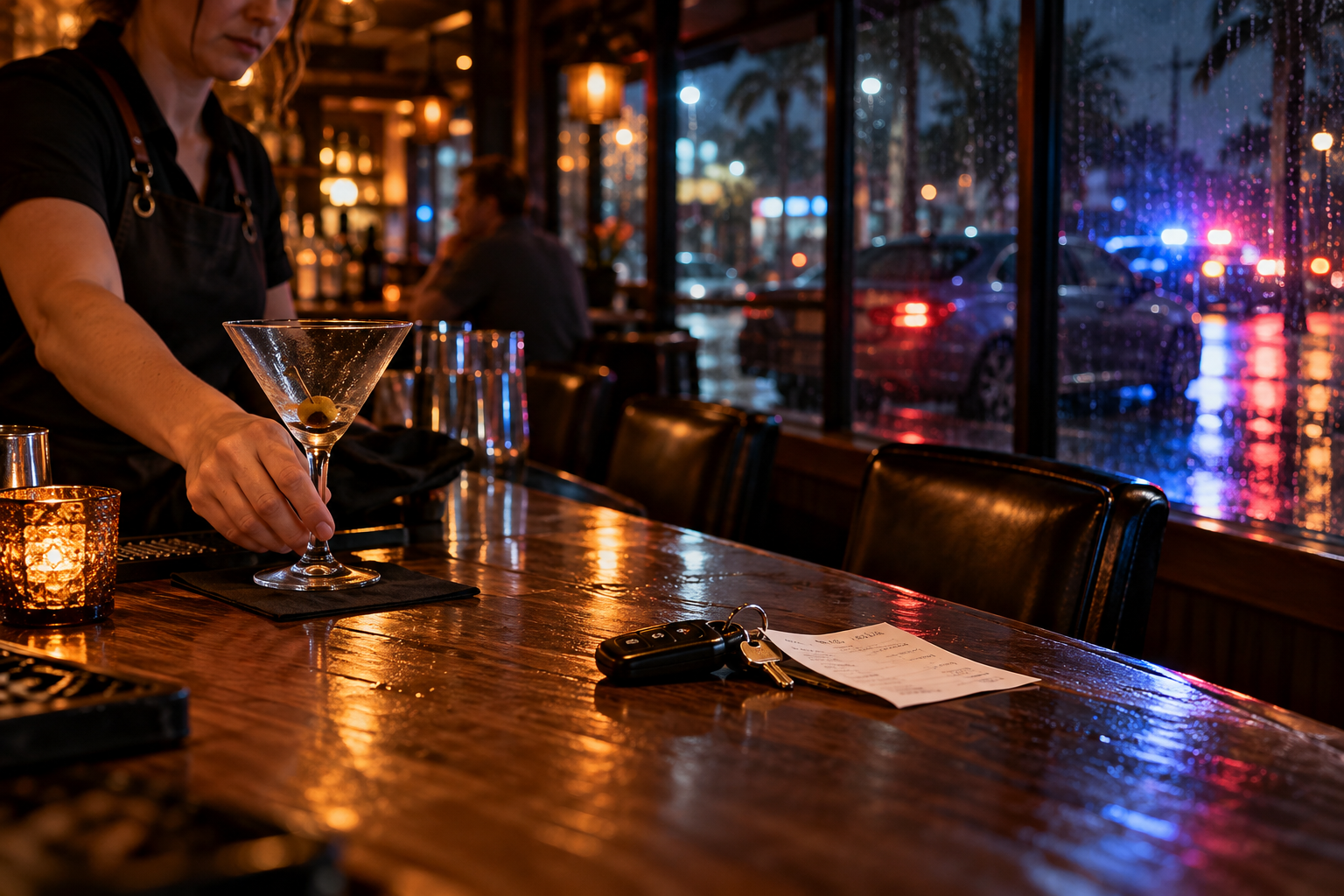
A bartender can watch a customer stumble, slur words, and order another round. Minutes later, that customer can cause a devastating crash. The facts may look like an obvious case against the bar. Under Florida law, however, “obviously drunk” is not itself a dram-shop exception.
Florida starts from a rule of vendor nonliability and then recognizes two narrow paths around it. That distinction matters after a drunk-driving collision because evidence of intoxication does not necessarily prove the fact the statute requires: either willful, unlawful service to someone under 21 or knowing service to a person habitually addicted to alcohol.
A recent appellate decision shows how specific that proof must be. In Sillaway v. Brandon Crossroads Bowl, Inc., issued August 12, 2026, uncertainty about who was driving became inseparable from the claim against the business that served the group. The case is a useful warning: identifying the intoxicated driver and preserving evidence of the establishment’s knowledge cannot wait.
Florida law begins with immunity, then creates two exceptions
Florida Statute § 768.125 says that a person who furnishes alcohol to someone of lawful drinking age generally is not liable for injury or damage caused by that person’s intoxication. The statute then creates two exceptions.
Willful and unlawful service to a person under 21
A seller or furnisher can face liability when it willfully and unlawfully provides alcohol to a person under the legal drinking age. Florida separately prohibits selling, giving, serving, or permitting service of alcohol to a person under 21 on licensed premises. The details of that rule and its identification-related defenses appear in Florida Statute § 562.11.
“Willfully” is important. This is not strict liability every time an underage person obtains a drink. Florida cases require proof directed to the defendant’s knowledge of the customer’s age, which may be established through the surrounding circumstances. An ignored ID problem, a server who knew the customer personally, or repeated service despite age-related warnings may matter very differently from a convincing fake ID presented during a single transaction.
Knowing service to a person habitually addicted to alcohol
The second exception applies when a seller or furnisher knowingly serves a person habitually addicted to alcoholic beverages. This is not the same as serving an adult who became extremely intoxicated that night. The issue is whether the customer had a habitual addiction and whether the defendant knew it.
The Florida Supreme Court explained in Ellis v. N.G.N. of Tampa, Inc. that knowledge can be shown through circumstantial evidence. A plaintiff does not necessarily need a written warning delivered to the bar or a criminal conviction identifying the patron as an alcoholic. A regular customer’s pattern, what employees observed over time, statements made to staff, and the volume and frequency of prior service may become part of the proof.
But a receipt showing many drinks on one occasion proves consumption, not automatically habitual addiction or the establishment’s prior knowledge. The evidence must connect the business to the statutory exception.
Why the identity of the driver changed the case in Sillaway
The crash in Sillaway followed a night in which three men drank heavily at a bowling alley. One man died and another was injured when their Ford F-250 crashed. A man found at the scene pleaded guilty to driving under the influence, and the original civil complaints treated him as the driver.
Years later, that man testified that he had been passed out in the truck bed and was not driving. The plaintiffs then tried to pursue claims based on allegations that one of the other men had driven and that the bowling alley knew those men were habitually addicted to alcohol.
The Second District Court of Appeal held that the newly framed claims did not relate back to the original complaints. The original theory depended on the establishment’s knowledge about one alleged driver; the later theory depended on its knowledge about a different alleged driver. That was not merely a corrected detail. It changed the core factual basis of the dram-shop claim. The court also noted the prejudice created by delay, including lost evidence and the death of a witness.
The decision did not announce a new third exception to Florida’s dram-shop statute. It instead illustrates why the adult-patron exception is person-specific. The claimant must identify the driver and prove that the establishment knowingly served that particular person while the person was habitually addicted.
The strongest evidence often belongs to someone else
After a serious alcohol-related crash, the injured person may have no idea where the driver had been drinking. Even when the location is known, the most useful evidence may sit in several different systems: the establishment’s point-of-sale records, itemized tabs, payment-card data, surveillance video, employee schedules, ID-scanning logs, loyalty records, prior incident reports, and witness accounts. Phone-location information, messages, photographs, and vehicle data can help establish the timeline outside the premises.
That evidence answers different questions. A timestamped tab may show what was purchased and when. Video may help identify who received the drinks. A server or regular patron may know whether the driver was a frequent customer. Prior interactions may bear on whether employees knew about habitual addiction. None of those records should be confused with proof of causation, but together they can reconstruct what happened and what the business knew.
Some records are routinely overwritten or discarded. That is why early preservation matters in any serious Florida car-accident claim. Tucker Law has also explained how quickly collision evidence can disappear. A targeted preservation demand can identify the customer, time window, transaction records, cameras, and electronic systems at issue before ordinary retention practices erase the trail.
The statutory exception is only part of the case
Establishing one of the two exceptions does not end the liability analysis. The plaintiff must still connect the unlawful service or knowing service to the intoxication that caused the injury. A claim can become complicated when the driver drank at multiple locations, consumed alcohol privately, or had other substances in the body. The timeline, toxicology evidence, receipts, witness testimony, and crash reconstruction may all bear on causation.
The conduct of other people can matter too. In Faircloth v. Main Street Entertainment, Inc., the Florida Supreme Court held that a claim under the underage-service exception is a negligence action for purposes of Florida’s comparative-fault statute, even though the dram-shop statute requires willful and unlawful service. The ruling allows fault to be allocated among responsible actors rather than treating the establishment’s conduct in isolation.
Under the current version of Florida Statute § 768.81, a person found more than 50 percent at fault for his or her own harm generally cannot recover damages in an ordinary negligence action, while a person at 50 percent or less may have damages reduced by the assigned percentage. How that rule applies depends on who is bringing the claim and the particular theories presented. Tucker Law’s discussion of shared fault after a Florida crash explains why the percentage is not an abstract detail.
A bar claim is not the same as a social-host claim
People often use “dram shop” loosely to describe anyone who supplied alcohol. Florida law is more exact. The Florida Supreme Court has rejected using § 768.125 to create a cause of action against a social host for furnishing alcohol to a minor in Bankston v. Brennan and for serving a known alcoholic in Dowell v. Gracewood Fruit Co.. A commercial alcohol-vendor claim should not be assumed to transfer unchanged to a private party.
That does not mean every claim involving a home, private event, employer, property owner, or independently negligent act has the same answer. It means the statutory dram-shop theory has defined boundaries, and the identity and conduct of each potential defendant must be analyzed separately.
“Everyone knew he was drunk” is the beginning of the investigation
Visible intoxication can be powerful evidence that continued service was dangerous. It may help establish a timeline, support witness credibility, or explain how a crash occurred. Standing alone, however, it does not replace either of Florida’s statutory exceptions.
For an underage driver, the investigation focuses on age, identification, service, knowledge, and causation. For an adult driver, it focuses on habitual addiction, the establishment’s knowledge of that condition, service to that specific person, and the causal connection to the injury. Sillaway adds a practical lesson: if the identity of the driver is uncertain, that question must be investigated before the evidence needed to prove the right theory disappears.
A drunk-driving crash can leave several people seriously injured or cause a death, making the legal and factual stakes unusually high. Tucker Law represents people pursuing Florida personal-injury claims and families evaluating wrongful-death claims. To discuss what the available evidence may show, contact Tucker Law before the establishment’s records and witness memories are lost.