The Defendant Blames Someone You Never Sued. Florida May Put Them on the Verdict Form
You sue the driver who hit you. The driver answers that a road contractor—not named in the case—created the dangerous condition. Or you sue a store after a fall, and the store says an outside cleaning company caused the spill. Or a trucking company argues that another motorist, who was never sued, set the collision in motion.
Florida law can allow that absent person or company to appear on the verdict form for purposes of allocating fault. Lawyers often call the nonparty a Fabre defendant, after the Florida Supreme Court decision that gave the doctrine its familiar name. But the label can make the rule sound easier than it is. A defendant cannot reduce its share of responsibility merely by pointing to an empty chair.
Under the current version of section 768.81, Florida Statutes, the defendant has procedural and evidentiary work to do: plead the nonparty’s fault, identify that nonparty as specifically as practicable, and prove by a preponderance of the evidence that the nonparty’s fault caused the plaintiff’s injuries.
That distinction can materially change a Florida injury case. The person whose name never appeared in the complaint may still determine how much of a verdict can actually be collected from the defendant who is in court.
A verdict can divide fault among people who are not all defendants
Florida’s comparative-fault statute directs the court, in a negligence action, to enter judgment against each liable party based on that party’s percentage of fault rather than joint and several liability. The same statute establishes the procedure for allocating fault to a nonparty.
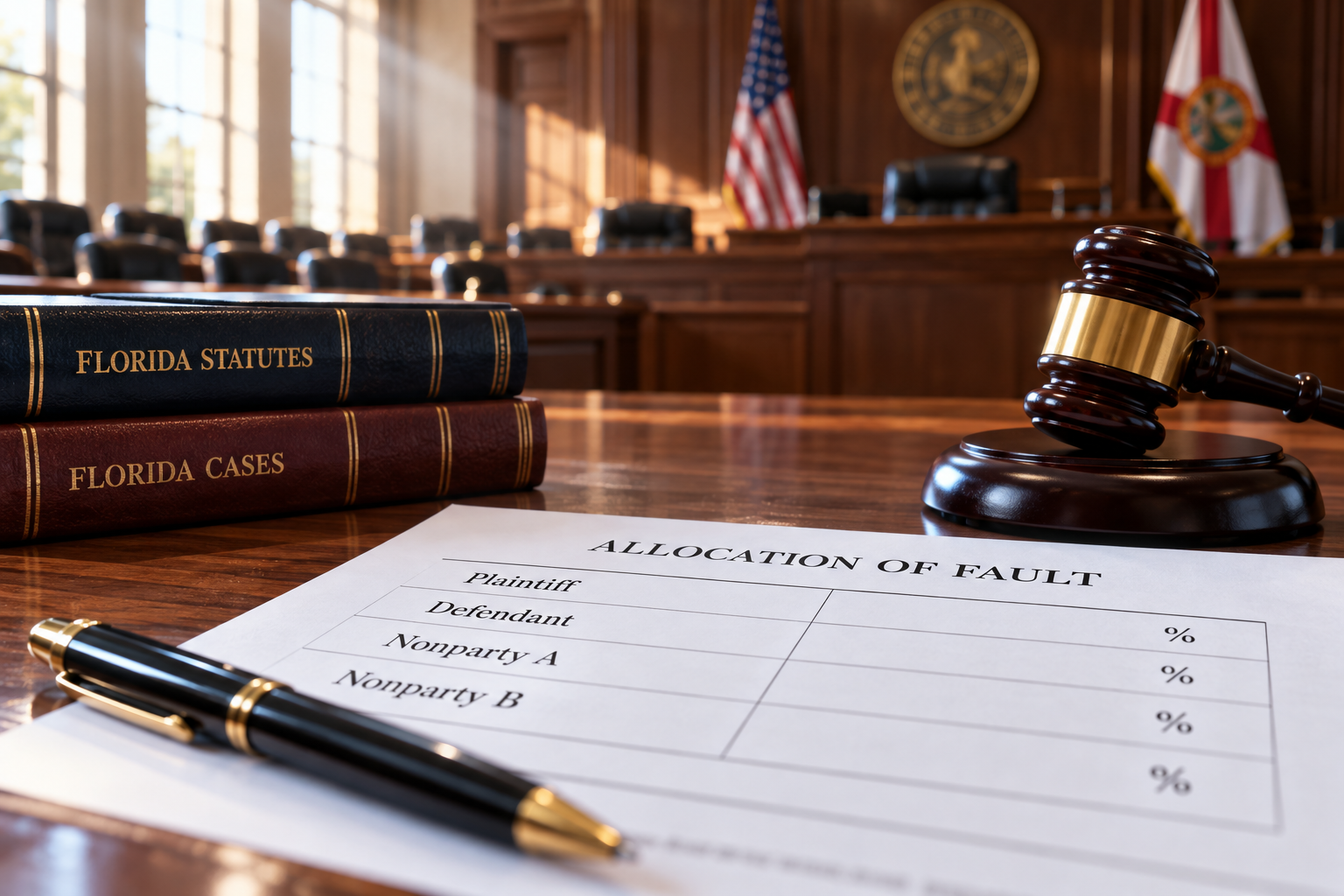
Suppose a jury finds $1 million in damages and assigns 60% of the fault to the defendant and 40% to a properly included nonparty. In a straightforward negligence case governed by section 768.81, the defendant’s judgment is generally tied to the defendant’s 60% share. The verdict does not transform the absent person into a judgment defendant. Instead, the nonparty percentage can reduce what the defendant in the lawsuit must pay.
That is why a nonparty-fault defense is more than a technical pleading issue. It can affect the economic value of the case even when the plaintiff proves that the named defendant was negligent.
Tucker Law’s Personal Injury Information Center explains the broader stages of a Florida injury claim, from investigation through litigation. Nonparty fault becomes especially important once the case moves beyond the basic question of whether the named defendant did something wrong and into the harder question of how responsibility should be divided.
The defendant has to identify the nonparty and plead the defense
Section 768.81(3)(a)1 requires a defendant seeking to allocate fault to a nonparty to affirmatively plead that fault. Absent good cause, the defendant must identify the nonparty if known, or describe the nonparty as specifically as practicable, when defenses are first presented. The statute allows amendment before trial in accordance with the Florida Rules of Civil Procedure, but it does not make nonparty allocation automatic.
That pleading requirement matters because it tells the plaintiff what theory must be investigated. If a property owner blames an outside maintenance contractor, the plaintiff may need the contract, work orders, employee testimony, inspection records, photographs, and communications between the owner and contractor. If a trucking company blames another motorist, the evidence may include dash-camera footage, event data, telematics, witness testimony, and physical evidence from the roadway.
In other words, the defense must identify a real theory of fault early enough for the parties to litigate it. A late-stage attempt to move responsibility to a vague or unidentified outsider can raise a very different issue from a properly pleaded nonparty defense supported by evidence.
Pleading a Fabre defendant is only the beginning
Even when the defense is pleaded, the nonparty does not automatically go on the verdict form. Section 768.81(3)(a)2 requires the defendant to prove the nonparty’s fault by a preponderance of the evidence before fault can be allocated to that nonparty.
The Fourth District illustrated that point in Jonathan’s Landing Property Owners Association, Inc. v. Schnurr. The defendant wanted a former developer placed on the verdict form in a premises case. The appellate court affirmed the exclusion of the developer because the evidence did not establish the duty necessary for premises liability. The developer had been out of the property’s ownership and control for decades before the incident.
The lesson is simple but important: blaming someone is not the same as proving that person was legally at fault. The defendant must establish the elements that would make the nonparty responsible for causing the injury.
That can be decisive in premises cases. A property owner may argue that a contractor created a hazard, but the contractor’s role, control, work scope, and actual conduct still have to be proven. Tucker Law’s Florida slip-and-fall practice page discusses the separate notice and premises-liability questions that often arise when an injury occurs on commercial property.
Bartley shows what happens when the defense is not actually tried
A more recent Second District decision underscores the procedural consequences. In Bartley Investments, Ltd. v. Menendez, decided December 19, 2025, the defendant sought a post-trial setoff based on settlements the plaintiff had reached with other defendants.
The Second District rejected that effort. The court explained that the defendant had not sought to place the settling entities on the verdict form as Fabre defendants, had not asserted their negligence as an affirmative defense, and had not presented evidence at trial that their negligence contributed to the injury. The jury therefore considered the liability of the remaining defendant, not an apportionment theory that had never been tried.
That decision demonstrates why a nonparty-fault defense must be developed as part of the liability case. A defendant cannot wait for the verdict, discover that the result is unfavorable, and then ask the court to retroactively assign a percentage to someone who was never properly put before the jury for allocation.
An absent nonparty can still matter even if the plaintiff cannot sue that person
Schnurr also notes an uncomfortable feature of Florida comparative-fault law: a nonparty may, in appropriate circumstances, be considered for allocation even if that person is immune from suit or a limitations period has run.
That can create a practical gap between responsibility and recovery. The jury may assign a percentage of fault to someone against whom the plaintiff cannot obtain a judgment in the pending case. The remaining defendant generally does not absorb that percentage merely because the nonparty cannot be made to pay.
This is one reason early investigation of every potentially responsible person or company matters. Identifying a contractor, vehicle owner, employer, maintenance vendor, property manager, manufacturer, or other actor after a filing deadline has passed can be much more consequential than simply discovering another witness.
In a motor-vehicle case, the investigation may require more than identifying the driver who received the citation. Tucker Law’s Florida car accident practice addresses the broader liability and insurance issues that can arise after a serious crash. Commercial cases can add another layer because a driver, motor carrier, maintenance provider, shipper, broker, vehicle owner, or other company may have separate roles in the events leading to the collision. Our truck accident practice focuses on those additional records and relationships.
The plaintiff’s own fault is a different part of the same statute
Nonparty fault should not be confused with fault assigned to the injured person. Both are addressed in section 768.81, but they operate differently.
Under subsection (6), in negligence actions to which the provision applies, a party found greater than 50% at fault for his or her own harm may not recover damages. The statute expressly excludes personal-injury and wrongful-death actions arising from medical negligence under chapter 766 from that greater-than-50% bar.
So a verdict can involve three separate questions at once: how much fault belongs to the plaintiff, how much belongs to the defendant, and whether a properly proven nonparty should receive a percentage. Those numbers are not interchangeable. The plaintiff’s percentage can trigger the current modified-comparative-fault rule; the nonparty’s percentage can reduce the share allocated to the named defendant.
That is why a case can become mathematically simple only after the factual and legal work is done.
Negligent-security cases now have a specific Florida statute
Negligent-security cases deserve special attention because the underlying injury is often caused by the intentional criminal act of a third person.
Section 768.0701, Florida Statutes, enacted in 2023 and still in the 2026 statutes, provides that notwithstanding section 768.81(4), when a person lawfully on commercial or real property sues the owner, lessor, operator, or manager for injuries caused by a third party’s criminal act, the factfinder must consider the fault of all persons who contributed to the injury.
That language matters because section 768.81(4) generally excludes actions based on intentional torts from the comparative-fault statute. Section 768.0701 creates a specific rule for this category of premises claim.
The practical consequence is that a negligent-security case may involve allocation questions about both the property defendant’s alleged negligence and the criminal actor’s conduct. That makes evidence of foreseeability, prior incidents, security practices, access control, lighting, warnings, surveillance, and the circumstances of the criminal act especially important.
The fight over a nonparty is usually a fight over evidence
At first glance, a Fabre defense can sound like a lawyer’s procedural maneuver. In a real injury case, it is usually an evidence problem.
If the defense says an unknown vehicle caused a crash and fled, is there video? Are there independent witnesses? Does physical damage support that sequence? If a store blames a cleaning company, who was contractually responsible for the area, when was the work performed, and what did the employees observe? If a property owner blames a prior owner or developer, did that entity have any duty or control when the accident happened? If a trucking company blames a third driver, do the electronic and physical records support the alleged maneuver?
The stronger the evidence connecting the nonparty to the injury, the stronger the allocation argument becomes. The weaker that connection, the more the defense risks becoming nothing more than an unsupported attempt to dilute responsibility.
Why this issue should be investigated before trial is anywhere close
Nonparty fault changes the litigation strategy on both sides. A plaintiff needs to know early who may be blamed, whether that person should be sued, what deadlines apply, and what evidence must be preserved. A defendant needs to plead the theory properly and develop admissible proof sufficient to earn a place for the nonparty on the verdict form.
Waiting until the pretrial conference can be expensive. Electronic data disappears, surveillance is overwritten, witnesses move, companies dissolve, contracts are archived, and limitations periods continue to run.
If you were seriously injured and another person, business, contractor, driver, or property entity may share responsibility, Tucker Law can evaluate the full chain of fault rather than treating the case as a two-person dispute. Contact Tucker Law to discuss the evidence, potential defendants, insurance coverage, and any nonparty-fault issues before they narrow the available recovery.
This article provides general information, not legal advice. Comparative fault, nonparty allocation, negligent security, immunity, settlements, and filing deadlines can produce different results depending on the claims, parties, dates, and evidence in a particular case.