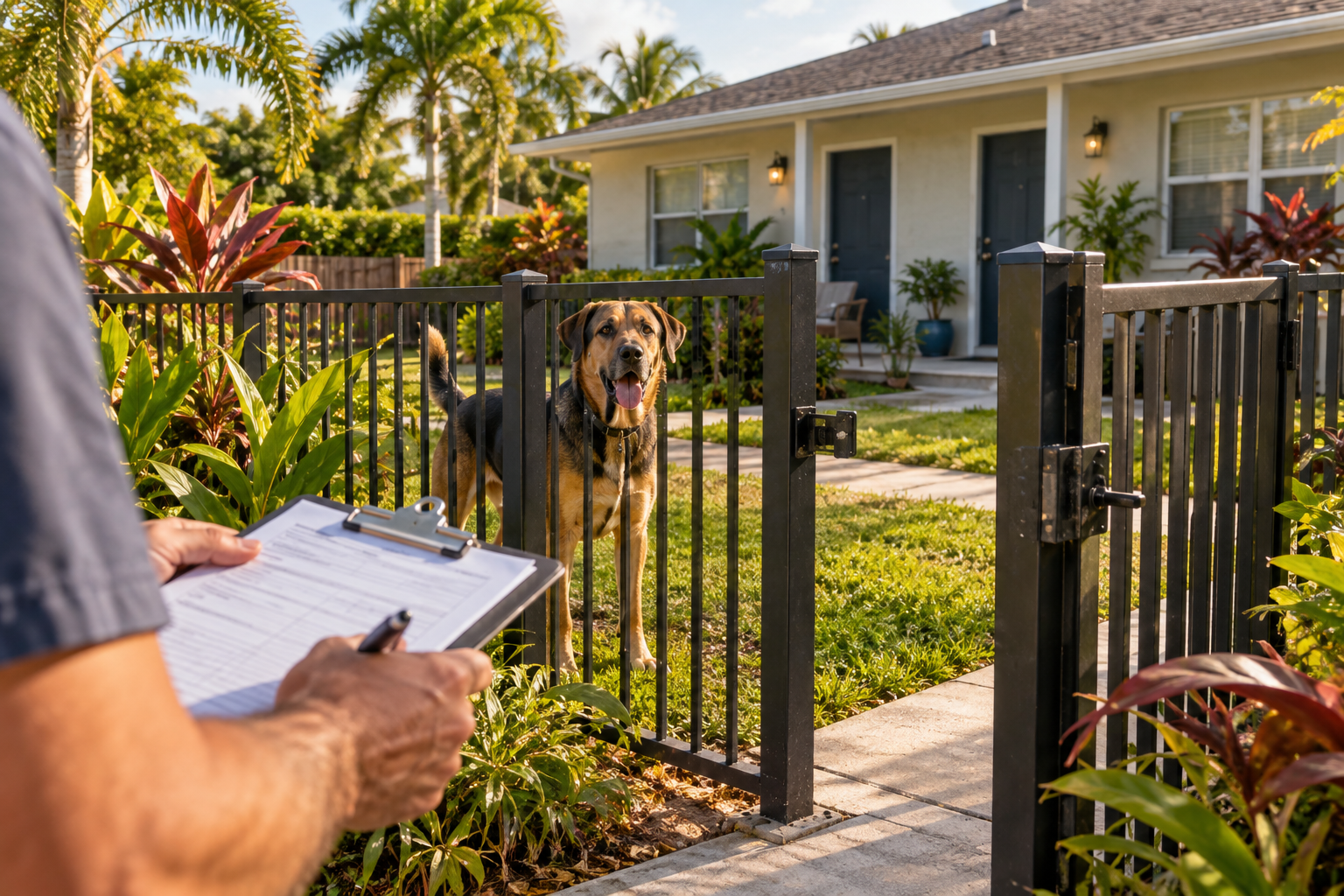
The Tenant’s Dog Escaped. When Can a Florida Landlord Be Liable?
A dog charges through a loose gate at a rental house and injures a neighbor, delivery driver, guest, or another tenant. The dog belongs to the tenant. The fence belongs to the property owner—or at least everyone assumes it does. Who is responsible?
Florida law does not treat the tenant and landlord as interchangeable defendants. The dog owner may face statutory liability for a bite even without advance warning that the dog was dangerous. A landlord who does not own the dog is judged under a different, narrower body of common law. For the landlord, the case often turns on what the landlord or property manager actually knew, what power they had to act, and exactly where the attack occurred.
Those questions are intensely factual. A lease, an animal-control file, a repair request, or a prior complaint can matter more than the label “landlord.”
The dog owner and the landlord do not start under the same rule
Florida Statutes section 767.04 makes a dog owner liable when the dog bites someone in a public place or while that person is lawfully in a private place, regardless of whether the dog had previously acted viciously or the owner knew of any danger. The statute also says that negligence by the person bitten can reduce the owner’s liability. It contains a limited “Bad Dog” sign provision, with exceptions, and preserves other statutory and common-law remedies.
That rule focuses on the owner of the dog. A landlord who neither owns nor keeps the animal is not automatically subject to the same statutory standard just because the attack began on rental property. Claims against a non-owner ordinarily depend on common-law negligence: Was there a legal duty, was it breached, and did that failure cause the injury?
This distinction affects the investigation from the first day. A strong Florida dog-bite claim may involve the tenant, the landlord, the property manager, or more than one of them—but the proof against each party is different.
For a landlord, knowledge and control usually travel together
Florida appellate courts have repeatedly examined two connected questions: Did the landlord know that a dangerous dog was present, and did the landlord have enough control to do something about it?
In Vasques v. Lopez, a child was attacked by a tenant’s pit bull. The Fourth District Court of Appeal held that a jury could find the landlord knew about the dangerous dog and had the ability to control the premises. The evidence included six “bad dog” signs, regular rent collection at the property, the landlord’s visits, and a week-to-week tenancy that could be terminated. Importantly, the court explained that actual knowledge may be proved through circumstantial evidence; it does not always require an admission from the landlord.
The decision does not make landlords insurers of every tenant’s conduct. Knowledge that a tenant owns a dog is not necessarily knowledge that the dog is dangerous. The useful evidence is more specific: prior bites or lunges, complaints from neighbors, warnings to management, animal-control contacts, repeated escapes, visible warning signs, or a manager’s personal observations.
Control is equally specific. A lease may prohibit certain animals, authorize management to demand removal, or permit termination for dangerous conduct. A landlord may retain control over a common yard, gate, walkway, or fence even when the tenant controls the inside of the home. On the other hand, a landlord with no notice and no practical or contractual ability to address the risk has a much stronger defense.
The doctrine remains active. In January 2025, Florida’s Third District Court of Appeal affirmed a judgment in Richman Three Lakes Development Partners, LLC v. Perez, citing the principle that a landlord has a duty to protect tenants in connection with a vicious dog of which the landlord has knowledge. The short opinion also cited authority allowing constructive knowledge of a dangerous condition to be shown when a condition occurred regularly and was therefore foreseeable. The precise route to proof still depends on the allegations and record in the individual case.
A shared fence can turn an animal case into a premises case too
Suppose management received repeated requests to repair a gate in a common backyard. The tenant’s dog had escaped before. The landlord promised to repair the latch but did not. When the dog escapes again and attacks someone, the analysis is no longer limited to who owned the animal. It also concerns who controlled the barrier, who was responsible for maintaining it, and who knew it was failing.
White v. Whitworth illustrates the point. A child was injured after a tenant’s pit bull entered the child’s apartment from a common backyard. There was evidence that the landlords knew about prior attacks, had assumed responsibility for making the premises safe, promised to remove the dog, and failed to provide a protective fence separating the tenants’ portions of the yard. The Fourth District held that a jury could decide whether the landlords acted reasonably.
The condition of a fence does not create automatic liability. A case can weaken if the tenant installed and exclusively controlled the barrier, if the defect arose moments before the incident, or if no one had reason to know the dog could escape. But a documented pattern of escapes plus unresolved repair requests can connect notice, control, and causation in a way that general statements about a dog’s temperament cannot.
Animal-control records may reveal the missing timeline
Florida’s current dangerous-dog law adds another potential source of proof. Under section 767.12, animal-control authorities investigate reported incidents that may support a dangerous-dog classification. The statute provides for sworn affidavits, notice, hearings, confinement requirements, warning signs, microchipping, and—after a final dangerous-dog classification—at least $100,000 in liability insurance.
A classification is not required before an injured person can bring a civil claim. Still, the underlying file may show when complaints were made, what the dog owner was told, where the dog was kept, whether the dog had been loose, and whether anyone notified the landlord or property manager. Local records may also identify prior calls that never resulted in a formal classification.
That is why evidence gathering should extend beyond photographs of the wound. The lease and pet addendum, management emails, rent-inspection notes, gate work orders, neighbor complaints, prior incident reports, animal-control records, and available camera footage may establish the notice timeline. Tucker Law’s Personal Injury Information Center explains how evidence and procedure shape an injury claim after the immediate emergency has passed.
The property line can change the legal duty
Where the attack happened may be as important as where the dog lived.
In Tran v. Bancroft, a tenant’s dog jumped a fence and attacked a neighbor on property the landlord did not own. Even accepting allegations that the landlord knew the dog was vicious, knew it might escape, and could control its presence, the Fourth District held that the landlord had no duty to prevent injury to a third party caused by the tenant’s dog away from the leased premises.
Compare that with a dog roaming a common apartment walkway, entering a co-tenant’s unit from a shared yard, or threatening people on a path controlled by management. The victim’s relationship to the property and the location of the danger can move the case into a different line of authority. It is not enough to say simply that the dog “came from a rental.” The scene must be mapped precisely: property boundary, gate, common area, path of escape, point of first contact, and place of injury.
The insurance questions also split
The tenant’s renters policy may cover animal liability, but some policies exclude particular animals, prior incidents, or dog claims altogether. A landlord’s premises or commercial liability policy may respond to a separate negligence claim involving management or property maintenance, yet coverage depends on the allegations and policy language. The existence of two possible defendants does not guarantee two sources of coverage.
This is also why a prior dog incident may affect more than liability. It may trigger policy exclusions, nonrenewal issues, or dangerous-dog insurance requirements. Tucker Law’s analysis of multiple bites and insurance “occurrences” in Maddox shows how the event sequence can change the amount of available coverage.
After an attack, preserve both the injury evidence and the property evidence
Emergency care comes first. Dog bites can involve infection, nerve or tendon damage, scarring, and reconstructive treatment. Falls during an attack can also cause fractures or head injuries even when the teeth do not cause the worst harm. Children may need treatment that continues long after the skin closes; Tucker Law’s guidance on injuries at another person’s home discusses why future care and insurance matter.
When it is safe, photographs should capture the injuries, clothing, fence, latch, warning signs, and the route the dog took. A report to local animal control can identify the dog and begin a public record. Witness names, doorbell video, security footage, and written repair requests should be preserved quickly. No one should trespass or put themselves in danger to collect evidence; formal preservation requests and public-records procedures can do work that an injured person should not attempt alone.
The right defendant depends on the facts behind the address
A tenant’s dog attack does not automatically become the landlord’s case. But neither does the word “tenant” end the inquiry. Florida law leaves room for landlord liability when evidence connects a known dangerous dog, meaningful control, and a failure to take reasonable precautions—especially where co-tenants or guests encounter the dog in areas the landlord controls.
The first questions should be concrete: Who owned the dog? Who controlled the gate? Who received the prior complaint? What did the lease permit management to do? Where did the attack actually occur?
If a tenant’s dog injured you or your child, contact Tucker Law for a review of the animal, property, insurance, and notice evidence. The earlier those pieces are identified, the less likely a repair record, surveillance clip, or witness account will disappear.