Your Spouse Was Hurt. Florida Law May Recognize What the Injury Took From Your Marriage.
A serious injury rarely stays confined to one person.
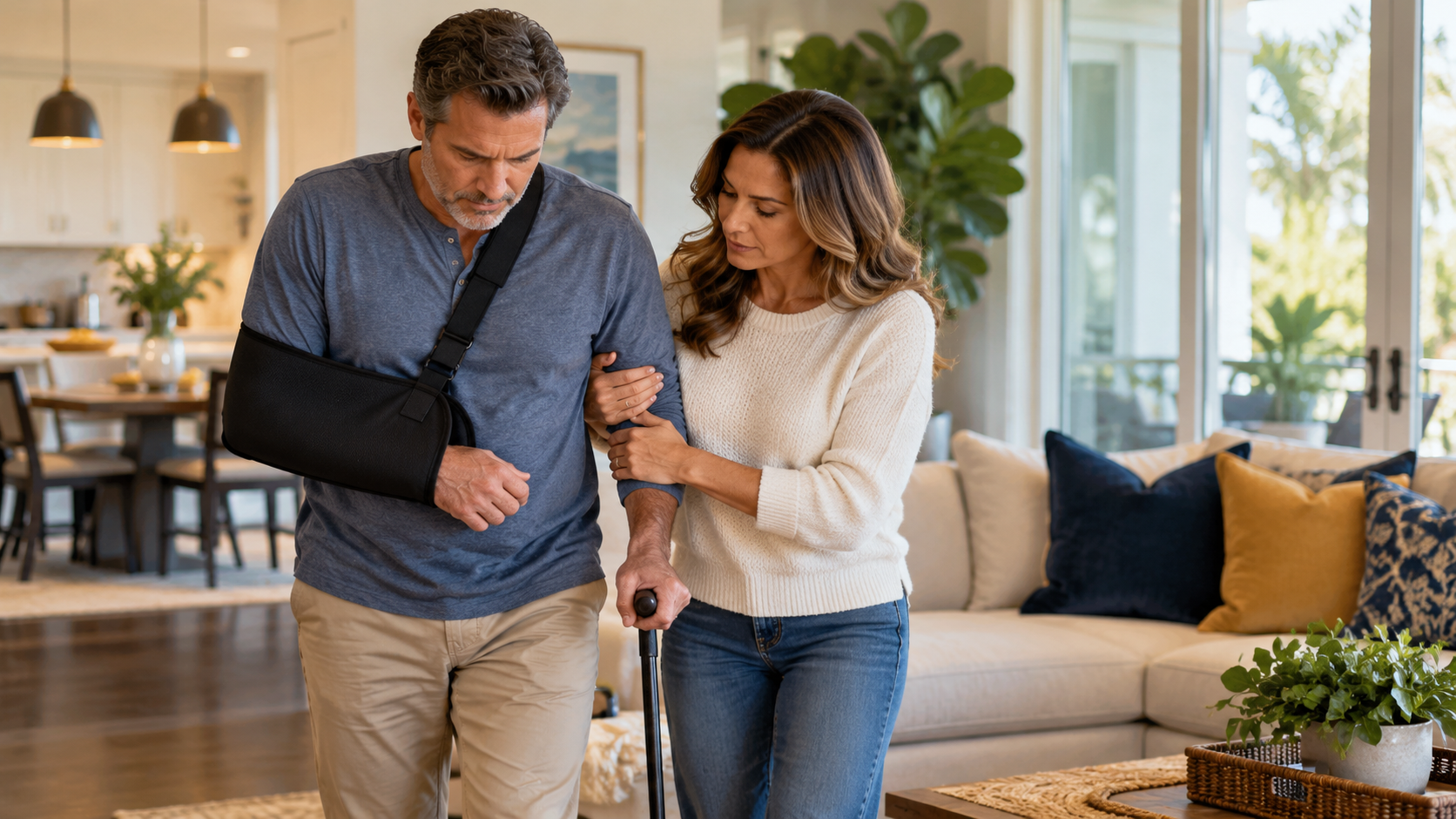
A spouse may become the driver, scheduler, caregiver, cook, and advocate. Weekend plans disappear. Physical affection changes. Sleep is interrupted. One partner may stop doing the household work the couple once divided without thinking about it. None of those losses appears on an MRI or hospital bill, but Florida law can recognize them.
Florida calls the spouse’s claim loss of consortium. It is a separate claim belonging to the non-injured spouse, although it depends on the injured spouse having a valid underlying claim against the defendant. That combination—separate, but derivative—is what makes consortium claims easy to misunderstand.
For families dealing with a major Florida personal injury, the practical question is not whether marriage was “affected” in the abstract. It is what the injury actually changed, whether Florida law recognizes those changes as compensable, and how the evidence proves them.
Florida recognizes injury to the marriage itself
The Florida Supreme Court’s leading decision is Gates v. Foley, decided in 1971. The Court rejected the idea that a spouse’s loss is limited to money or household labor. It described consortium broadly to include the companionship, cooperation, affection, comfort, society, assistance, and other incidents of married life that can be diminished when one spouse is seriously injured.
That concept remains reflected in Florida’s current civil jury instructions. The Florida Bar’s 2026 Standard Jury Instructions in Civil Cases tell jurors, when a consortium claim is properly before them, to consider the spouse’s loss of the injured partner’s services, comfort, society, and attentions.
The point is important: a consortium claim is not simply a second claim for the injured person’s pain and suffering. The injured spouse’s damages compensate the injured person. The consortium claim compensates the other spouse for a different injury—the effect of the physical injury on the marital relationship.
Separate claim, derivative liability
Gates also established the rule that a consortium claim is derivative. In ordinary terms, the non-injured spouse cannot recover against a defendant unless the injured spouse has a viable claim against that same defendant.
If a careless driver causes a collision and seriously injures a married passenger, the passenger may have a negligence claim and the spouse may have a derivative consortium claim. But if the evidence ultimately establishes that the defendant was not legally responsible for the injury, the consortium claim generally falls with the underlying case.
This matters in Florida car accident cases, premises cases, trucking crashes, and other negligence claims because defenses directed at liability or causation can affect both spouses. A dispute over whether the crash caused a lumbar injury, for example, may also determine whether the claimed changes in the marriage are legally attributable to that crash.
At the same time, “derivative” does not mean the spouse’s claim belongs to the injured person. In Metropolitan Dade County v. Reyes, the Florida Supreme Court explained that loss of consortium is a separate cause of action belonging to the spouse, even though it arises from injury to the married partner. That distinction can have procedural consequences, which is one reason the claim should be identified early rather than treated as an afterthought.
What does a jury actually evaluate?
Consortium damages are intensely fact-specific. There is no invoice for the value of a changed marriage and no chart that assigns a dollar amount to a spouse taking over bathing assistance, child care, driving, housework, or nighttime care.
The evidence instead builds a before-and-after picture.
Suppose a husband handled most of the cooking, grocery shopping, and outdoor work before a crash. After a spinal injury, he cannot stand long enough to cook, cannot safely lift groceries, and no longer manages the yard. His wife now performs those tasks while also helping him dress and get to medical appointments. The claim is not simply that she is “doing more.” The evidence can show specifically which services disappeared from the relationship and how long those changes are expected to continue.
Companionship is similar. A couple who regularly traveled, went boating, attended their children’s activities, exercised together, or simply had an active social routine may experience a very different marriage after a catastrophic injury. The strongest evidence is usually concrete: what they did before, what they can do now, how often the changes occur, and whether physicians expect the limitations to improve.
Physical intimacy can also be part of consortium, but it is not the entire claim. Florida law has never limited consortium to sexual relations. The broader marital relationship—care, affection, help, attention, companionship, and shared life—is central.
The evidence often comes from ordinary life, not expert testimony
Medical testimony is important because it explains the nature, severity, and likely duration of the injured spouse’s limitations. But a physician usually cannot describe what a marriage looked like on a Tuesday night before the crash.
That evidence often comes from the spouses themselves and from people who observed their life before and after the incident. A spouse can explain who handled school drop-offs, whether the couple shared hobbies, how responsibilities were divided, and what assistance is now necessary. Family members or close friends may be able to describe visible changes in activities and independence.
Contemporaneous records can matter too. Calendars, travel records, photographs, messages, household-service invoices, and records of missed events can help give the claim a real-world timeline. The goal is not to manufacture drama. It is to replace vague statements such as “everything changed” with facts a jury can understand.
That kind of factual detail is especially important after a catastrophic injury, where the effect on the household may continue for years.
A consortium claim can make private parts of the marriage relevant
There is a tradeoff. When a spouse asks for damages based on the condition of the marital relationship, the defense may investigate that relationship.
Questions may address household responsibilities, time spent together, physical intimacy, prior separations, counseling, preexisting medical problems, and other matters that bear on whether the claimed loss was actually caused by the incident. The proper scope depends on the facts and the governing discovery rules, but spouses should understand from the beginning that a consortium claim can open subjects that would otherwise have little relevance to the lawsuit.
That does not mean every private detail becomes fair game. Discovery still has legal limits. It does mean counsel should evaluate the value of the consortium claim together with the evidence necessary to prove it and the discovery issues it may create.
Florida generally requires the marriage to exist when the injury occurs
Another rule can produce harsh results. In an ordinary personal injury consortium claim, Florida generally requires the couple to have been legally married when the underlying injury occurred.
In Tremblay v. Carter, the Second District held that a woman who married an injured man after his accident could not recover loss-of-consortium damages, even though the couple had been dating before the accident and had discussed marriage. The court treated marriage at the time of injury as a prerequisite to the ordinary marital consortium claim.
That rule is distinct from Florida’s statutory wrongful-death framework, which has its own definitions and damages provisions. A serious injury claim should not be analyzed as though it were already a wrongful-death case.
Wrongful death uses a different legal structure
When an injury causes death, Florida’s Wrongful Death Act changes the framework. Under section 768.21, Florida Statutes, a surviving spouse may recover for loss of the decedent’s companionship and protection and for mental pain and suffering from the date of injury.
Those are statutory survivor damages pursued within the wrongful-death action, not simply a continuation of the ordinary personal-injury consortium count. Tucker Law’s article Who Receives Florida Wrongful-Death Damages? explains how survivor damages and estate damages are divided under the statute, and our wrongful death practice page addresses the broader claim.
The distinction matters because the plaintiff, beneficiaries, available damages, and procedural rules change when the injury results in death.
Children have a different and much narrower statutory claim
Florida also recognizes a separate statutory claim for certain children of an injured parent, but its requirements are much stricter than an ordinary spousal consortium claim.
Section 768.0415, Florida Statutes, applies when negligence causes a significant permanent injury to the natural or adoptive parent of an unmarried dependent and the injury results in permanent total disability. In that circumstance, the dependent may recover for permanent loss of services, comfort, companionship, and society.
That statute should not be confused with the ordinary spouse’s consortium claim. The family relationship may be similar, but the legal elements are not.
Why identifying the claim early matters
A consortium claim can be overlooked because the household changes gradually. During the first weeks after a crash, a spouse may simply do whatever is necessary. Months later, temporary help has become a permanent redistribution of the marriage.
Identifying the claim early allows the legal team to preserve the evidence that shows that transition. It also allows both spouses to understand that the claim is separate, to evaluate discovery implications, and to make sure any settlement discussion accounts for all legally recognized claims rather than only the injured person’s medical bills and pain.
The broader Tucker Law Personal Injury Information Center explains other parts of Florida injury claims, including medical evidence, damages, insurance, and litigation.
If your spouse suffered a serious Florida injury and your marriage has absorbed the consequences, contact Tucker Law. We can evaluate the underlying injury claim and whether Florida law recognizes a separate consortium claim based on what the injury actually changed in your family.
This article provides general information, not legal advice. Loss-of-consortium issues depend on the relationship, timing, underlying cause of action, defenses, and procedural posture of the particular case.