Two Pool-Area Injuries, Two Outcomes: Florida’s Open-and-Obvious Rule
Two guests are injured near Florida pools. One suffers burns so severe that part of his foot is amputated. The other trips where a sidewalk meets a pool-area ramp. Both conditions can be seen. Yet one lawsuit ends at the pleading stage, while the other survives summary judgment.
The different outcomes show why “open and obvious” is not a universal answer in a Florida premises-liability case. The words describe what a visitor could perceive, but the legal analysis also asks what the condition was, whether it was inherently dangerous, which duty the owner allegedly breached, and what evidence supports the claim.
A new Third District Court of Appeal decision, Lekas v. Dezer Properties, LLC, draws the defense side of that line. A 2025 Fifth District decision involving another hotel pool area, Sutley v. The Ocean Trillium Suites, Inc., shows why visibility alone does not always eliminate a property owner’s maintenance duty.
A catastrophic injury did not create a legal duty in Lekas
According to the September 2, 2026 opinion, Theoharis Lekas stayed at the Trump International Beach Resort in Sunny Isles in August 2022. He walked and stood barefoot on the resort’s cement pool deck and private beach sand while daily temperatures were approximately 95 degrees. Lekas had diabetic neuropathy and did not feel the heat beneath his feet. After noticing peeling skin, his condition worsened and ultimately required two hospitalizations and a partial foot amputation.
Lekas sued entities involved in owning, developing, or operating the resort. The trial court dismissed his negligence claim with prejudice, and the Third District affirmed. The appellate court held that the resort owed no duty to warn or protect him from the sun-heated concrete and sand under the circumstances alleged.
The severity of the harm did not drive the duty analysis. The court characterized cement pool decks and sandy beaches as common features of Florida life that are not inherently dangerous. Even assuming the heat created danger, the court concluded that it was so open and obvious that an invitee could reasonably be expected to discover it and protect himself.
Lekas argued that his diabetic neuropathy kept him from perceiving the heat and created a special duty. The court rejected that argument. His medical condition did not transform the ordinary surfaces into dangerous conditions or impose a new duty on the landowner on the pleaded facts.
Sutley reached the opposite result at another hotel pool area
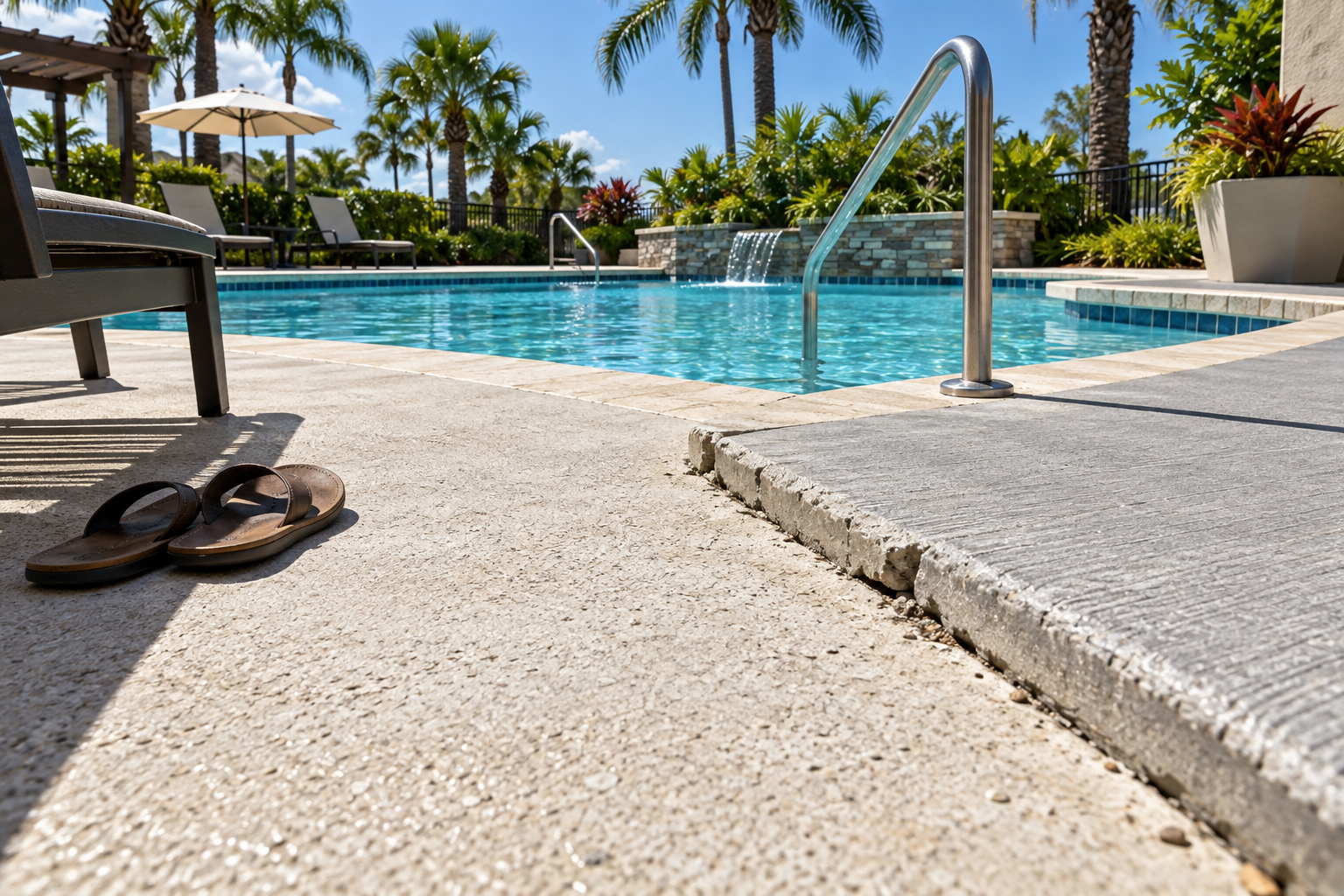
Sutley involved a trip where a sidewalk met the ramp leading to a hotel pool area. The trial court entered summary judgment for the hotel after finding that the abrupt elevation change was open and obvious. The Fifth District reversed on November 7, 2025.
The claimant had presented expert testimony that the elevation change violated the building code. The appellate court held that an open and obvious condition does not by itself discharge a property owner’s separate duty to maintain the premises in a reasonably safe condition. The code-violation opinion supplied prima facie evidence of negligence and created a sufficient factual dispute to prevent summary judgment.
The contrast with Lekas is sharp. Both accidents arose near hotel pools, and both involved conditions a visitor potentially could observe. But Sutley involved evidence that the physical transition in a walking surface was defective and violated a governing safety standard. Lekas involved ordinary concrete and sand made hot by the Florida summer sun, with no alleged physical defect that the court regarded as inherently dangerous.
Florida landowners owe invitees two distinct duties
A business generally owes an invitee a duty to use reasonable care in maintaining its property and a duty to warn about concealed dangers that the owner knows or should know about but the visitor cannot discover through reasonable care. The two duties overlap in everyday conversation, but they are legally distinct.
An open condition ordinarily eliminates the need for a warning because the visitor can perceive the same condition a warning would identify. The maintenance question can remain. A visible broken stair, code-violating change in elevation, or damaged walkway may still require correction if it is genuinely dangerous and the owner should anticipate that guests will encounter it.
There is an outer limit. Florida courts recognize that some conditions are so common, ordinary, and innocuous that they are not dangerous conditions as a matter of law. When a court places a condition in that category, the claim can fail because there is no breach of either duty—not simply because the visitor should have watched more carefully. The Fifth District applied that principle to a minor public-sidewalk misalignment in Jackson v. Florida Department of Transportation. The Third District applied it to naturally sun-heated pool concrete and beach sand in Lekas.
This is why the shorthand “you could see it, so you have no case” is incomplete. The court must identify the duty at issue and determine whether the condition was merely visible, visibly dangerous but still unreasonably maintained, or so ordinary that it created no actionable danger at all.
The procedural stage can change what the court is allowed to consider
Lekas arose from a motion to dismiss. At that stage, the question was whether the complaint’s allegations established a legal duty and stated a viable claim. The court concluded they did not. Sutley arose from summary judgment after the claimant produced an expert opinion connecting the elevation change to a building-code violation.
That difference does not explain away the substantive holdings, but it does matter. A complaint must allege facts showing why the condition created a legally recognized risk. Later, the claimant must produce admissible evidence supporting those allegations. Photographs, measurements, contemporaneous video, maintenance records, code provisions, prior complaints, and a properly grounded expert opinion can move a case from general description to provable defect.
The connection between the standard and the property is critical. In Sutley, the cited building code applied to the hotel walkway and the expert’s testimony supported the claim. In Jackson, the expert tried to apply building-code provisions to a public right-of-way sidewalk that was not connected to a building. The Fifth District held the code inapplicable and affirmed summary judgment. An impressive-sounding standard does not help if it does not govern the place or condition at issue.
What Lekas does—and does not—decide about pool injuries
The new opinion does not establish that Florida resorts are immune whenever someone is injured at a pool or beach. Its holding addresses ordinary cement and sand heated naturally by the summer sun on the specific facts pleaded. It did not decide a case involving defective decking, a broken drain, unsafe chemicals, faulty equipment, a hidden change in elevation, a code violation, or another hazard created or worsened by the property’s operation.
Tucker Law’s article on swimming-pool accidents and Florida premises liability discusses several other ways pool injuries can occur. The firm’s Florida slip-and-fall practice page also explains claims involving unsafe walking surfaces. Those situations still require a condition-specific analysis rather than a rule based only on the location of the accident.
The opinion also should not be read as saying a person’s medical vulnerability is irrelevant to every issue in an injury case. In Lekas, the neuropathy did not create a special premises duty or turn ordinary sun-heated surfaces into a legally dangerous condition. Different facts—such as a property owner’s undertaking to provide assistance or a hazard not reasonably apparent to the visitor—would require their own analysis. The court did not decide those hypothetical cases.
Comparative fault begins only after an actionable duty and breach exist
Florida’s current comparative-fault statute can reduce an award when an injured person shares responsibility. Under section 768.81, fault attributable to the claimant proportionally reduces damages, and a claimant found more than 50 percent at fault generally cannot recover in covered negligence actions.
But comparative fault is not the same as the no-duty conclusion in Lekas. If a property owner owed no duty regarding the condition, there is no negligence to compare. If a dangerous condition implicates the continuing maintenance duty, the visitor’s ability to see or avoid it may instead become part of the fault allocation. Keeping those concepts separate prevents “open and obvious” from becoming a catch-all slogan.
Evidence at the property can disappear long before the legal issue is clear
Someone injured at a hotel, resort, apartment complex, or store may not know whether the claim will turn on warning, maintenance, code compliance, notice, or comparative fault. That is precisely why prompt documentation matters. A changed surface may be repaired. Surveillance may be overwritten. Signs can be moved, weather changes, and employees’ memories fade.
Useful evidence often includes wide and close photographs showing the condition in context, video of the approach path, measurements, footwear, incident reports, witness information, and records identifying who controlled inspection and repair. Medical documentation should explain the injury and its timing without exaggerating what the property evidence can prove. Tucker Law’s Personal Injury Information Center provides broader guidance about evidence and the progression of Florida injury claims.
Deadlines also make delay risky. The 2026 version of Florida Statutes section 95.11 generally provides a two-year limitations period for negligence actions, although accrual questions, defendants, and claim-specific rules can affect the calculation.
The right question is what made this condition legally dangerous
A devastating injury can occur without a legally actionable hazard, as Lekas demonstrates. A visible condition can also remain actionable when evidence shows an unsafe defect within the owner’s maintenance responsibility, as Sutley demonstrates. The difference is not sympathy, and it is not visibility alone. It is the relationship among duty, the nature of the condition, the governing safety standard, and the available evidence.
If you were seriously hurt at a Florida hotel, resort, pool, or other business property, Tucker Law can investigate the condition before critical evidence disappears. Learn more about the firm’s Florida personal injury practice or contact Tucker Law for a confidential case review. Every case depends on its own facts, and prior results do not guarantee a similar outcome.