No Police Report After a Florida Car Accident? What to Do Next
A no police report car accident can leave you wondering whether an insurance or injury claim is still possible. A report can be useful, but it is not the only evidence that proves how a crash happened. Photos, witness information, medical records, vehicle damage, electronic data, and the parties’ statements may all help establish the facts.
The best response is to create a reliable record as soon as possible. These eight steps can help after a Florida collision when an officer did not prepare a report.
1. Make sure everyone is safe
Move to a safe location if the vehicles can be moved and it is safe to do so. Call 911 when someone is hurt, complains of pain, appears disoriented, or when a vehicle creates a road hazard. Emergency care comes before claim documentation.
Some injuries are not obvious at the scene. Adrenaline can mask pain, and neck, back, or head symptoms may become clearer later. If symptoms appear or worsen, seek appropriate medical attention.
2. Understand that Florida has reporting rules
Whether law enforcement must investigate depends on the circumstances. Florida law calls for a long-form report for crashes involving death, personal injury, complaints of pain, certain serious violations, a vehicle that must be removed by a wrecker, or a commercial motor vehicle. The statute also addresses written reports for crashes that do not require a law-enforcement report.
Read the current requirements in Florida Statute § 316.066. If you are unsure whether a report is required, contact the appropriate law-enforcement agency or obtain legal advice promptly. Do not assume that a no police report car accident means no reporting duty exists.
3. Photograph the entire scene
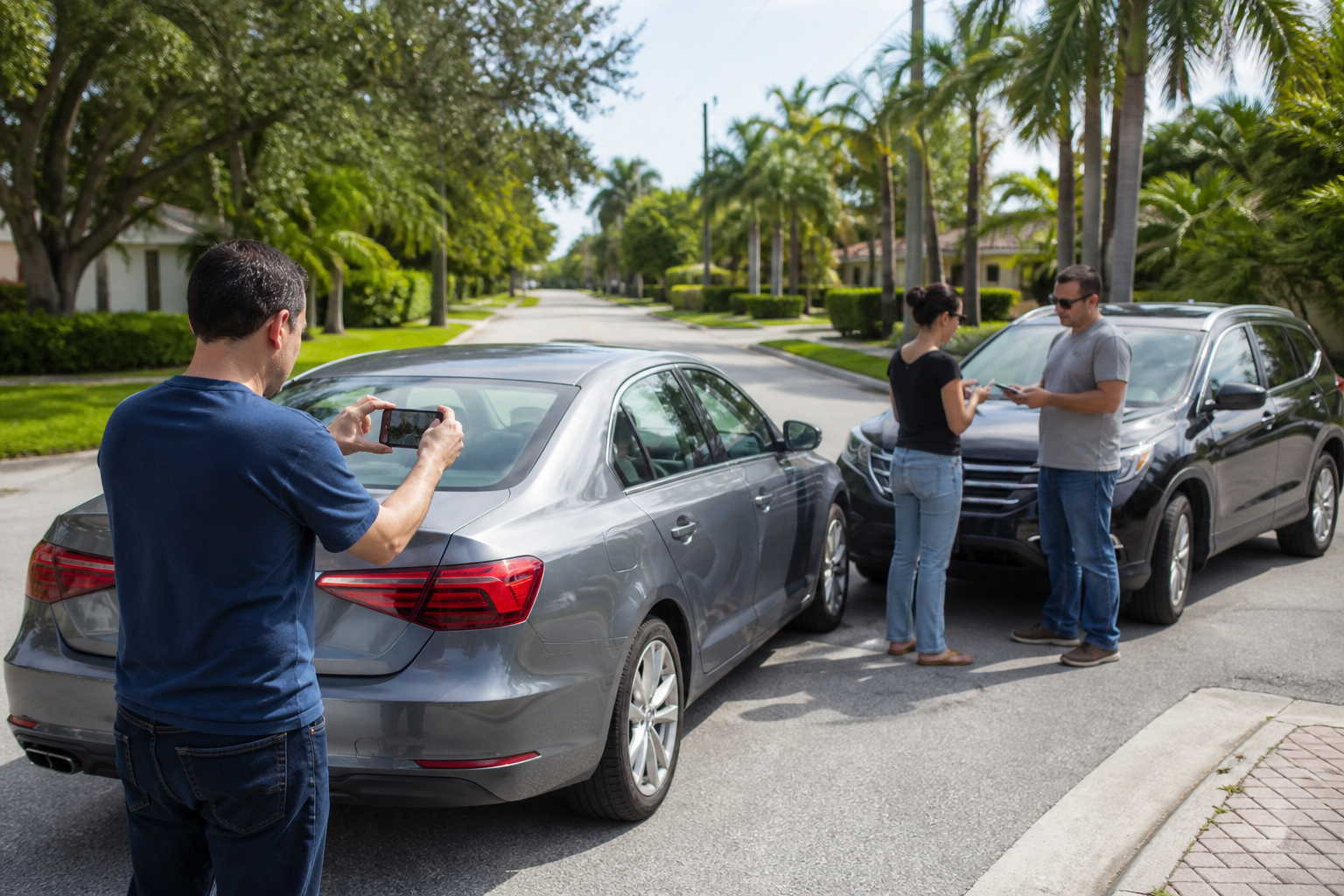
Take wide and close photographs before vehicles are repaired. Capture the resting positions, damage to every vehicle, debris, skid or tire marks, traffic signals, lane markings, signs, lighting, weather, and nearby businesses or homes that may have cameras. Photograph visible injuries as they develop, while respecting privacy.
Save the original files. Avoid editing, cropping, filtering, or posting them publicly. Original metadata may help show when and where the images were taken.
4. Exchange complete information
- Driver names, addresses, phone numbers, and email addresses
- Driver’s-license information
- Vehicle owner information when different from the driver
- License plate numbers and vehicle descriptions
- Insurance company names and policy numbers
- Employer or business information if a driver was working
Photograph insurance cards and licenses with permission, then confirm that the images are readable. A simple license-plate photo alone is rarely enough.
5. Find independent witnesses and video
Ask witnesses for their names and contact information. Record a short note about what each person observed. Nearby doorbell cameras, storefront systems, parking-lot cameras, buses, and dash cameras may have recorded the collision, but footage can be overwritten quickly. Identify each possible source and request preservation without delay.
If the other driver later changes the story, independent evidence can be especially valuable. A no police report car accident often turns on the documentation created by the people who were present.
6. Notify the appropriate insurers
Report the collision to your own insurer according to the policy requirements, even when you believe another driver caused it. Provide accurate basic facts, but do not guess about speeds, distances, injuries, or fault. If an adjuster asks for a recorded statement, medical authorization, or quick release, understand the request before agreeing.
Florida’s no-fault system may make your own personal injury protection coverage relevant to initial medical expenses. Under current Florida Statute § 627.736, initial services and care generally must occur within 14 days for PIP medical benefits.
7. Document injuries and treatment
Tell each provider exactly how the crash occurred, when symptoms began, and how they affect daily activities. Attend recommended follow-up visits and keep bills, receipts, work notes, and mileage records. Our guide to writing a pain journal after an accident explains how to record symptoms without exaggeration.
Passengers should document the same details and gather insurance information for every involved vehicle. They can also review our article on whether a passenger can file an injury claim after a Florida car accident.
8. Avoid common mistakes
- Do not rely on a verbal promise that the other driver will pay later.
- Do not repair or dispose of the vehicle before documenting it.
- Do not post accident details or activity photos publicly.
- Do not sign a release before understanding whether treatment is complete.
- Do not delay while possible video and witness memories disappear.
Can you still prove fault without a report?
Yes, depending on the evidence. A police report is not a final judicial decision about civil liability. Likewise, the absence of a report does not establish that no one was hurt or that both drivers were equally responsible. Insurers and lawyers examine the full record, including physical evidence, testimony, medical history, and vehicle data.
A prompt, consistent account is important. Write down what you remember while it is fresh, but do not fill gaps with assumptions. If a fact is unknown, say so.
Get help after a no-report crash
A no police report car accident can become more difficult as evidence disappears. Tucker Law can review the reporting issue, insurance coverage, injuries, and available proof. Visit our personal injury practice areas or contact Tucker Law for a case-specific discussion.
This article provides general information, not legal advice. Reporting duties, deadlines, coverage, and claim options depend on the facts and current law.