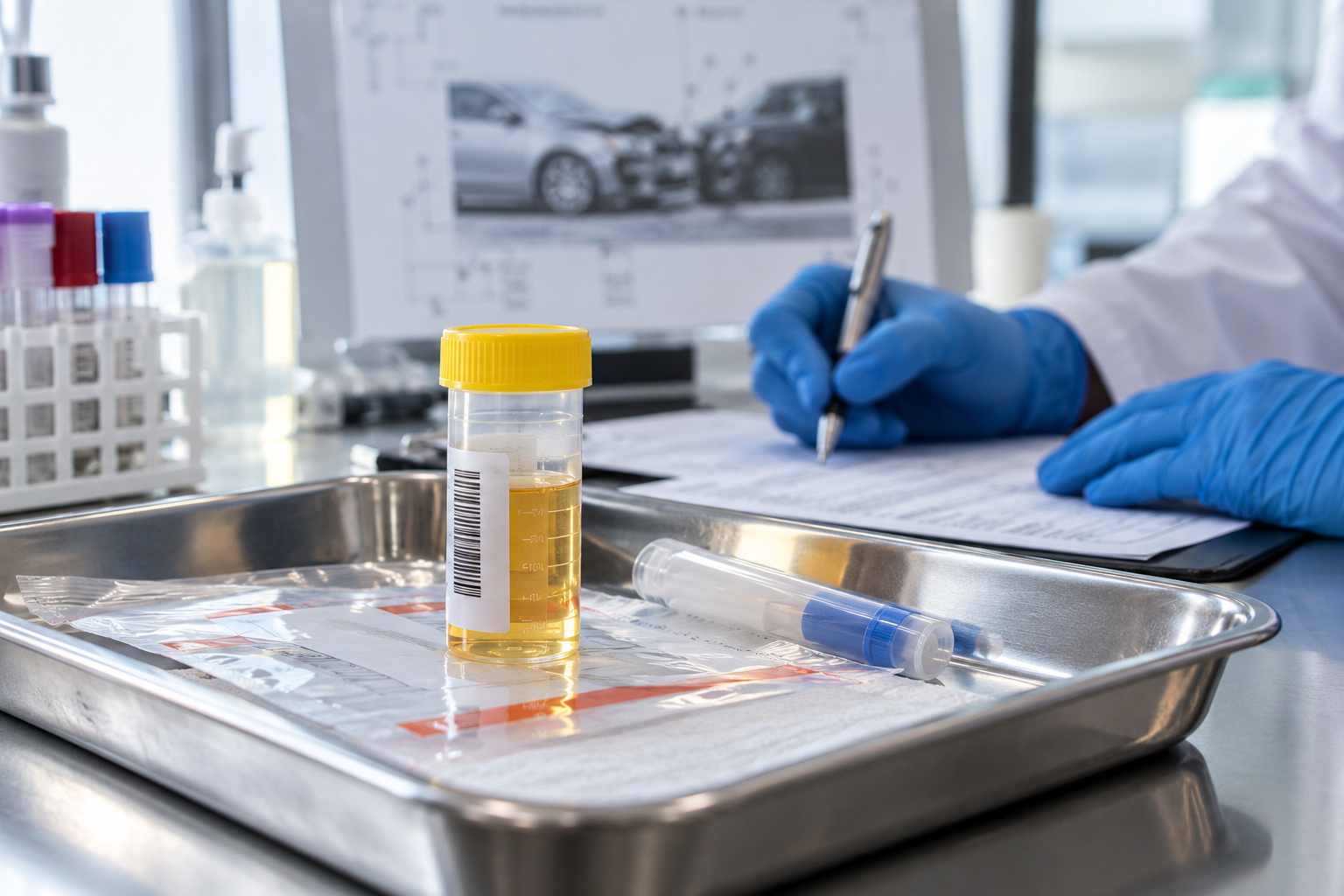
A Positive Toxicology Test Is Evidence, Not a Verdict in a Florida Injury Case
The number 0.08 attracts too much attention.
After a Florida crash or fall, an insurer may obtain an emergency-room toxicology result and treat it as the end of the claim. A blood-alcohol concentration at or above 0.08 can be important. A positive screen for a controlled substance can be important too. But neither result answers the entire civil-liability question.
Florida has a specific alcohol-or-drug defense. It can eliminate a plaintiff’s recovery, but only if the factfinder makes two connected findings. First comes intoxication or impairment. Second comes causation: the influence of the substance must have made the plaintiff more than 50% responsible for the plaintiff’s own harm.
The word because separates evidence from a complete defense.
Florida’s statute has two gates
Florida Statute section 768.36 applies in “any civil action” seeking damages for personal injury or property loss. Under the first part of the statute, the plaintiff must have been under the influence of alcohol or a covered drug to the extent that normal faculties were impaired, or the plaintiff must have had a blood- or breath-alcohol level of at least 0.08.
For alcohol, that creates two possible routes through the first gate. A result of 0.08 or higher satisfies the statute’s numerical alternative. A lower result does not necessarily end the issue if other evidence proves that the person’s normal faculties were impaired. For drugs, section 768.36 supplies no numerical concentration that automatically decides impairment.
The second gate is separate and demanding. The factfinder must determine that, as a result of the alcohol or drug, the plaintiff was more than 50% at fault for the plaintiff’s own harm. The statute does not say that a person loses merely because a substance was present. It requires a causal connection between the substance’s influence, the person’s conduct, and the injury.
Both findings matter. Evidence that opens the first gate does not automatically open the second.
Kempton v. McComb: 0.08 and 55% fault were still not enough
The Fifth District’s decision in Kempton v. McComb shows why the causal finding cannot be assumed.
The case arose from a motorcycle-automobile collision. The jury found the motorcyclist 55% negligent and found that his blood-alcohol level was at least 0.08. The trial court applied section 768.36 and entered judgment barring recovery.
The appellate court reversed that part of the judgment. The verdict form never asked whether the motorcyclist was more than 50% at fault as a result of alcohol’s influence. The record contained other evidence from which the jury could have attributed fault to him. Because the verdict did not identify the required causal connection, the two findings could not simply be combined after the fact.
Kempton predates Florida’s 2023 change to the general comparative-fault statute, so its damage calculation arose under a different comparative-negligence landscape. Its interpretation of section 768.36 remains instructive: a party relying on the alcohol-or-drug defense must obtain every factual finding the statute requires.
A positive drug screen presents an even different problem
A laboratory report can identify a substance or metabolite. Section 768.36 asks a legal and factual question the result alone may not answer: was the plaintiff under the influence to the extent that normal faculties were impaired at the time of the injury?
Timing, the substance tested, the kind of specimen, the testing method, confirmation procedures, medical administration, dosage information, and expert interpretation may all affect what a result proves. The important comparison is not simply “positive” versus “negative.” It is the result’s reliable meaning at the relevant time.
That difference can be decisive. An insurer may point to a positive drug screen from hospital records while witnesses describe normal speech, balance, reactions, and decision-making before the incident. Or the outward evidence may strongly suggest impairment even though no timely specimen was collected. Video, body-camera footage, emergency records, witness observations, and qualified scientific testimony can support or contradict the laboratory evidence.
Florida’s Evidence Code requires evidence to be authenticated under section 90.901. When specialized interpretation is necessary, section 90.702 requires expert testimony to rest on sufficient facts or data and reliable methods reliably applied. A printed result should not be treated as self-explanatory when the disputed issue is impairment or causation.
Prescription and over-the-counter medication are treated carefully
The statute’s definition of a “drug” contains express exclusions. It does not include a medication obtained by prescription when the person took it in accordance with the prescription. It also excludes a medication legally available without a prescription when taken at the recommended dosage.
That language makes the medication history important. The name of a medication on a chart does not establish how it was obtained, when it was taken, or whether the person followed the prescribed or recommended dosage. Pharmacy records, the prescription instructions, medication-administration records, and testimony about timing may matter.
The exclusion is not permission to ignore medication-related conduct. A prescription may carry driving or activity warnings, and the evidence may support a different comparative-fault argument depending on the facts. But section 768.36 has its own definition, and a lawfully obtained medication taken as directed should not be casually relabeled a statutory “drug” without examining that definition.
The intoxication defense and comparative fault now overlap—but they are not identical
Florida’s current comparative-fault statute provides that, in most negligence actions, a party found more than 50% at fault for that party’s own harm may not recover damages. A claimant who is 50% or less at fault may generally recover a reduced amount reflecting the assigned share of fault. Medical-negligence actions are excepted from that greater-than-50% bar.
Section 768.36 is phrased differently. It applies in any civil action, defines covered alcohol and drugs, establishes its own impairment threshold, and requires the plaintiff’s greater-than-50% fault to result from the substance’s influence.
In a conventional negligence case governed by section 768.81, the practical outcomes can overlap. If a jury finds a plaintiff 51% responsible, the current comparative-fault rule may already bar recovery without relying on intoxication. But the legal questions are still not interchangeable. A defense lawyer cannot convert proof that someone drank alcohol into proof that the person caused the incident. Nor does the alcohol-or-drug defense excuse the jury from identifying whose conduct caused the harm.
Tucker Law’s article about a Florida crash involving shared fault explains the broader percentage-based rule. Section 768.36 adds the more specific inquiry into substance influence and causation.
The defendant’s negligence does not disappear from the reconstruction
Consider a pedestrian who consumed alcohol before being struck in a poorly lit crosswalk. The evidence may raise legitimate questions about the pedestrian’s attention, movement, and ability to perceive traffic. It should also address the driver’s speed, headlights, braking, line of sight, distraction, and duty to yield. The laboratory result does not reconstruct the collision.
The same is true in a premises case. Alcohol may affect balance or judgment, but the investigation still asks whether a dangerous condition existed, whether the property owner had actual or constructive notice when notice is required, whether warnings were adequate, and whether the condition caused the fall. A toxicology result cannot supply missing proof of the plaintiff’s conduct or erase evidence about the property.
A passenger presents another causal problem. A passenger may have no control over either vehicle. Unless the passenger’s conduct distracted or interfered with the driver, affected restraint use, or otherwise contributed to the harm, the mere fact that the passenger had been drinking may have little to say about who caused the crash. Tucker Law’s passenger-injury guidance discusses the separate coverage and fault questions passengers encounter.
The defense should be tested against the mechanism of injury, not used as a character judgment.
Stricklin v. Allen shows how broadly the defense can arise
The First District considered a different setting in Stricklin v. Allen. An underage plaintiff was seriously injured when the ATV she was driving struck a tree after a gathering where alcohol was consumed. She pursued negligence per se based on Florida’s open-house-party statute.
The appellate court held that the trial court did not err by giving an instruction on section 768.36. The alcohol-or-drug defense’s “any civil action” language permitted the issue even though the plaintiff’s theory alleged that the homeowner violated a statute intended to address underage drinking at a residence. The jury ultimately found no open-house-party violation and therefore did not reach the special-verdict questions about intoxication and resulting fault.
The case illustrates two points. The defense is not confined to lawsuits against another driver, and a carefully structured verdict form matters. Liability, intoxication, causation, fault percentage, and damages may be related, but they remain distinct questions.
Evidence should be preserved before the accusation hardens into a narrative
When alcohol or drugs may become an issue, the investigation should preserve the original laboratory records, collection time, specimen type, chain-of-custody material where applicable, testing methodology, confirmation results, medication-administration record, prescriptions, and pharmacy history. The timing of emergency treatment should be aligned with the incident time.
Equally important are the nonlaboratory records: surveillance and body-camera video, 911 audio, photographs, vehicle data, phone records when relevant, bar or restaurant receipts, rideshare history, witness statements, and the observations recorded by first responders and medical personnel. These sources may show both impairment and the conduct that actually produced the injury.
An injured person should not guess in a recorded interview about drinks, medication names, doses, or timing. Estimates given while hurt or medicated can become permanent sound bites. Tucker Law’s discussion of insurance recorded statements explains why early questioning deserves care.
The case turns on why the injury happened
Florida law does not make alcohol or a positive drug result irrelevant. It also does not make either one a substitute for causation.
The complete analysis asks what substance was involved, whether section 768.36 covers it, whether the plaintiff met the statute’s intoxication or impairment requirement, what conduct caused the incident, and whether the substance’s influence made the plaintiff more than 50% responsible for the harm. Each step requires its own evidence.
People facing that issue after a collision can review Tucker Law’s car-accident practice and Personal Injury Information Center. To discuss the facts and available insurance with Tucker Law, contact the firm.
This article provides general information and is not legal advice. The admissibility and meaning of toxicology evidence, the applicable comparative-fault rule, and the effect of alcohol or medication depend on the evidence, claim, and date of the incident.