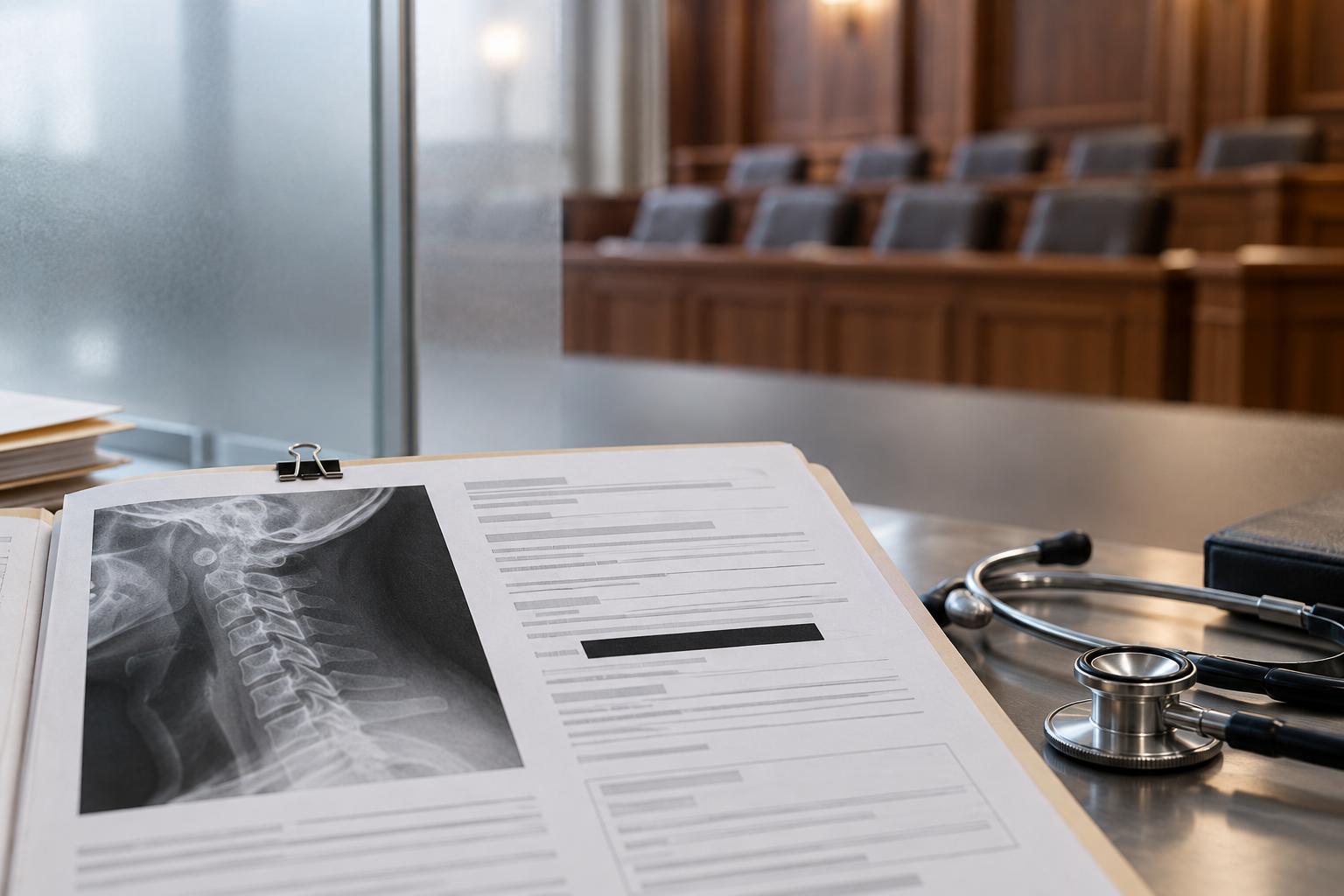
Your Medical Record Says “Permanent Injury.” Will a Florida Jury Ever See It?
A doctor’s chart can contain the words “permanent impairment” and still fail to prove a permanent injury at trial. That sounds counterintuitive. Patients reasonably assume that if a medical provider wrote something in the record, the jury will be allowed to consider it.
A September 2, 2026 decision from Florida’s Fourth District Court of Appeal shows why that assumption can be dangerous. In Velez Rivera v. Lopes, a treatment record included a four-percent whole-body impairment rating. The notation was redacted before trial as hearsay, however, and the appellate court treated it as evidence that did not exist for the jury’s purposes.
The decision is not a ruling that medical records are unimportant. It is a warning about the difference between information in a file and evidence presented in an admissible form. That distinction can determine whether a person injured in a Florida car crash may recover damages for pain, suffering, mental anguish, and inconvenience.
What happened in Velez Rivera
Norma Velez Rivera was a passenger in a vehicle involved in a February 2023 collision. Her treatment included 26 visits to Family Medical Group, later orthopedic care, and cervical surgery in August 2024. Her treating spine surgeon testified that the collision caused a herniated disc and permanent injuries. Defense experts attributed her condition to preexisting degeneration and testified that any crash-related sprain or strain was not permanent.
Before trial, the defense asked the court to remove a notation from the Family Medical Group records assigning a four-percent permanent impairment rating. The plaintiff did not argue that the notation was admissible, and the court redacted it as hearsay. Other language remained in the record, including a statement that no further functional improvement was reasonably anticipated and that maintenance care had been offered.
During closing argument, defense counsel said that no one from Family Medical Group had rendered an opinion that the plaintiff sustained a permanent injury. That wording was too broad: the unredacted chart had contained an impairment rating. But because the notation had been properly excluded, the Fourth District explained that it was not part of the evidence the jury could consider. The court called the categorical argument improper but ultimately found it harmless. The plaintiff had also declined a proposed curative instruction.
The jury awarded past medical expenses but found that the plaintiff had not sustained a permanent injury. The Fourth District affirmed the final judgment. The opinion was not final until the disposition of any timely rehearing motion, but its evidentiary lesson is immediate: the merits of a medical conclusion and the method used to place it before a jury are separate questions.
Why permanency matters in a Florida motor-vehicle claim
Florida’s no-fault framework limits noneconomic damages in many claims arising from the ownership, maintenance, operation, or use of a motor vehicle. Under section 627.737(2), Florida Statutes, a claimant generally must establish one of four threshold injuries before recovering for pain, suffering, mental anguish, and inconvenience: a significant and permanent loss of an important bodily function; a permanent injury within a reasonable degree of medical probability; significant and permanent scarring or disfigurement; or death.
This threshold does not mean that every recoverable loss disappears when a jury rejects permanency. Economic damages and noneconomic damages involve different questions. In Velez Rivera, for example, the jury awarded past medical expenses while answering “no” to the permanent-injury question.
The distinction is important for anyone evaluating a Florida car accident claim. Medical bills may show that treatment occurred. Imaging may show an anatomical condition. Testimony may connect that condition to the collision. But none of those items necessarily answers, by itself, the statutory question of whether an injury is permanent within a reasonable degree of medical probability.
A medical chart is not automatically admissible proof
Medical records often contain several kinds of information at once: dates, test results, patient history, observations, diagnoses, treatment plans, prognoses, and opinions about causation or permanency. The fact that all of this appears in one chart does not make every sentence admissible for every purpose.
Florida’s hearsay rule generally excludes out-of-court statements offered to prove what they assert unless an exception applies. The business-record exception in section 90.803(6), Florida Statutes, frequently provides a path for medical records. Yet the statute expressly treats recorded opinions and diagnoses differently: an opinion or diagnosis must also be admissible under Florida’s rules governing opinion testimony if the person who made it were testifying directly.
That is why the label “business record” does not end the analysis. Counsel may still need to establish who made a permanency determination, that person’s qualifications, the basis for the opinion, and whether the conclusion satisfies the legal standard. An opposing party may also challenge authenticity, relevance, foundation, causation, or the form of the opinion.
The problem in Velez Rivera was especially stark. Once the impairment notation was redacted without an admissibility argument, it was no longer evidence. The appellate court distinguished situations in which a judge wrongly excludes evidence and the opposing lawyer then exploits its absence. Here, the exclusion itself was not challenged as error.
An impairment rating and a permanent injury are related—but not identical
A percentage impairment rating can be useful medical evidence, but it should not be treated as a magic number. The statutory threshold asks whether the claimant sustained a permanent injury within a reasonable degree of medical probability, or one of the other qualifying injuries listed in section 627.737. A rating may support that conclusion, depending on who issued it, what methodology was used, and how it relates to the diagnosed condition. It does not necessarily prove the legal threshold by itself.
The reverse is also true. A claimant does not necessarily need a particular percentage printed in a chart if admissible medical testimony otherwise establishes permanency under the correct standard. In Velez Rivera, the treating spine surgeon did testify that the injuries were permanent. The defense presented competing experts, and the jury was entitled to weigh that conflict.
This is a useful reminder that a personal injury trial is not a mechanical document review. Jurors evaluate credibility, competing medical explanations, the timing and course of treatment, prior conditions, objective findings, and whether the opinions they hear fit the medical history as a whole.
The treatment timeline can shape the causation dispute
The decision also illustrates why the story between the crash and the courtroom matters. Velez Rivera’s early course of care ended in April 2023, while her cervical surgery occurred in August 2024. The opinion does not declare that this timing defeated her claim. It does show, however, how a defense can use preexisting degeneration, treatment chronology, and competing expert testimony to challenge both causation and permanence.
A gap or change in treatment may have an innocent explanation: a referral delay, insurance issue, temporary improvement, work or family obligations, or a conservative-care plan that eventually failed. If that explanation is not documented and presented, the empty space in the timeline can take on a meaning of its own.
People with severe injuries may also move between emergency physicians, primary-care providers, therapists, diagnostic facilities, pain-management doctors, and surgeons. Each provider sees only part of the story. Building a coherent account may require more than collecting records. It can require identifying which clinician can explain the diagnosis, the causal relationship to the collision, the prognosis, and the functional consequences in terms a jury can lawfully consider. Tucker Law’s Personal Injury Information Center discusses other issues that commonly arise as a claim develops.
The evidence plan should start before the pretrial conference
The lasting lesson from Velez Rivera is not to manufacture a permanency opinion or pressure a provider to use particular language. The medical judgment must remain the provider’s. The lesson is to discover early what opinions actually exist, who formed them, and how they can be authenticated and presented if the case reaches trial.
That may include reviewing the complete, legible treatment file; confirming the identity and role of the author of a critical notation; comparing the chart with imaging and later specialist findings; addressing prior symptoms and degenerative changes candidly; and deciding whether testimony or another proper evidentiary foundation will be required. When an injury may be catastrophic, future limitations and prognosis also need to be evaluated with the same care as past bills.
Evidence preservation is broader than medical paperwork. Photographs, vehicle data, witness accounts, employment records, and communications with insurers can all affect the case. Even a seemingly routine request for a recorded statement can create evidence that is later compared with medical histories and testimony.
What an injured person should take from the decision
A chart entry is a starting point, not a guarantee. If a provider has reached a genuine medical conclusion about permanent injury, the litigation team must still determine whether that opinion addresses the applicable Florida standard and whether it will reach the factfinder in admissible form. Waiting until a motion in limine or closing argument to confront that question can be too late.
The general information in an article about pain-and-suffering compensation helps explain the available category of damages. Velez Rivera adds the practical courtroom point: eligibility for those damages may turn not only on what a doctor wrote, but on what evidence the jury is legally permitted to hear.
If you were injured in a Florida collision and the insurer disputes whether the crash caused a permanent injury, Tucker Law can review the medical record, the competing explanations, and the evidence needed to present the claim. Contact Tucker Law to discuss the circumstances of your case.