A Deer Appears in the Road: How a Florida Animal-Avoidance Crash Is Evaluated
An animal avoidance accident claim rarely turns on the animal alone. A deer, dog, livestock animal, or other unexpected hazard may trigger a sudden reaction, but investigators still examine speed, visibility, following distance, vehicle control, roadway conditions, another driver’s conduct, and sometimes animal ownership. A hypothetical Florida scenario shows how those facts fit together.
The scenario
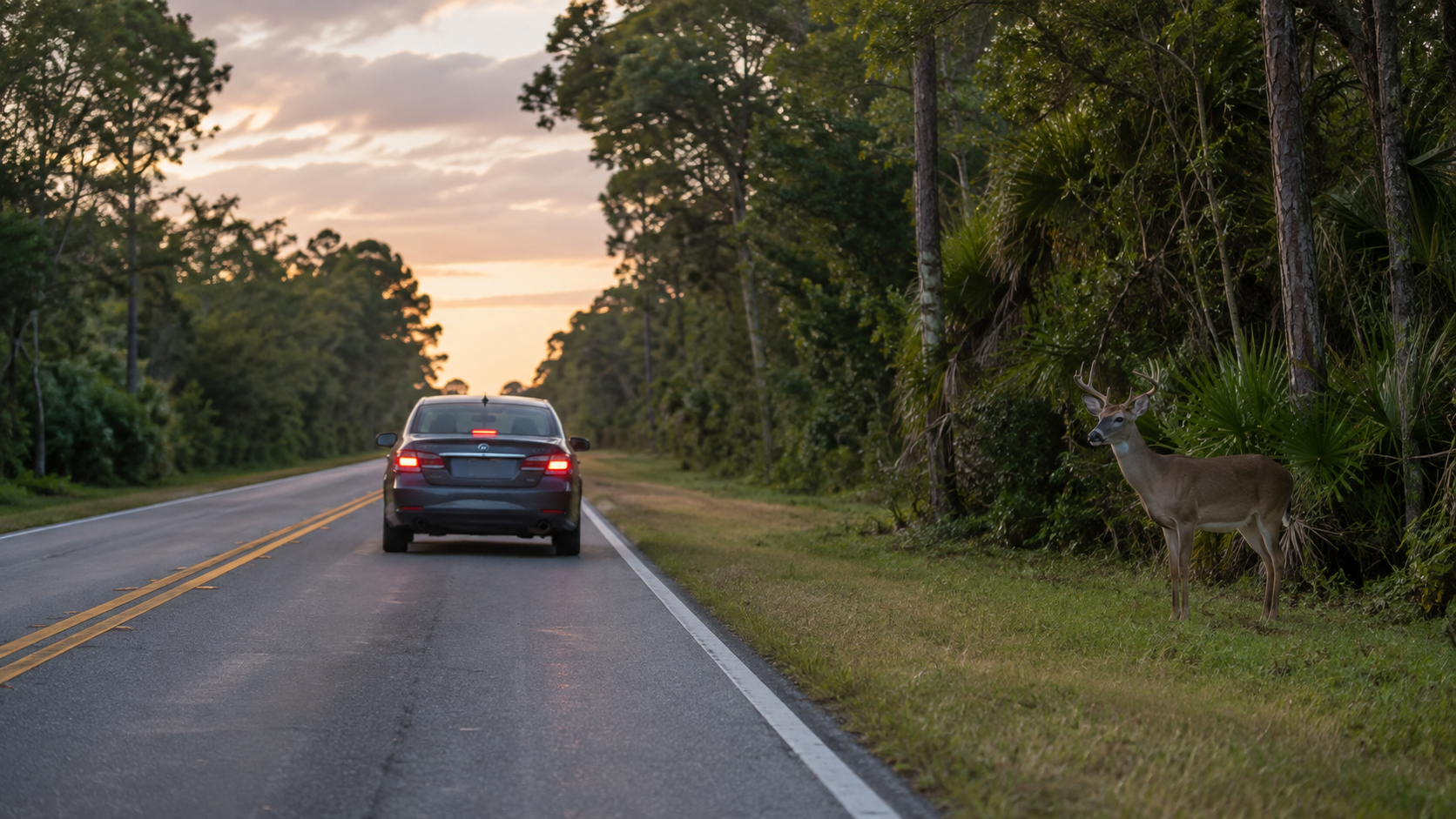
Imagine Driver A traveling on a two-lane road near dawn. A deer appears at the shoulder. Driver A brakes and moves left, avoiding the animal but entering the opposite lane. Driver B swerves, leaves the pavement, and is injured without the vehicles touching. Driver A says the maneuver prevented a direct impact. Driver B says Driver A was traveling too fast and crossed the center line unnecessarily.
Neither statement resolves fault. Investigators need the animal’s location, available reaction time, approach speeds, sight distance, braking, lane positions, and alternatives.
The first question is what the driver could perceive
Photograph the road from driver eye level near the same time of day. Record curves, hills, tree cover, grass height, signs, lighting, weather, and reflective surfaces. Dash cameras, doorbell footage, trail cameras, and nearby business video may show the animal or vehicle approaches.
Witnesses should identify where they were and what drew their attention. Someone who heard tires and looked afterward should not be described as having seen the animal enter the road.
Speed is evaluated under the actual conditions
Florida Statute section 316.183 requires a reasonable and prudent speed under actual and potential hazards. The posted limit is relevant but does not prove the same speed was safe in darkness, fog, heavy rain, or an area where animals were plainly present.
Vehicle event data, video, navigation records, tire marks, and final positions may help estimate speed and reaction. Avoid guessing about seconds or feet in an insurance interview.
A no-contact collision can still be a real crash
Driver B does not need visible contact with Driver A for Driver A’s movement to matter factually. The evidence must still connect that movement to the evasive action and injury. Identify the other vehicle, preserve plate information, and obtain witness contacts before it leaves.
TuckerUp’s no-contact accident guide explains why video and uninsured motorist issues may become important when a vehicle cannot be identified.
Suppose Driver B was following behind instead
A following driver may strike Driver A after the sudden stop. Investigators examine following distance, brake lights, traffic, visibility, and whether the animal created an abrupt emergency. A rear impact should not be reduced to a slogan about automatic fault.
If several vehicles brake and collide, the timeline methods in TuckerUp’s chain-reaction article can identify separate opportunities to avoid impact.
Domestic animals can add different questions
If a dog or livestock animal entered from identifiable property, ownership, containment, gates, fencing, prior escapes, and notice may be relevant. That does not automatically make the animal’s owner responsible for a vehicle crash. Control, reasonable precautions, causation, and local rules require factual review.
Photograph damaged fencing or open gates from lawful locations. Preserve animal-control reports and witness information without trespassing or confronting property owners.
The reaction itself is judged in context
Braking, steering, and staying within a lane may not all be possible in a fraction of a second. Investigators compare the chosen maneuver with the available roadway, oncoming traffic, shoulder condition, vehicle stability, and collision risk. A result that looks poor in hindsight was not necessarily unreasonable when made.
Vehicle data can show steering and braking order. Tire and suspension evidence may explain why control was lost. The hydroplaning article illustrates how road conditions can combine with a sudden hazard.
Medical and insurance proof
Obtain appropriate care and report the event accurately. Keep medical records, wage documents, receipts, towing bills, repair estimates, photographs, and complete policies. Liability, personal injury protection, collision, and uninsured motorist coverage may address different losses.
Preserve damaged vehicle parts when a mechanical problem is disputed. A quick property settlement should not unintentionally release an unresolved injury claim.
Evaluating the animal avoidance accident claim
The useful questions are what appeared, when it became visible, how each driver responded, and whether another person controlled a contributing risk. Tucker Law Group’s practice areas describe its injury work. To discuss a Florida avoidance crash, contact the firm.
Preserve any evidence showing that the animal was present, but do not approach injured wildlife or enter private property. Note whether law enforcement, animal control, or a property owner responded and keep the related incident number. If the animal disappeared, fresh tracks, damaged fencing, hair, or debris may still help establish the location and sequence when collected safely and lawfully.
This article provides general information, not legal advice. Every matter is different, and reading this page does not create an attorney-client relationship.