A Cow Is Standing in the Road. Who Pays for the Florida Crash?
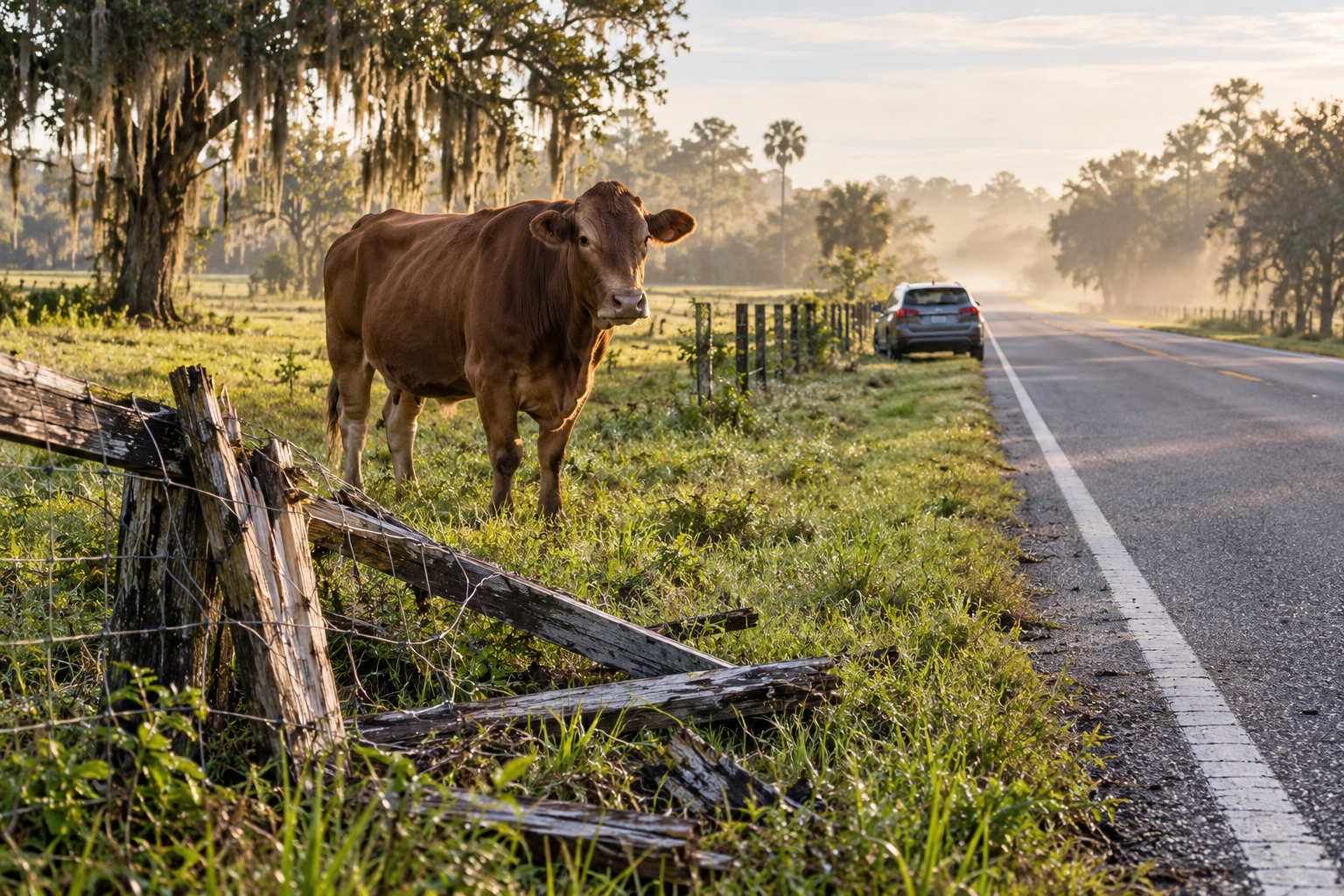
At 4:45 in the morning, a black cow can disappear into an unlit Florida road.
The collision may look simple afterward. The animal was in the lane. The vehicle struck it. The driver was hurt. But Florida law does not make the livestock owner automatically responsible just because a cow, horse, goat, or other grazing animal reached the roadway.
The decisive question usually comes one step earlier: How did the animal get out?
An open gate, a broken fence, storm damage, vandals, hunters’ dogs, or a careless worker can lead to the same dangerous scene. They do not necessarily lead to the same legal result. That is why a livestock crash must be investigated as both a traffic collision and an escape from confinement.
Florida’s livestock law reaches more than cattle
Florida’s statewide livestock law is commonly called the Warren Act. Its definition of “livestock” in section 588.13 includes animals of the equine, bovine, and swine classes, as well as goats, sheep, mules, horses, hogs, cattle, ostriches, and other grazing animals.
The statute’s definition of an “owner” is also broader than the name on a purchase receipt. It includes a person or company owning, having custody of, or being in charge of the livestock. Depending on the facts, the investigation may therefore extend beyond the landowner to a lessee, ranch operator, caretaker, or another person responsible for the animals.
Under section 588.15, an owner is liable for injury and property damage when the owner intentionally, willfully, carelessly, or negligently suffers or permits livestock to run or stray on a public road. The statute covers the full right-of-way of qualifying state, county, and municipal roads—not only the paved travel lane.
That language creates a claim when the evidence connects the animal’s presence to conduct by the person responsible for it. It does not create automatic liability for every escape.
The cow in the lane proves danger, not negligence
Florida’s Fourth District Court of Appeal confronted that distinction in Carnahan v. Norvell. A driver collided with cows on an unlit road before dawn. A nearby pasture gate was open, and the driver claimed the owner had left it unlocked and unlatched.
The appellate court explained that the Warren Act is not a strict-liability statute. The mere fact that livestock was at large on a highway does not, by itself, establish that the owner intentionally, willfully, carelessly, or negligently allowed it to be there.
That rule changes the investigation. It is not enough to photograph a cow beside a damaged vehicle and stop. The evidence must help reconstruct the route from pasture to road and the reason the barrier failed.
A gate hanging open may support several competing explanations. Someone responsible for the property may have failed to latch it. A stranger may have opened it. A vehicle may have struck it. An animal may have pushed through a deteriorated hinge. A fallen tree may have damaged a different section of fence and made the gate irrelevant. Each explanation points to different witnesses, records, and responsible parties.
The escape route is part of the crash scene
Investigators often concentrate on the skid marks, vehicle damage, and final resting positions. Those facts matter, but a livestock collision can have a second scene hundreds of yards away.
The nearby fence line should be documented before repairs erase its condition. Photographs and video may show broken wire, bent posts, fresh cuts, tire tracks, hoof marks, vegetation, a displaced cattle guard, or a gate that could not latch. The position of chains, locks, hinges, and padlocks may be important. So may the distance from the opening to the point of impact and the path the animal would have taken.
Chapter 588 describes minimum features of a legal fence and gate and requires an owner of legally enclosed land to maintain the enclosure in reasonably good condition. Whether a particular barrier complied with those provisions is a factual question; a fence’s height alone does not decide the entire negligence claim. The condition, location, use, and known history of the actual opening still matter.
Weather records can distinguish ordinary deterioration from sudden storm damage. Repair invoices, ranch logs, text messages, work schedules, surveillance video, and photographs taken before the collision may show who last used the gate and whether a defect was already known. Ear tags, brands, veterinary records, sale records, and law-enforcement or animal-control reports may establish which herd the animal belonged to.
This is one reason Tucker Law’s discussion of vanishing collision evidence applies even though no truck caused the crash. A gate can be rehung, a fence repaired, and an animal moved before an injured driver knows where to look.
Prior escapes matter only when they illuminate this escape
Evidence that livestock escaped before may show notice of a recurring weakness. But Carnahan also demonstrates why “the cows got out before” is not enough.
The prior incident discussed in that case involved hunters’ dogs frightening cows through or over a fence at a different pasture and road. The claim being tried concerned an allegedly unlocked or unlatched gate. The Fourth District held that the earlier event was not sufficiently similar or relevant to the gate theory presented at trial.
By contrast, the court discussed an earlier Florida case in which evidence that cows had previously escaped from the same pasture should have been admitted as evidence of negligence. The difference was the connection between the earlier event and the claimed failure.
Useful prior-incident evidence is therefore specific. Did animals leave through the same gate? Had the latch failed before? Were there earlier complaints about livestock along the same road? Did animal control return the same tagged animal? Had the responsible person promised to repair that section of fence? Similarity can turn a vague history into proof of notice.
A third party or natural event can change the liability analysis
Not every escape begins with the livestock owner. A motorist can damage a fence. A contractor can leave a gate open. Vandals can cut wire. A neighboring landowner can remove a barrier. Severe weather can bring down a tree.
Those facts do not automatically end the injured driver’s claim. They may identify a different responsible party, divide fault among several actors, or raise questions about whether the livestock custodian responded reasonably to a known risk. For example, a fence damaged several days earlier presents a different notice issue from a fence knocked down moments before the crash.
Section 588.25 also recognizes that some counties may have special or locally applicable livestock-confinement laws. The statewide provisions continue to operate in specified circumstances, including when the local law does not prohibit livestock from straying on public highways or does not provide owner liability. A proper review should therefore check both the current Florida statutes and any applicable local rule rather than assuming that every county is governed identically.
The driver’s conduct remains part of the case
A livestock owner’s negligence does not make the driver’s actions irrelevant. Visibility, speed, headlights, weather, road geometry, warning signs, braking, distraction, and evasive movement can all become disputed.
Florida’s comparative-fault statute generally reduces damages according to an injured person’s share of fault and bars recovery in covered negligence actions when the person is found more than 50% at fault for the person’s own harm. A claim that the driver was traveling too fast for darkness or failed to react will require evidence, not hindsight.
The reconstruction should account for what a reasonable driver could actually see. Headlight reach, the animal’s color and orientation, ambient lighting, road grade, curves, oncoming glare, vehicle speed, perception-response time, and the available stopping distance may matter. A sudden encounter with a dark animal in a travel lane is not fairly analyzed from a daylight photograph taken after the animal has moved.
Vehicle-event data, dash-camera footage, nearby cameras, 911 calls, witness accounts, roadway measurements, and the physical damage can help separate a real opportunity to avoid the collision from speculation.
The first report can preserve two investigations
Safety comes first. An injured person should not approach frightened or wounded livestock or walk into traffic to inspect a fence. Call 911, obtain medical help, and let law enforcement and animal-control personnel manage the roadway and animal.
Current Florida section 316.065 requires immediate notice to the appropriate law-enforcement agency when a crash results in injury or death or apparent vehicle or property damage of at least $2,000. A livestock collision capable of injuring an occupant will often meet that rule. Even apart from the threshold, a prompt report can help identify the animal, its custodian, the responding agencies, and the location from which it escaped.
If it can be done safely, photographs should capture the animal’s identifying marks, the roadway, lighting, debris, vehicle damage, sight lines, nearby gates, and adjacent properties. Witness contact information matters. So does preserving the vehicle before destructive repairs, downloading dash-camera video before it loops, and noting the names of towing, animal-control, sheriff’s, or highway-patrol personnel.
The report may begin the traffic-crash investigation. The animal-control or impound record may begin a separate paper trail under Chapter 588. Both can be important.
Insurance may come from more than one place
The liable party’s coverage may be found in a farm or ranch policy, commercial general-liability policy, homeowners policy, or another liability contract, depending on who controlled the livestock and how the property was used. Coverage cannot be assumed from the animal owner’s personal auto policy.
The injured driver’s own automobile policy may also matter. Collision coverage can address vehicle damage subject to the policy terms and deductible. Personal injury protection, medical-payments coverage, health insurance, disability benefits, or uninsured-motorist coverage may raise separate questions. Whether any particular coverage applies depends on the policy language, insured status, and facts.
A serious livestock collision can produce head injuries, spinal trauma, fractures, disfigurement, and death. Tucker Law’s catastrophic-injury practice discusses the long-term medical and functional consequences that must be considered, not merely the emergency-room bill.
The deadline should not be chosen by label alone
Florida’s limitations statute assigns different periods to different legal theories. Section 95.11 lists a four-year period for an action founded on statutory liability, while negligence and wrongful-death actions are generally listed at two years. A livestock-roadway crash may involve statutory and negligence allegations, multiple parties, insurance notice duties, and facts affecting when a claim accrued.
No injured person should assume the longest period applies. Evidence disappears far sooner than any filing deadline, and the correct period depends on the claim, date, and parties.
The best question is not “Whose cow was it?”
Ownership is only the beginning. A useful investigation asks who owned, possessed, or controlled the animal; where it was normally confined; how it reached the public right-of-way; who last handled the gate or fence; whether the same defect caused earlier escapes; and what each person knew before the collision.
That is the distinction Florida law draws. The animal’s presence establishes the emergency. The path to the road can establish responsibility.
If you or a family member was injured in a collision with cattle, horses, or other livestock, review Tucker Law’s Florida car-accident practice and Personal Injury Information Center. To discuss the escape evidence, available insurance, and applicable deadlines, contact Tucker Law.
This article provides general information, not legal advice. Liability, coverage, local livestock rules, comparative fault, and filing deadlines depend on the evidence and date of the incident.