The Cruise Passenger Said He Swallowed Glass. What Proof Was Missing?
A passenger says he swallowed glass hidden in a chicken quesadilla aboard a cruise ship. He later reports internal bleeding, throat and stomach problems, and difficulty continuing his work as a truck driver. At first glance, the liability question may seem almost automatic: if the ship served the food, why would the passenger need to prove anything beyond the glass and the injury?
A recent federal appeal shows why that assumption can fail.
On July 6, 2026, the Eleventh Circuit affirmed summary judgment for the cruise line in Cunningham v. Carnival Cruise Line. The decision did not hold that foreign objects in shipboard food are harmless or that a cruise line can never be liable. It held that the record in that case contained no evidence that Carnival had actual or constructive notice of the risk-creating condition. The panel did not need to reach the separate dispute over medical causation.
Cunningham is an unpublished opinion. Under the Eleventh Circuit’s precedent rules, unpublished opinions are not binding precedent, though they may have persuasive value. Its real usefulness is practical: it reveals the proof gap that can exist between a disturbing event and a legally supportable cruise ship injury claim.
What happened in Cunningham
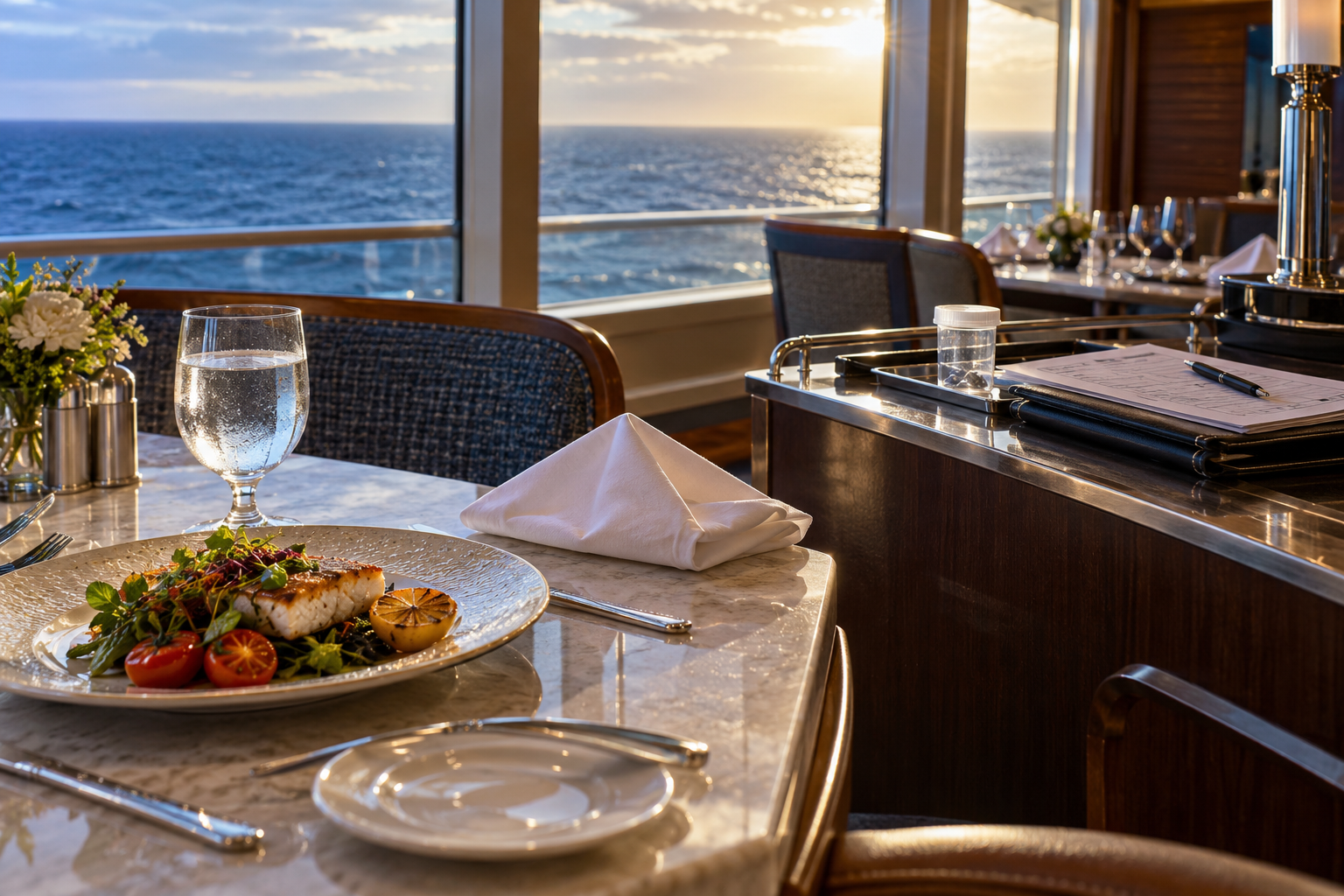
According to the opinion, Maurice Cunningham alleged that he was dining at the Canal Grande restaurant aboard the Carnival Venezia in June 2023 when he ingested glass in a chicken quesadilla. He claimed significant stomach injuries, throat complications, and internal bleeding. He sued Carnival for negligence in the Southern District of Florida.
The appeal turned less on the dramatic allegation than on what had—and had not—entered the court record. Carnival identified four crew members in its initial disclosures. The plaintiff did not attempt to schedule their depositions until one business day before discovery closed. By the deadline, no depositions had been taken and no expert disclosures had been made. Written discovery had also begun late in the discovery period.
When Carnival moved for summary judgment, it argued that the record contained no evidence of actual or constructive notice and no expert opinion connecting the alleged ingestion to the claimed injuries. In opposing the motion, the plaintiff conceded that he had no evidence Carnival knew or should have known about the condition. He instead argued, among other things, that the circumstances permitted an inference of negligence under the doctrine of res ipsa loquitur.
The district court ruled for Carnival on the notice issue, and the Eleventh Circuit affirmed. Because the absence of notice evidence was dispositive, the courts did not decide the parties’ medical-causation arguments.
Why maritime law changes the first question
An onboard injury is not necessarily analyzed under the same law that governs a restaurant injury on land. The Eleventh Circuit explained that an alleged tort aboard a ship on navigable waters is governed by general maritime law. Tucker Law’s overview of maritime injury law discusses why the vessel, location, and legal status of the injured person can matter.
Maritime negligence still requires the familiar elements of duty, breach, causation, and harm. But a cruise operator is not treated as an insurer of every passenger’s safety. It owes reasonable care under the circumstances. Under the published authorities applied in Cunningham, liability for a risk-creating condition generally requires proof that the carrier had actual or constructive notice of that condition.
Actual notice means the cruise line knew about the relevant danger. Constructive notice asks whether the circumstances would permit the law to treat the cruise line as having had enough opportunity or information to discover and address it. The proof is highly fact-specific. A prior report, a substantially similar incident, a recurring condition, a warning from an employee or supplier, or evidence that a hazard existed long enough for reasonable corrective action may become important. The precise route depends on the alleged danger and the available evidence.
In Cunningham, the plaintiff acknowledged that he had no evidence a crew member knew about glass in his food before the incident. He also lacked information about another passenger encountering glass or another foreign object at the restaurant or elsewhere on a Carnival vessel. That left the notice element unsupported.
The ship served the meal. Why did that not prove the claim by itself?
The passenger’s argument relied in part on res ipsa loquitur, an evidentiary doctrine that can permit negligence to be inferred from circumstances that ordinarily would not occur without negligence. But the Eleventh Circuit explained that an inference of breach cannot create a duty that has not otherwise been established. Under the notice rule the court applied, the doctrine did not eliminate the plaintiff’s obligation to show actual or constructive notice.
That point deserves care. The panel did not announce that the same notice analysis will resolve every contaminated-food or foreign-object case. Different allegations, evidence, defendants, or theories can present different legal questions. Nor did it decide who placed the alleged glass in the food, whether the glass existed, or whether a particular galley practice was negligent. The case reached summary judgment on a record where the plaintiff conceded the absence of notice evidence.
The lesson is narrower and more useful: the shocking nature of an allegation does not identify the evidence needed for each legal element. “The ship served it” may describe the event, but a viable claim still requires a supported theory of why the cruise line is legally responsible.
Notice evidence may be in the galley, not at the dining table
A passenger usually sees only the finished plate. The facts relevant to notice may be scattered across departments, systems, and people the passenger never encounters.
For a foreign-object allegation, potentially relevant evidence can include the incident report; photographs of the plate and object; the restaurant reservation and point-of-sale record; the server’s and supervisor’s accounts; galley cleaning and inspection records; broken-glass reports; dishwashing or food-preparation logs; supplier and packaging information; surveillance video; prior guest complaints; and messages sent among restaurant, security, medical, and housekeeping personnel. None of those records automatically proves negligence, but each can help reconstruct where the object came from, who encountered it, and whether the danger was known earlier.
Timing matters because shipboard evidence moves. Crew members may rotate to another vessel or leave the company. Surveillance can be overwritten. Food is discarded. A broken glass may be swept up during the same service. An incident may be recorded in a system the passenger cannot access without a focused request or formal discovery.
The procedural history in Cunningham illustrates why identifying witnesses is not the same as obtaining their testimony. The names of four crew members appeared in Carnival’s initial disclosures, but their depositions were not pursued until discovery was about to close. When witnesses work aboard a vessel and may be outside the country, scheduling and procedural issues deserve early attention.
The foreign object itself can answer questions no incident report can
If it is safe to do so, the object, remaining food, packaging, photographs, and purchase information should be preserved without unnecessary handling. Sharp material should not be touched in a way that risks another injury. If a crew member takes the plate or object, note the person’s name or role, the time, and where the item was taken. Ask for the incident-report number and written confirmation that the item and related video will be retained.
Original photographs are more useful than screenshots posted to social media. Capture the object in place, the full plate, the table, nearby glassware, the restaurant location, and any visible injury. Keep the original image files and do not apply filters or mark them up. A dining companion’s contemporaneous observations may also matter, especially if that person saw the object before the plate was removed.
Preservation does not mean attempting a home investigation. Do not wash, scrape, break, or test suspected glass. Later analysis may depend on size, edges, composition, food residue, or comparison with glassware used aboard the ship. A documented chain of custody is more valuable than an item that has passed through several undocumented hands.
Medical causation remains a separate bridge
The Eleventh Circuit did not reach medical causation in Cunningham, but the dispute shows why that issue should be developed independently. Proof that a foreign object was present does not automatically establish that every later symptom or diagnosis resulted from ingesting it.
Prompt medical evaluation can document the timeline, symptoms, examination findings, imaging, endoscopy, laboratory results, and treatment. The ship’s medical-center record may establish the first report and immediate condition, while later hospital and specialist records may address progression. If a fragment is removed during treatment, the medical facility’s pathology or evidence-retention procedures may become important.
Some causal relationships may be understandable without specialized testimony. Others—particularly claims involving internal bleeding, delayed symptoms, competing conditions, or long-term impairment—may require qualified medical opinions. A careful claim distinguishes what the records demonstrate from what still requires expert analysis.
The legal deadline is not the evidence deadline
Federal law generally provides a three-year limitations period for a personal-injury or death action arising from a maritime tort under 46 U.S.C. § 30106. But passenger ticket contracts may contain shorter notice and suit requirements within limits regulated by 46 U.S.C. § 30526. The correct deadline depends on the vessel, contract, claim, and facts; it should not be calculated from a general article.
Even the shortest contractual filing period may be much longer than the life of a video, food item, galley log, or crew assignment. That is why Tucker Law’s cruise and shore-excursion guidance emphasizes preserving ticket terms, booking records, incident details, photographs, witnesses, and medical information promptly.
What the decision does—and does not—mean for passengers
Cunningham does not mean that a passenger has no claim when glass or another foreign object appears in shipboard food. It does not make a cruise line immune from careless food preparation, unsafe galley practices, ignored complaints, or a known contamination problem. And because the opinion is unpublished, it is not binding Eleventh Circuit precedent.
It does show how a claim can fail when the record never develops evidence for a required element. The passenger alleged a serious and disturbing injury. Yet by summary judgment, there was no evidence that Carnival had actual or constructive notice of the relevant condition, and the plaintiff had conceded that absence. An inference of negligence could not fill the duty gap the court identified.
For an injured passenger, the practical response is not to predict the outcome at the dining table. It is to protect the facts: the object, the meal, the witnesses, the incident report, the medical timeline, the voyage documents, and the identity of the crew members who handled the event. Those facts allow the legal theory to be evaluated before the proof disappears.
A cruise meal injury should be investigated as both a medical event and an evidence event
A foreign object in food can cause cuts, choking, dental injury, internal injury, infection concerns, or severe emotional distress. The medical response comes first. At the same time, a short factual record created onboard may determine whether a later investigation can answer where the object came from and what the cruise line knew.
Tucker Law reviews injuries that occur aboard ships sailing from Florida and the evidence, maritime rules, ticket provisions, and medical proof those claims may involve. If you were injured by glass, metal, plastic, or another foreign object in food or a beverage during a cruise, preserve what you safely can and contact Tucker Law for a case-specific review.
This article provides general information, not legal advice. Maritime claims can depend on the vessel, location, ticket contract, alleged condition, defendants, evidence, and applicable law.