There Was No Driver. What Evidence Decides a Florida Autonomous-Vehicle Crash?
The car enters the intersection without a steering wheel, brake pedal, or person in a driver’s seat. After impact, the injured driver looks for someone to exchange information with and finds only passengers and a screen.
That scene changes the investigation, but it does not place the crash outside Florida law. Florida allows a fully autonomous vehicle to operate without a human operator physically inside it. When the automated driving system is engaged, the law treats that system as the vehicle’s operator for purposes of the state traffic code. The practical problem is that software cannot answer questions, preserve evidence, identify insurance, or pay a judgment. People and companies still own, deploy, insure, maintain, update, and sometimes remotely assist the vehicle.
The distinction became more concrete on September 4, 2026, when the National Highway Traffic Safety Administration announced an Audit Query into Tesla’s Cybercab self-certification after commercial deployment began in Austin, Texas. NHTSA said the inquiry will examine the process and technical data used to certify a vehicle that lacks permanently attached conventional controls. The agency has not made a defect finding, and the announcement does not concern a Florida crash. It does show why a driverless-car case cannot be reduced to “the computer was driving.” Federal compliance, Florida traffic law, insurance, vehicle design, remote assistance, and the electronic record may all intersect.
Florida starts by asking what was controlling the vehicle
A car that helps a human steer or maintain speed is not necessarily a fully autonomous vehicle. Under Florida Statutes section 316.003, an “automated driving system” is hardware and software collectively capable of performing the entire dynamic driving task on a sustained basis. A fully autonomous vehicle is designed to function without a human operator. By contrast, NHTSA explains that Level 2 driver-assistance systems still require a human driver to remain engaged in the driving task.
That classification can change the case. If a human was required to supervise a Level 2 system, the investigation may focus on attention, warnings, takeover opportunities, and what the driver did. If a true automated driving system was performing the entire driving task, the investigation shifts toward what the system perceived, the operating limits it was designed for, and what the owner, network, manufacturer, or remote-support personnel did before and during the event.
Florida’s autonomous-vehicle statute makes the threshold point unusually direct: when the automated driving system is engaged, it is deemed the operator for purposes of Chapter 316, regardless of whether anyone is physically present. That rule helps apply traffic laws to a vehicle with an empty driver’s seat. It does not automatically identify the civil defendant, prove negligence, or make the manufacturer liable whenever the vehicle violates a traffic rule.
The collision has a human timeline and a machine timeline
In an ordinary Florida car-accident claim, witnesses may disagree about speed, signal color, braking, or right of way. An autonomous-vehicle crash adds another chronology: what the system detected, how it classified the scene, what driving mode was active, which software version was installed, and whether a remote human became involved.
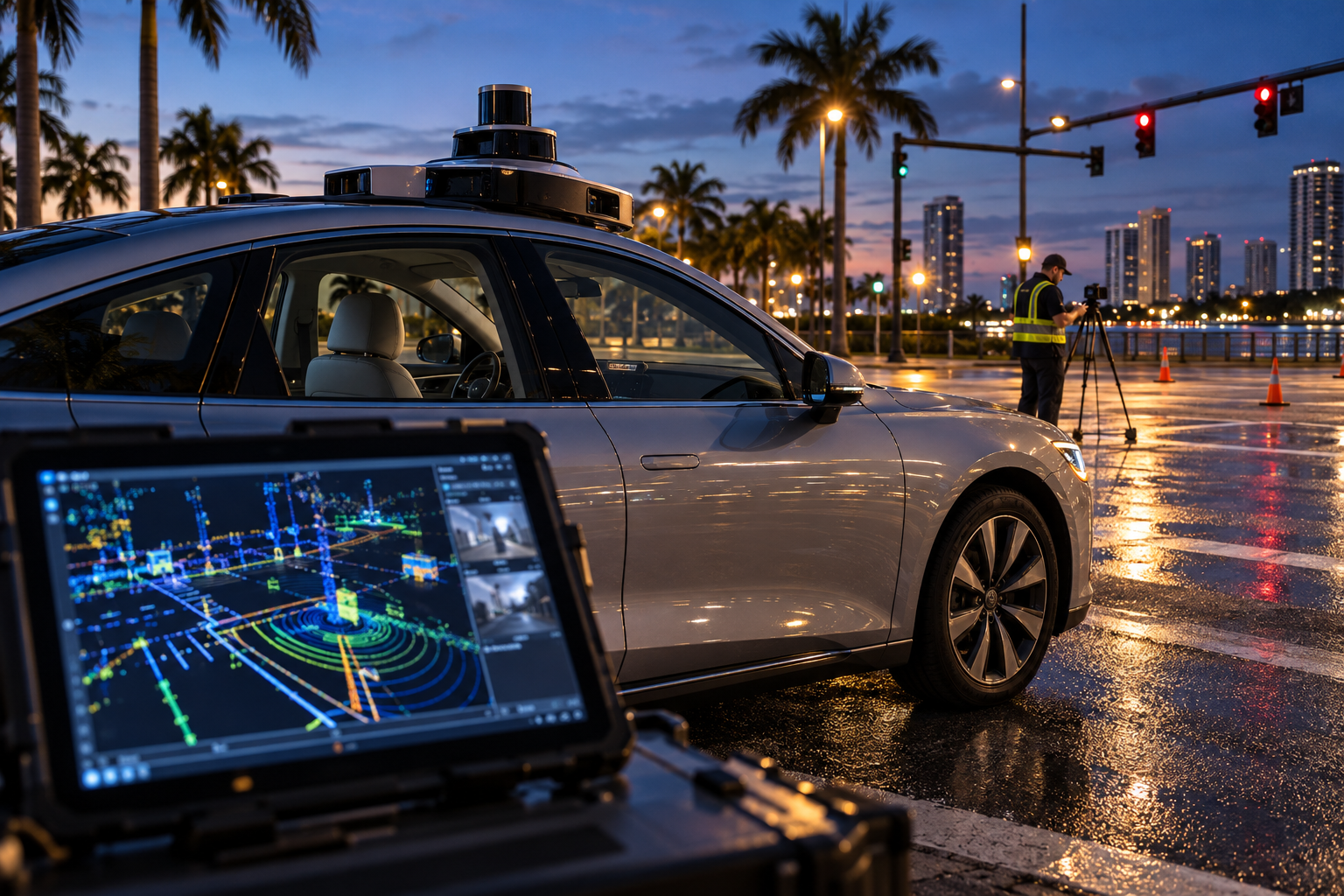
The most revealing interval may be only a few seconds. A meaningful inquiry can include when the automated system engaged; whether it remained inside its intended route, weather, lighting, and speed limits; which objects or road markings its sensors detected; when it planned a turn or lane change; whether it issued a request for remote assistance; and what steering, braking, or acceleration commands followed. Depending on the vehicle, relevant information may be distributed among onboard modules, cameras, lidar or radar systems, fleet servers, mobile applications, mapping services, and vendor platforms. No single device should be assumed to hold the complete record.
The software build matters too. An over-the-air update after a crash can change vehicle behavior without changing any bent metal. Records showing the installed version, deployment date, release notes, configuration, and later updates can help establish what system was actually operating. Tucker Law’s article about a rearview-camera failure and crash evidence addresses the same preservation problem on a smaller scale: a safety repair or software update may be necessary, but the pre-update condition should be documented when that can be done safely.
The route is part of the evidence
Florida law defines an automated system’s “operational design domain” as the conditions in which it is designed to operate. Those limits can include roadway type, speed range, weather, time of day, and other constraints. This makes the route more than background scenery.
Suppose a vehicle was designed for mapped urban streets in fair weather, but it encountered flooded pavement, temporary construction markings, an emergency officer directing traffic, or a pickup point outside its approved area. The key questions are not simply whether the vehicle struck something and whether the technology is generally safe. The investigation must determine whether the system was where it was supposed to be, whether the condition was foreseeable, whether it recognized that it had reached a limit, and whether it achieved a safe fallback.
Section 319.145 requires a fully autonomous vehicle registered in Florida to be capable of achieving a “minimal risk condition” if an automated-driving-system failure prevents it from performing the entire driving task within its intended domain. The statute gives stopping and activating hazard lamps as an example of a reasonably safe state. After a crash, the vehicle’s response to a failure or uncertain scene can therefore be as important as the event that first created the danger.
Remote assistance creates a second scene
A driverless vehicle may still have a human involved somewhere else. Florida defines a teleoperation system as hardware and software that allow a remote human operator to supervise or perform some or all of the driving task. The remote operator must be physically present in the United States and licensed by a U.S. jurisdiction.
If remote assistance occurred, there may be a second scene hundreds or thousands of miles away. Records may show when the vehicle requested help, what images and alerts the remote operator received, whether communications lagged or disconnected, what instructions were sent, and whether the human actually steered the vehicle or merely advised it. Staffing, training, workload, and escalation rules may matter depending on the facts.
This is why a passenger’s statement that “nobody was driving” is only the beginning. The system may have been acting alone, following a remote command, pausing for guidance, or transitioning between modes. The answer should come from synchronized records rather than assumptions based on the empty front seat.
No driver does not mean no responsible party
A serious crash may require investigation of several distinct roles. The vehicle owner may be different from the company operating the passenger network. The automated-driving-system developer may be different from the vehicle manufacturer. A third party may have converted a conventional vehicle, supplied sensors, maintained the fleet, created high-definition maps, or provided remote support. Another road user may also have contributed to the collision.
Those relationships matter because Florida law does not make every entity connected to an autonomous vehicle responsible for every crash. For example, section 316.86 protects an original manufacturer from a claim based on a defect caused by a third party’s autonomous conversion or installed equipment, unless the alleged defect existed in the vehicle as originally manufactured. In a converted vehicle, identifying who designed and installed the automation is therefore not a technical footnote; it can determine whether a liability theory is directed at the correct party.
The same caution applies to federal oversight. NHTSA’s September Cybercab inquiry concerns the basis for Tesla’s federal safety self-certification. It does not establish that a Cybercab is defective, that Tesla caused any particular collision, or that federal certification resolves a state injury claim. A Florida case still requires proof tied to the vehicle, system, event, and injury at issue.
Federal crash reports can be a lead, not a fault scorecard
NHTSA’s current Standing General Order on crash reporting requires identified manufacturers and operators to report certain crashes involving automated driving systems and Level 2 driver-assistance systems. For ADS crashes, reportability can turn on whether the system was in use within 30 seconds before the crash and whether specified injury or property-damage conditions occurred.
A related federal report may help identify an incident, system, or recurring issue. But NHTSA expressly warns that the public data have limits. Recording and telemetry capabilities vary; more than one entity can report the same crash; fields may be incomplete; and raw report counts are not normalized by fleet size, miles traveled, or operating domain. The data reflect information submitted to the agency, not a judicial determination of fault.
For an individual claim, a public report is best treated as an investigative lead. It does not replace the vehicle-specific electronic data, scene evidence, witness accounts, physical inspection, or qualified technical analysis.
Insurance depends on how the vehicle was being used
Florida created a specific insurance rule for fully autonomous vehicles operating through an on-demand autonomous vehicle network. Under section 627.749, a fully autonomous vehicle with its system engaged while logged on to such a network or engaged in a prearranged ride must carry at least $1 million in primary liability coverage, along with required PIP and uninsured/underinsured motorist coverage. The owner, the network, or a combination of both may provide that coverage.
The statute’s conditions matter. It does not say that every privately used automated vehicle carries a $1 million policy. A coverage review should establish whether the system was engaged, whether the vehicle was logged on to a qualifying network, whether a ride had been arranged, who owned the vehicle, and which policies were in force. When another vehicle contributed to the crash or the available liability coverage is inadequate, the injured person’s own coverage may also matter; Tucker Law’s discussion of stacked and non-stacked UM coverage explains why the declarations page is only the beginning of that analysis.
The vehicle may report the crash, but that does not preserve the case
Florida adapts some post-crash duties to vehicles without human operators. Sections 316.062 and 316.065 provide exceptions for a fully autonomous vehicle operating with its system engaged when the owner or someone acting for the owner promptly contacts law enforcement, or when the vehicle can alert law enforcement itself.
An automated alert is not the same as full evidence preservation. It may summon help and create a record that a crash occurred, yet say little about the perception stack, route plan, remote communications, or software state. Police body-camera footage, intersection video, 911 and computer-aided-dispatch records, witness photos, and the other vehicle’s data can still be essential. Tucker Law’s guidance on vanishing evidence after a collision explains why outside video and government records should be pursued promptly.
Preserve the system before the story is simplified
An autonomous-vehicle claim can be weakened when the physical car is repaired while the less visible evidence changes in the background. A preservation request may need to reach the owner, fleet operator, network, manufacturer, automated-system developer, remote-operations provider, maintenance contractor, mapping provider, and insurers. The appropriate recipients depend on the actual deployment and should not be guessed from a logo on the vehicle.
Potentially relevant material may include system-engagement records; sensor and perception data; onboard and outward-facing video; route and operational-domain information; event and diagnostic logs; remote-assistance audio, video, commands, and connection records; software versions and update history; maintenance and calibration records; ride-status and dispatch data; crash notifications; and communications with NHTSA or law enforcement. Some of that material may not exist, may be overwritten quickly, or may be controlled by a company outside Florida. Early, targeted action matters more than a broad request made after systems have rolled over their data.
The injured person should not attempt to access, alter, or test a damaged vehicle in an unsafe way. Photographs of the vehicle, passenger interface, displayed messages, scene, road markings, weather, and temporary traffic controls can be collected without disturbing electronic systems. Receipts, ride confirmations, application screenshots, and communications with the network should also be retained.
A driverless crash still requires a human investigation
Florida law can name the automated system as the traffic-law operator. The civil case still has to connect conduct, technology, companies, insurance, and injuries with admissible evidence. The empty driver’s seat is visually striking, but the decisive proof may be a mode-change timestamp, a remote-support recording, an out-of-domain route, a calibration record, or an update deployed days later.
Tucker Law’s Personal Injury Information Center provides additional guidance for people navigating Florida injury claims. If you or a family member was injured in a crash involving a driverless vehicle or automated driving system, contact Tucker Law before the vehicle and platform records change. The first task is not to blame the technology or trust it; it is to preserve enough evidence to learn what actually happened.
This article provides general information and is not legal advice. Autonomous-vehicle technology, insurance, and potential claims depend on the vehicle, system, use, contracts, and facts of the crash.