Who May Be Liable After an Emergency Vehicle Accident in Florida?
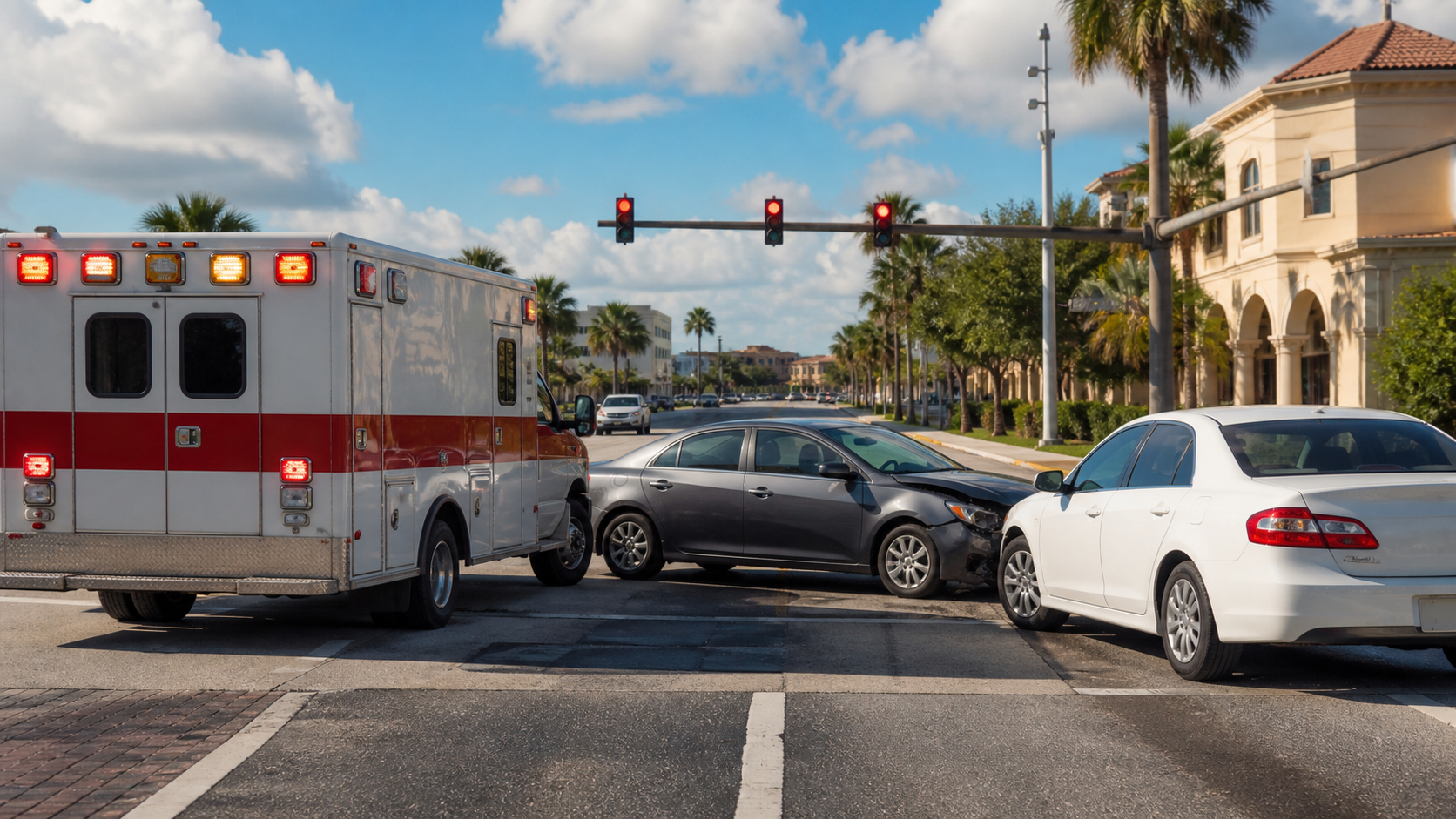
An emergency vehicle accident claim can involve competing duties. Police cars, fire apparatus, and ambulances may need to move quickly, while other drivers must react safely to lights and sirens. The emergency does not make every collision unavoidable, and it does not mean the same party is responsible in every case.
The analysis may involve the emergency driver, another motorist, the employing agency, a private ambulance company, vehicle maintenance, roadway design, and special rules for government claims. These eight questions can help organize the evidence after a Florida emergency vehicle accident.
1. Was the Vehicle Responding to an Emergency?
Identify the type of vehicle, agency or company, direction of travel, and purpose of the trip. Record whether lights and sirens were operating and when you first saw or heard them. A marked ambulance responding to a call may present different issues from a private vehicle or a public vehicle traveling without emergency signals.
Dispatch records, onboard video, GPS data, radio traffic, and incident reports may help establish the vehicle’s status and route.
2. What Did Other Drivers Have to Do?
Florida Statute section 316.126 addresses how drivers must respond to an approaching authorized emergency vehicle using audible or visible signals. In general, motorists must yield, move toward the closest edge of the roadway when reasonable, clear intersections, and stop until the emergency vehicle passes unless directed otherwise.
The exact response must still account for immediate safety. A driver should not make a blind lane change, stop in an intersection, or create a new collision while trying to yield.
3. Did the Emergency Driver Use Reasonable Care?
Emergency drivers may have operational privileges in qualifying situations, but those privileges do not eliminate the need to consider traffic, visibility, pedestrians, speed, and intersection conditions. Relevant questions include whether the driver slowed before entering against a signal, used appropriate warnings, maintained a lookout, and followed agency training.
Witness statements and synchronized video can help determine whether motorists had enough time and distance to perceive and respond.
4. Did Another Motorist Cause or Contribute to the Crash?
A driver may fail to yield, follow an emergency vehicle too closely, enter the intersection after other traffic stops, or make an abrupt move into another lane. More than one driver can contribute to a collision. Preserve the position and movement of every involved vehicle rather than focusing only on the emergency unit.
When several vehicles react at once, the evidence questions can resemble those in a chain-reaction accident claim.
5. Who Owned and Operated the Emergency Vehicle?
The vehicle might belong to a city, county, fire district, state agency, hospital, contractor, or private ambulance service. The driver’s employment status and scope of work can affect the responsible parties and insurance. Obtain the unit number, agency name, driver’s identity, and any contractor information.
Government-related claims may involve notice requirements, defenses, and limits that differ from ordinary private claims. Early identification of the correct entity is important.
6. Did Equipment or Maintenance Play a Role?
Brakes, tires, steering, lights, sirens, onboard systems, and visibility equipment may matter. If a mechanical problem is suspected, maintenance records, inspection logs, repair history, and vehicle data should be preserved. Avoid assuming the driver was the only possible cause.
A tire or equipment issue may raise questions similar to those discussed in our tire blowout accident claim article.
7. What Evidence Is Available?
Photograph the full intersection, traffic signals, lane markings, sight lines, debris, skid marks, and damage to every vehicle. Obtain witness names and identify nearby business, home, traffic, dashcam, and body-camera footage. Record weather and noise conditions that could affect the ability to see or hear warnings.
Request reports, 911 recordings, dispatch data, and video promptly through the appropriate process. Some records may be overwritten or subject to special procedures.
8. What Insurance and Damages Must Be Evaluated?
Potential coverage may include personal injury protection, bodily injury liability, uninsured or underinsured motorist coverage, commercial insurance, and government risk programs. Medical records, wage loss, out-of-pocket expenses, vehicle damage, and future care should be documented carefully.
If the emergency vehicle was operated by a private company or contractor, issues may overlap with a company-driver accident claim.
Act Early When a Public Entity May Be Involved
An emergency vehicle accident claim can require fast evidence preservation and precise identification of the driver, owner, employer, and coverage. Tucker Law can evaluate the sequence, obtain available records, and assess the parties and procedures that may apply.
Learn about our practice areas or contact Tucker Law to discuss a Florida accident.
Before giving a detailed recorded statement, make sure the correct entities and insurers have been identified and that the basic facts are preserved. An early account should be accurate, but injured people may not yet know every vehicle movement, diagnosis, or source of coverage. Written records and objective evidence should guide the investigation.
This article is general information and not legal advice. Government and private claims have different requirements, and each case depends on current law and its facts.