The Driver Says They Blacked Out. Does That End a Florida Crash Claim?
A car runs a red light, keeps accelerating, and strikes a vehicle stopped ahead. The driver does not deny the impact. Instead, the insurer offers a different explanation: the driver suddenly blacked out.
That assertion can change a Florida car-accident case. An unforeseeable loss of consciousness may be a complete defense to negligence because a person who suddenly loses the capacity to control a vehicle may not have made a careless driving choice at all.
But “I blacked out” is not a legal conclusion, and it does not automatically end the injured person’s claim. Florida courts examine what happened before the collision, whether the driver actually lost capacity, and whether warning signs made the event foreseeable. Those questions often turn on evidence collected in the first minutes after the crash and medical history reaching much further back.
A blackout is a defense—not a magic phrase
Florida’s sudden-loss-of-capacity rule is narrower than a general claim that the driver became distracted, confused, tired, or ill. In Hernandez v. Mishali, the Third District Court of Appeal explained that a driver relying on the defense must prove four points: the driver suffered a loss of consciousness or capacity; the loss occurred before the allegedly negligent conduct; it was sudden; and it was neither foreseen nor foreseeable.
Each part matters.
A driver who loses consciousness only after impact has not explained what caused the crash. A person who remains conscious but fails to react may still have been negligent. And even a genuine seizure, fainting episode, cardiac event, or other incapacity does not necessarily excuse driving if the driver had enough warning to stop safely or already knew that a disabling episode could occur.
The defense focuses on capacity and foreseeability, not simply the name of a diagnosis.
Foreseeability is the hinge
The Florida Supreme Court framed the central question decades ago in Bridges v. Speer: did the driver have knowledge or warning of being unfit to drive? When an attack arrives without premonition, the foreseeability needed for negligence may be absent. When the driver knows of a condition that can suddenly destroy the ability to control a vehicle, continuing to drive presents a different issue.
That does not mean any prior medical condition defeats the defense. A remote fainting episode, a controlled condition, or a vague complaint may not make a later blackout foreseeable. The inquiry is specific. Courts may consider what the driver had experienced before, what medical providers had advised, whether medications were being taken as directed, whether driving restrictions existed, and what symptoms appeared during the trip.
The warning must also be meaningful. In Wingate v. United Services Automobile Association, the Fifth District affirmed judgment for the defense after an unexpected heart attack. The estate presented uncontradicted medical and lay evidence that the driver had no reason to anticipate it. A statement that he was not “feeling well” shortly before the crash did not, on that record, establish warning of an impending heart attack.
Compare that with a driver who experiences increasing dizziness, an aura associated with prior seizures, chest pressure like an earlier cardiac episode, or another familiar symptom but continues at highway speed. The physical event may be real while the decision to keep driving remains a question for the jury.
The Florida case that shows why the facts cannot be skipped
Hernandez v. Mishali arose from a violent rear-end crash in North Miami. The struck vehicle was stopped at a red light and was pushed into a transit bus. The rear driver said he had felt strangely hot and “weird,” remembered driving through a school zone, and then remembered nothing until after the collision. A neurologist opined that he had experienced syncope before impact.
Other evidence complicated that account.
The passenger testified that the driver sped through the school zone, ran a red light, remained upright with his eyes open, looked forward, and continued accelerating. The medical expert’s explanation depended partly on the history supplied by the driver, and the appellate opinion noted gaps between the proposed mechanism and the observable facts. The jury rejected the blackout defense and found the driver negligent.
A successor trial judge later set that verdict aside. The Third District reversed and directed that the jury’s liability verdict be reinstated. The appellate court did not hold that the driver could never have fainted. It held that conflicting evidence allowed a reasonable jury to disbelieve the claimed sudden and unforeseeable loss of consciousness.
That distinction is important. A post-crash diagnosis of syncope does not necessarily prove when capacity was lost, what caused it, or whether it was foreseeable. Those remain evidentiary questions.
Two timelines can decide the claim
The seconds before impact
The immediate timeline asks what the driver and vehicle were doing before the collision. A passenger may have heard the driver describe symptoms, seen the driver slump, tried to take the wheel, or noticed that the driver stayed responsive. Witnesses in other vehicles may have observed braking, steering, lane movement, or the absence of any evasive action.
Video can be especially valuable. A dash camera, traffic camera, storefront system, bus camera, or doorbell camera may show whether the vehicle drifted gradually, accelerated, braked, or traveled through multiple hazards before impact. Original files and metadata should be preserved because many systems overwrite footage quickly.
Vehicle data may add speed, throttle, braking, steering, seat-belt, or other information, depending on the vehicle and event. It usually will not diagnose a medical condition. Its role is to compare the physical movement of the vehicle with the account being offered.
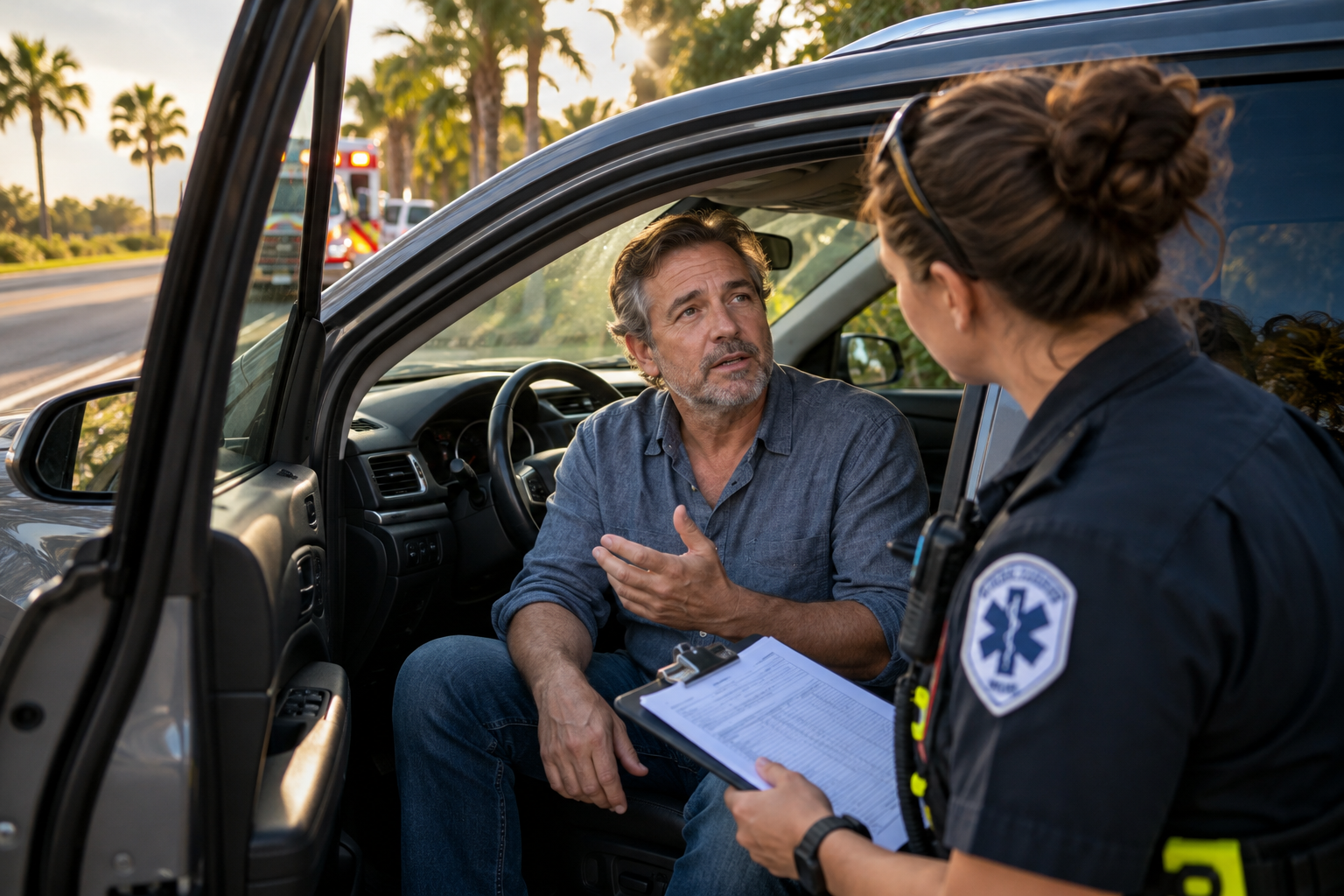
Emergency records begin the timeline immediately after impact. The 911 call, computer-aided dispatch record, body-camera footage, paramedic observations, and emergency-department notes may capture the driver’s condition and earliest explanation before litigation positions harden. Injured people should also keep their own account accurate and avoid guessing. Tucker Law’s guide to a Florida crash with no police report explains how independent documentation can matter when the official record is limited.
The medical history before the trip
The longer timeline asks whether the event was foreseeable to this driver. Relevant evidence may include earlier fainting or seizure episodes, cardiac symptoms, blood-sugar events, medication changes, sleep-related conditions, prior crashes with a similar explanation, medical advice about driving, and restrictions on the driver’s license.
Context matters. A diagnosis alone does not establish that a sudden loss of capacity was likely. Likewise, the absence of a formal diagnosis does not erase repeated warning episodes. The important connection is between what the driver knew or reasonably should have understood before getting behind the wheel and the incapacity claimed after the crash.
Medical privacy is not automatically erased because an insurer mentions a blackout. Relevant records ordinarily must be obtained through proper authorization, subpoena, or discovery procedures, with disputes addressed under applicable rules. A demand for an entire lifetime of records may be broader than the issue. At the same time, a driver who affirmatively relies on a medical event can place relevant medical history squarely in dispute.
Credibility can be as important as the diagnosis
A sudden-incapacity case often depends on information that only the driver initially controls. The first explanation therefore matters. Did the driver tell the passenger, officer, paramedic, emergency physician, and insurer the same thing? Did the account appear only after ordinary negligence became difficult to deny? Are the symptoms described in the recorded history consistent with the medical opinion?
Inconsistency does not prove dishonesty. Trauma can disrupt memory, and witnesses can perceive the same event differently. But a jury is allowed to assess credibility, weigh expert opinions, and compare those opinions with lay testimony and physical evidence. Hernandez confirms that an expert’s conclusion does not automatically displace contradictory facts.
Early insurer interviews can also create lasting evidence. Before agreeing to a call, an injured person should understand who is requesting it and whether a policy imposes a cooperation duty. Tucker Law’s discussion of recorded statements after a Florida crash explains why a supposedly routine conversation deserves care.
A medical emergency does not answer every insurance question
The defense addresses whether the driver was negligent. It does not erase the collision or the injuries, and it does not by itself resolve every available benefit.
Florida personal injury protection coverage generally addresses certain initial medical and disability benefits without deciding fault, subject to the policy and statutory requirements. Claims against a driver or vehicle owner depend on separate liability and coverage rules. Uninsured-motorist coverage, employer responsibility, vehicle ownership, and other potential claims require their own analysis; none should be assumed merely because one insurer accepts or rejects a blackout explanation.
If the driver was operating a company vehicle, additional facts may matter. An employer may have information about required medical certifications, prior incidents, work hours, reported symptoms, or driving restrictions. But company ownership alone does not prove independent negligence. The question is whether a legally recognized duty, breach, and causal connection can be supported with evidence.
For an overview of Florida roadway claims and insurance issues, visit Tucker Law’s Car Accident practice page.
The filing deadline is longer than the life of some evidence
Florida’s current section 95.11 generally places an action founded on negligence within a two-year limitations period. Older incidents and claims involving government entities, wrongful death, minors, or other special circumstances can involve different rules.
That deadline should not be confused with an evidence-preservation window. Surveillance may be overwritten in days. A vehicle may be repaired, sold, or destroyed. Dispatch audio and electronic records may follow agency-specific retention schedules. Passengers’ memories fade, and the driver’s earliest medical presentation can become buried beneath later testing.
The point is not to diagnose the other driver at the scene. It is to preserve the neutral evidence that can later test a medical explanation.
The right question is not simply whether the driver was sick
A genuine, unforeseeable loss of capacity can defeat a Florida negligence claim. A vague recollection gap, a diagnosis written after the collision, or the phrase “medical emergency” cannot do that work by itself.
The defensible analysis asks when capacity was lost, whether it was sudden, what warning existed, and whether the medical opinion fits the vehicle movement and witness accounts. That is why a blackout case should be investigated from both directions: the seconds before impact and the driver’s relevant history before the trip.
If an insurer says a sudden medical event excuses the driver who injured you, Tucker Law can evaluate the evidence and the available coverage before digital records disappear. Explore the firm’s Personal Injury Information Center or contact Tucker Law for a case evaluation.
This article provides general information and is not legal advice for any particular crash or medical condition.