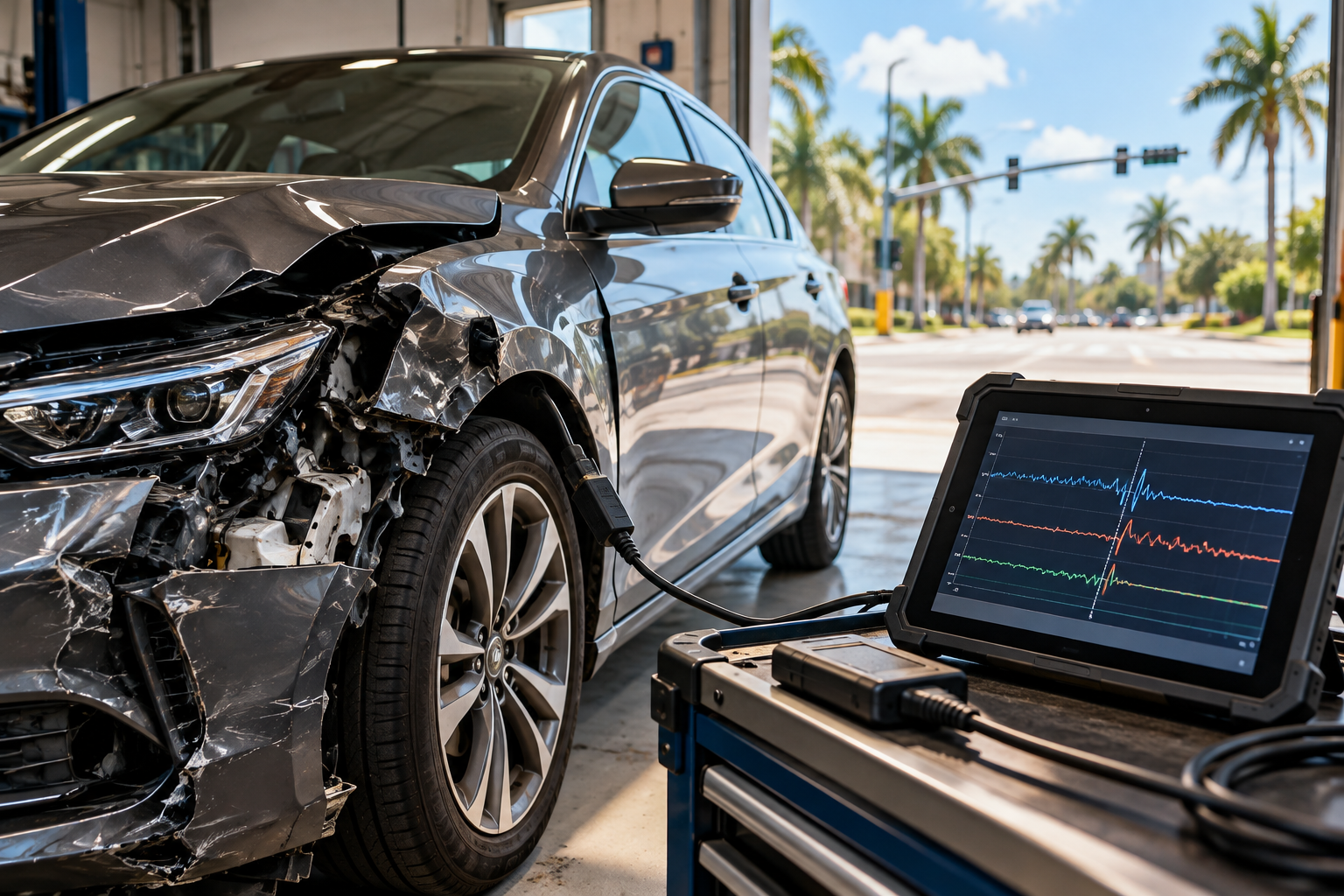
Seconds Before Impact: Reading a Car’s Black Box After a Florida Crash
Two drivers can leave the same Florida intersection with completely different versions of the same crash. One says the other car accelerated. The other says the brakes were already applied. One estimates 35 mph. The other insists it was closer to 55. There may be no neutral witness, and the physical scene may be cleared within an hour.
Modern vehicles can preserve a separate source of evidence: the event data recorder, commonly called the car’s “black box.” The name can make the technology sound more comprehensive than it is. An EDR is not a continuous surveillance system, and it does not replay the collision like a dash camera. It is a short-duration crash data recorder that can preserve selected vehicle and restraint information from the seconds surrounding a triggering event.
For a serious Florida injury claim, that narrow window can matter. Properly interpreted, the data may help test claims about speed, braking, accelerator input, crash severity, seat-belt status, and air-bag deployment. But the download is strongest when it is treated as one piece of a reconstruction rather than a digital verdict.
A black box is not a dash camera, GPS history, or audio recorder
The National Highway Traffic Safety Administration defines an event data recorder as a device or function that records technical vehicle and occupant information for a brief period—seconds, not minutes—before, during, and after a crash event. NHTSA expressly distinguishes EDR information from audio and video recordings.
That means a typical EDR will not tell an investigator what color the traffic light was, what a driver was looking at, whether someone was holding a phone, or which lane another vehicle occupied. It also should not be described as a complete GPS travel history. The recorder answers a narrower set of technical questions about the vehicle itself.
This distinction matters when a client hears that a car has a “black box” and assumes the case is solved. The data may be extremely useful, but it still has to be placed beside photographs, roadway evidence, surveillance video, witness testimony, vehicle damage, and the rest of the crash record. Tucker Law’s article on photographs to preserve after a crash explains why those other sources should be captured before the scene changes.
Federal law standardizes important EDR data, but it does not make every vehicle identical
49 C.F.R. Part 563 sets national requirements for covered light vehicles that are equipped with an EDR. The rule applies to specified passenger cars, multipurpose passenger vehicles, trucks, and buses manufactured on or after September 1, 2012 if they have an EDR. The regulation standardizes data collection, storage, format, survivability, and retrievability; it does not mean that every vehicle on a Florida road contains the same recorder or exposes the same optional data.
The required elements include longitudinal change in velocity during the crash, indicated vehicle speed before the event, accelerator or throttle position, service-brake status, driver safety-belt status, and frontal air-bag deployment information. Depending on what a vehicle records, additional elements can include engine RPM, steering input, anti-lock braking activity, stability-control activity, lateral change in velocity, roll angle, passenger restraint information, and pretensioner deployment.
Those distinctions are important. A reconstruction should identify the exact year, make, model, restraint-control module, software, and supported data elements rather than assuming that one manufacturer’s report will look like another’s.
The 2026 rule change does not mean today’s cars suddenly store twenty seconds
The current version of Part 563 reflects a 2026 amendment to the federal phase-in schedule for longer pre-crash recording. The table now calls for 20 seconds of pre-crash vehicle speed, accelerator or throttle, and brake data at 10 samples per second, but that expanded requirement phases in beginning with vehicles manufactured on or after September 1, 2028. The rule specifies 25 percent of covered EDR-equipped production in the first phase-in year, 50 percent in the next, and 75 percent in the following year, with later dates for certain small-volume and multi-stage manufacturers.
For many EDR-equipped vehicles manufactured before September 1, 2031, the rule still permits the older required interval of five seconds before time zero at two samples per second unless the vehicle falls within the phase-in. That is a major practical point for a 2026 Florida crash. An investigator should not promise twenty seconds of pre-impact history simply because the federal regulation now displays a twenty-second table.
The exact report controls. Some manufacturers may record more than the federal minimum; others may provide only the required information for that vehicle and event.
Speed, braking, and accelerator data can test a driver’s story
Suppose a left-turn crash produces two incompatible accounts. The turning driver says the approaching car was “flying.” The approaching driver says the vehicle was traveling at the limit and braked immediately. The EDR may preserve a sequence of indicated speed, service-brake status, and accelerator position leading into the event.
That sequence can be more useful than any single number. A reconstructionist may be able to evaluate whether the indicated speed was steady, increasing, or decreasing; when the brake signal changed; whether the accelerator was released; and how those changes align with physical evidence and video. In a case involving disputed turning movements, the same analysis can complement the issues discussed in Tucker Law’s article on Florida left-turn crashes.
But an EDR does not identify legal fault. A vehicle traveling at a particular speed may still have the right of way, may be approaching a stale green light, may be reacting to another road user, or may have insufficient time to avoid a sudden incursion. The data answers factual questions. Florida negligence and comparative-fault questions require the rest of the circumstances.
Delta-V helps describe the crash, not diagnose the injury
EDRs commonly report longitudinal delta-V—the change in the vehicle’s velocity during the crash—and some systems record lateral delta-V as well. That information can be valuable when engineers assess crash severity, force direction, and the sequence of impacts. NHTSA itself uses EDR information in crash research and investigation.
Delta-V should not be converted into a medical conclusion by itself. A person’s injury depends on more than vehicle change in velocity: seating position, occupant movement, belt and pretensioner performance, air-bag interaction, age, body mechanics, prior conditions, intrusion, direction of force, secondary impacts, and other facts can matter. The medical evidence remains necessary to establish what injuries occurred and what caused them.
Restraint information can also require careful interpretation. A reported driver-belt status and air-bag deployment time may help reconstruct occupant protection, but the meaning of a specific field should be confirmed against the manufacturer’s data-reporting documentation and the physical condition of the restraints.
The recorder has limits that can create false confidence
Part 563 defines “speed, vehicle indicated” as the speed reported by a manufacturer-designated subsystem. The regulation also specifies ranges, accuracy requirements, and sampling intervals. In other words, the download is measured data with defined parameters—not a frame-by-frame film of reality.
A reconstructionist should examine whether a field is supported for that vehicle, whether the file is complete, whether any sensor reached its design range, and whether multiple events were recorded. The report should also be compared with tire evidence, roadway marks, vehicle damage, known signal timing, video, GPS or telematics when independently available, and measurements from the scene.
NHTSA’s own EDR research describes the information as a powerful investigative tool while cautioning that it has limitations and should be used with other data sources. Its Special Crash Investigations program follows that same approach: investigators collect EDR data when available, but also inspect the scene and vehicles, photograph damage, interview crash participants, and review official and medical records.
Who owns the data can matter before anyone touches the module
The federal Driver Privacy Act treats data retained by an EDR as the property of the vehicle owner, or the lessee when the vehicle is leased. It generally restricts access by others unless a statutory exception applies, including owner or lessee consent, authorization from a court or other qualifying authority, certain federal safety investigations, emergency medical response, or qualifying traffic-safety research. The relevant federal provisions appear in the Driver Privacy Act of 2015.
That is one reason an injury investigation should distinguish preservation from extraction. A party can request that a vehicle and its electronic data be preserved without assuming a right to plug into someone else’s car immediately. Access can then be handled through consent, discovery, court process, or another lawful route that fits the case.
The same principle matters when a vehicle is leased, rented, financed, totaled, or sitting at a tow yard. The person driving at the time of the crash may not be the person whose authorization controls the EDR download.
Waiting can make a technically recoverable file practically inaccessible
Part 563 treats deployment and non-deployment events differently. For qualifying air-bag deployment events, the required event memory must be locked against future overwriting. For certain non-deployment events, however, manufacturers may use buffers that can be overwritten by later qualifying events when no empty memory buffer remains.
Even when the data itself remains intact, access to the vehicle can disappear. A totaled car may move from a tow yard to a salvage auction. A repair shop may replace the restraint-control module. An insurer may release the vehicle. A leased or rental vehicle may return to a fleet. Those changes can turn a straightforward inspection into a chain-of-custody and access problem.
For that reason, preserving a serious crash claim should identify the vehicle and the electronic evidence early. A preservation demand can address the EDR or air-bag control module, the vehicle itself, available telematics, onboard cameras, infotainment data where relevant, and other electronic sources without assuming they all store the same information.
The cleanest download is one that can be explained later
When EDR evidence may be important, the download should be performed in a way that permits another expert, insurer, court, or jury to understand how the report was obtained. The process should document the vehicle identification number, module and retrieval method, date and location, condition of the vehicle, software or tool used, original report files, photographs of the connection and vehicle, and any warnings or limitations displayed during retrieval.
A qualified reconstruction professional can then compare the electronic record against the physical evidence. NHTSA’s Crash Investigation Sampling System illustrates why that combination matters: its trained technicians document scene evidence and vehicle damage, inspect safety systems, and assemble a broader factual picture rather than relying on a single data source.
That same discipline helps in ordinary Florida litigation. An EDR report can corroborate a witness, contradict an estimate, narrow a speed range, or reveal a braking sequence. It can also be inconclusive. The value comes from fitting the data to the crash, not forcing the crash to fit the data.
Preserve the car before the evidence becomes someone else’s problem
The best time to ask whether a vehicle has useful crash data is before it is repaired, sold, salvaged, or returned to a fleet. Tucker Law’s car-accident practice evaluates the physical and electronic evidence that can matter in serious Florida collisions, while the Personal Injury Information Center provides broader guidance about protecting an injury claim.
If a disputed Florida crash caused serious injuries and speed, braking, vehicle movement, or restraint performance may become important, the vehicle’s EDR should be considered early—not after the car has disappeared into the salvage system. Request a Tucker Law car-accident case review so the available scene, vehicle, electronic, insurance, and medical evidence can be evaluated together.
This article provides general information and is not legal advice. EDR availability, recorded fields, access rights, admissibility, and evidentiary significance depend on the vehicle and the facts of the particular case.