The Recall Says Stop Using the Blanket. A Burn Claim Says Preserve the Evidence.
A heated blanket starts smoking in the middle of the night. The immediate choices are obvious: unplug it if that can be done safely, get away from the heat, and deal with the burn. A day later, an email arrives offering a refund under a federal recall. That message creates a less obvious choice. The recall program may tell the owner how to obtain a refund, while an injury investigation may depend on the blanket, its controller, the packaging, and the digital order history still existing.
Safety comes first. No one should keep using a product that may overheat, and no one should handle an actively burning or energized item merely to save evidence. But once the emergency has passed, returning, cutting, washing, repairing, or discarding the product without a preservation plan can make it much harder to determine what failed.
A September 2026 recall gives the issue unusual urgency
On September 17, 2026, the U.S. Consumer Product Safety Commission announced the recall of about 195,000 JKMAX heated blankets and heating pads. According to CPSC, the internal wire heating elements can overheat and create fire and burn hazards. The agency reported that JKMAX knew of 577 incidents involving smoking, melting, or burning and 53 burn injuries.
The recall covers all JKMAX heated blankets and heating pads, including listed models JKMAX-002, JKMAX-7284B, JKMAX-6284B, JKMAX-10090B, and JKMAX-8490B. CPSC says the model number appears on the back of the detachable white remote and on a white label attached to the packaging. The products were sold on Amazon from September 2022 through July 2026. CPSC’s direction is clear: stop using the recalled product immediately and contact JKMAX for a full refund.
That safety instruction should be followed. It does not answer every question that arises after an injury.
The refund and the injury claim solve different problems
A recall remedy is designed to remove a hazardous product from use and compensate the consumer for the purchase. A burn may create losses far beyond the price of a blanket: emergency treatment, wound care, infection, time away from work, grafting or reconstructive treatment, permanent discoloration or scarring, nerve symptoms, sleep disruption, and the emotional effects of a fire in the home.
A refund is therefore not the same thing as compensation for an injury. Nor does a recall announcement automatically establish that a particular unit was defective or that it caused a particular burn. Before accepting terms, sending the product away, or making a certification about its destruction, an injured consumer should understand exactly what the recall process requires and whether any document includes a release of claims.
This is where a Florida personal injury investigation and a consumer recall begin to move on parallel tracks. One focuses on getting a dangerous item out of service. The other asks what happened, why it happened, who was in the distribution chain, and what harm followed.
The product itself can answer questions that photographs cannot
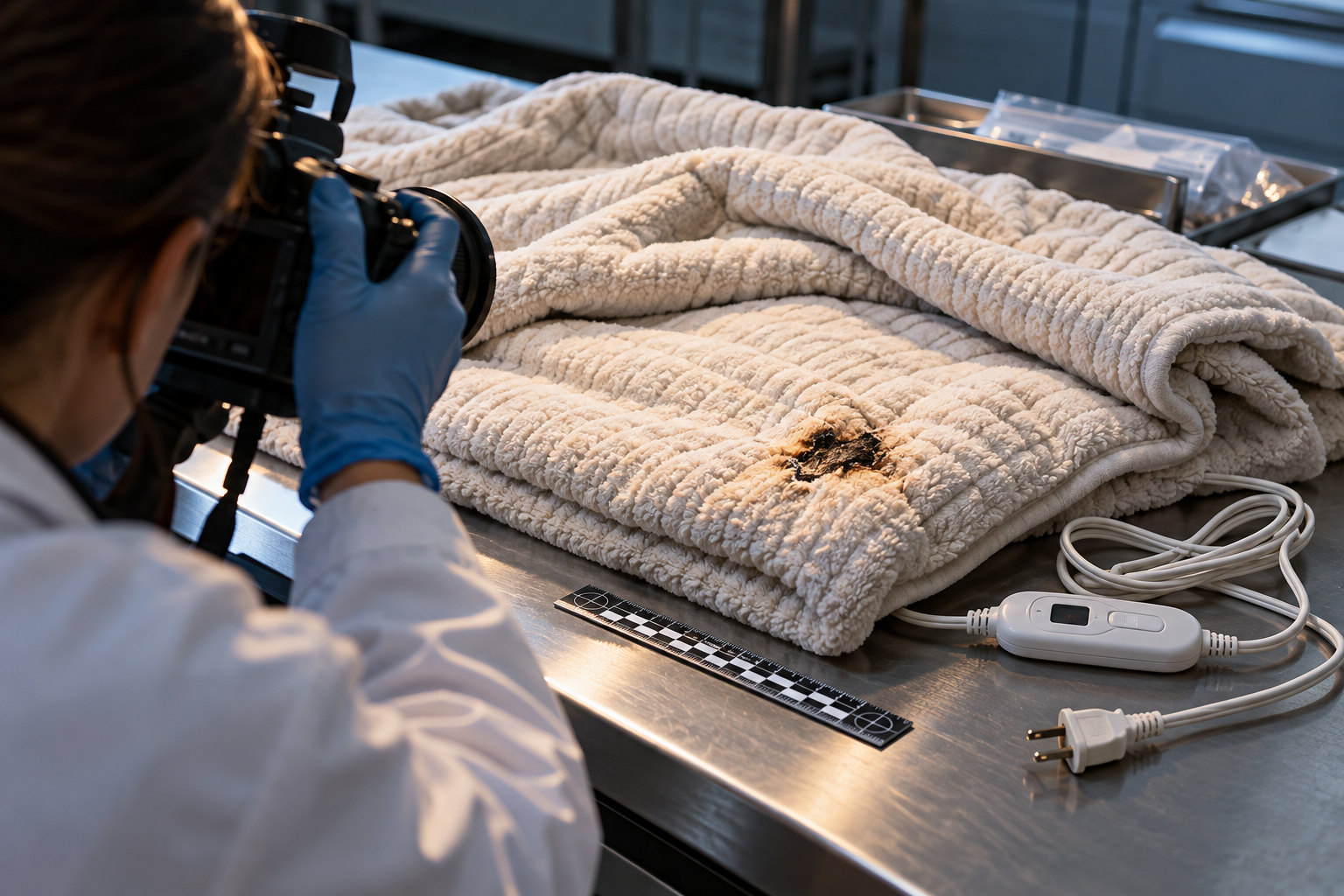
A photograph can show a scorched area. It cannot always reveal whether an internal wire broke, a connection arced, the controller malfunctioned, the fabric trapped heat, or the unit was altered after sale. Those questions may require an engineer to inspect the blanket, cord, plug, controller, and the surface on which the product was used.
The condition of the entire scene matters. The controller setting, wall outlet, extension cord, bedding, mattress, smoke detector, and nearby damaged property may help distinguish among competing explanations. So may the owner’s manual, packaging, purchase receipt, Amazon order page, recall email, product listing, photographs taken before cleanup, fire-department records, and communications with the seller or importer.
Digital records are especially easy to lose. Product pages change. Marketplace sellers disappear. Accounts stop displaying old messages. That is why the same basic preservation lesson discussed in Tucker Law’s article on vanishing evidence after a collision applies here too: the evidence that exists today may not be available when a claim is evaluated months later.
Preservation must be safe, not improvised
If a blanket or pad is hot, smoking, burning, or still connected to electricity, the priority is people—not property. Leave the area, call 911 when appropriate, and follow the directions of firefighters or other safety officials. Do not re-energize the product to recreate the event. Do not open the controller, cut into the fabric, wash away residue, or attempt a repair.
After the item is no longer an immediate hazard, photographs can document all sides of the product, the controller and its model label, the plug, cord, damaged area, packaging label, and the wider scene. The date, time, heat setting, how long the product had been on, where it was positioned, and who first noticed smoke or heat should be written down while memories are fresh. Clothing and bedding with burn patterns may also matter.
Storage requires judgment. A damaged electrical product should not be placed in an occupied living area simply because it may be evidence. Fire authorities, a qualified professional, or counsel can help arrange secure storage or inspection. If an official directs that the item be surrendered or destroyed for safety reasons, document its condition and the instruction as fully as circumstances permit. Preservation should never create a second emergency.
A federal recall is important evidence, but it is not the whole Florida case
Florida product cases can involve different theories, including a manufacturing defect, a design defect, inadequate warnings, or negligence. The correct theory depends on the product and the evidence. Florida’s standard civil jury instructions for product liability distinguish, among other things, a unit that departed from its intended design from a design that was unreasonably dangerous. They separately require proof that the defect or negligence legally caused the injury.
The CPSC notice can help identify the product, describe the reported overheating hazard, and establish the scope and timing of the recall. It does not prove that every covered unit failed in the same way. A claimant still must connect the particular blanket or pad to the incident and connect the incident to the claimed injuries. The defense may ask whether the product was substantially changed, whether it was used as instructed, whether another electrical source caused the damage, or whether the injury occurred as described.
Those questions explain why the controller, labels, order records, medical documentation, and scene evidence all matter. A recall can supply context. The product-specific proof builds the case.
The seller on the screen may not be the only company to investigate
Online purchases can obscure the path from factory to bedroom. The brand name, importer, marketplace, storefront seller, fulfillment records, and any domestic distributor may identify different entities. CPSC’s notice names Jiande Pengshuai Trading Co., Ltd., of China as the importer for the recalled JKMAX products and Amazon as the online sales channel. Those facts are a starting point, not a conclusion about who is legally responsible in an individual case.
An investigation may trace invoices, import records, product listings, insurance coverage, testing, warnings, complaints, and recall communications. It may also examine when a seller or other participant learned of the alleged hazard and what happened afterward. Because parties and legal theories can differ from case to case, it is risky to assume that the name printed on the blanket is the only relevant name.
Burn evidence changes as the body heals
The product is only half of the proof. Burns evolve. Swelling, blistering, infection, pigment changes, scarring, and loss of sensation can look different over days and months. Contemporaneous medical records and a consistent series of photographs may show that progression better than a single image taken after healing.
Follow-up care can also clarify whether an injury is superficial or will require long-term treatment. For more serious burns, the consequences may overlap with the losses discussed on Tucker Law’s catastrophic injury page. Records of prescriptions, dressings, mileage to appointments, missed work, assistance with daily activities, and recommended future care help translate the injury into documented losses.
Medical attention should be based on health needs, not litigation strategy. But unexplained gaps, missing photographs, and discarded treatment instructions can leave an incomplete picture later. Tucker Law’s Personal Injury Information Center collects broader guidance about protecting a Florida injury claim.
Florida’s deadlines do not all look alike
Florida’s current limitations statute generally gives four years for an action seeking recovery for personal injury founded on the design, manufacture, distribution, or sale of personal property. Ordinary negligence actions generally have a two-year period. Florida law also contains accrual and product-repose rules, including special language tied to discovery and the age and expected useful life of a product. The applicable deadline can therefore depend on the theory, dates, and product history—not simply the day a recall was announced.
The relevant provisions are Florida Statutes section 95.11 and section 95.031. A general explanation of Florida filing periods is also available in Tucker Law’s article, How Long Do I Have to File a Personal Injury Claim in Florida? A deadline, however, is the last permissible filing point—not a safe timetable for preserving a heat-damaged product or a changing online sales record.
Before the blanket becomes only a refund receipt
The safest sequence after a suspected product fire or burn is not complicated in principle: protect people, stop using the product, obtain appropriate medical care, and then preserve what can be preserved without creating a new hazard. The difficult part is coordinating the recall remedy with the evidence an expert may need.
If a heated blanket or pad caused a serious burn or fire in Florida, Tucker Law can evaluate the product identity, recall documents, distribution chain, medical losses, and preservation options before the item is returned or destroyed. Contact Tucker Law to discuss the incident and the next safe step.
This article provides general information and is not legal advice. Product-liability claims are fact-specific, and reading this article does not create an attorney-client relationship.