The WALK Signal Was On. What Proves Fault After a Florida Crosswalk Crash?
The pedestrian sees WALK and steps into a marked crosswalk. A driver facing green begins a right turn, looks left for approaching cars, and strikes the pedestrian from the right. Both insist the signal favored them.
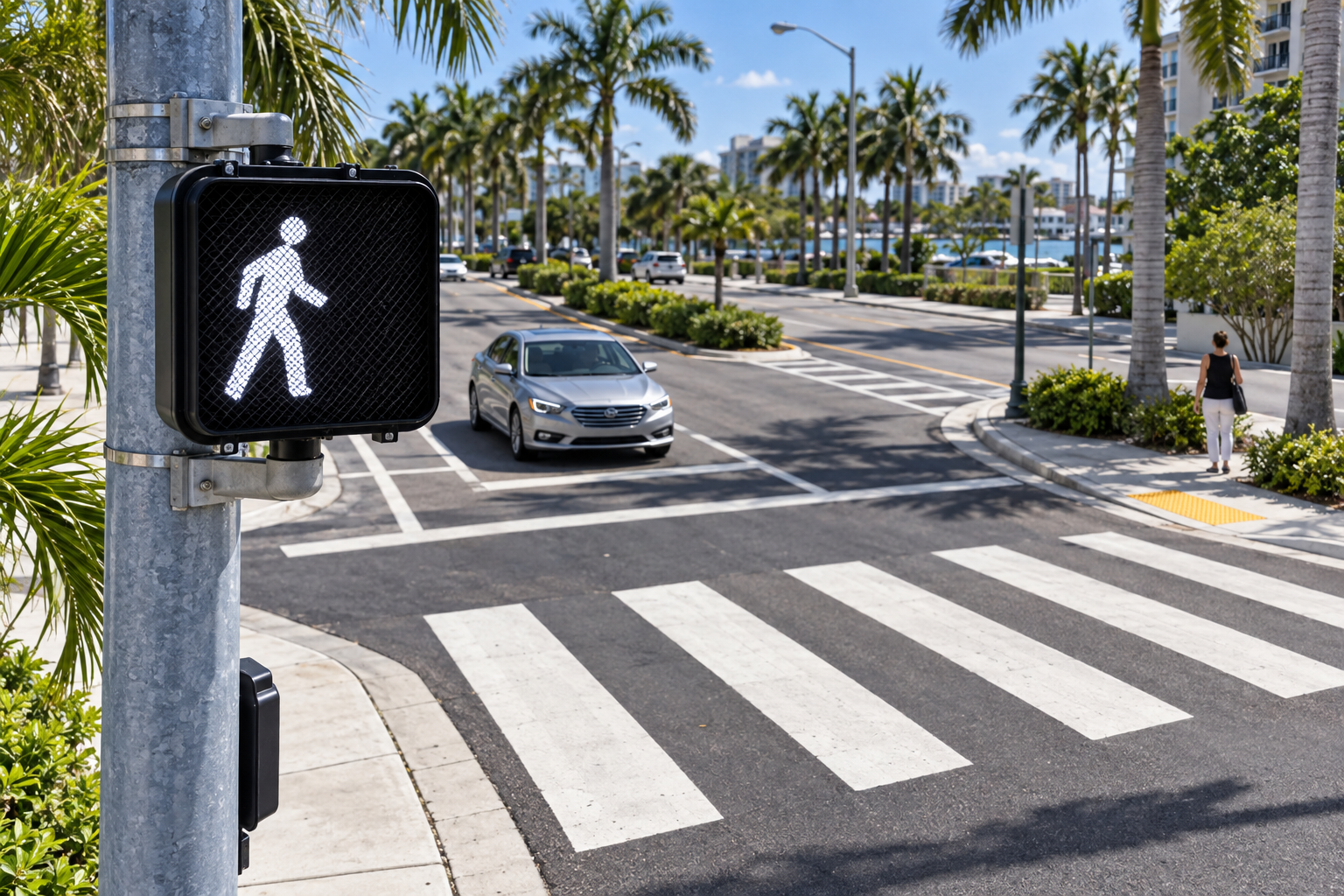
That is not a contradiction. At many Florida intersections, a pedestrian crossing phase runs at the same time that vehicles are permitted to turn. The WALK indication matters, but it does not answer every fault question. The turning path, the pedestrian’s location, the signal sequence, and what each person could see in the seconds before impact can decide a Florida crosswalk accident claim.
The stakes are unusually high. In its 2026 Strategic Highway Safety Plan, the Florida Department of Transportation reports that more than 17,000 people died and nearly 78,000 suffered serious injuries on Florida roads from 2020 through 2024. Pedestrians and bicyclists accounted for 28% of roadway fatalities. Those numbers help explain why a crosswalk investigation should go beyond asking which light appeared green.
A green light does not give a turning driver an empty intersection
Florida law expressly separates permission to move from priority over everyone else in the intersection. Under Florida Statutes section 316.075, a driver facing a circular green may proceed cautiously and turn unless the movement is prohibited. The same provision requires a driver turning right or left to yield to pedestrians lawfully within the intersection or an adjacent crosswalk.
A green arrow is not an absolute shield either. The statute still requires traffic moving on the arrow to yield to pedestrians lawfully within an adjacent crosswalk. A driver turning right on red must first stop and then yield to pedestrians and other traffic proceeding as directed by the signal.
Section 316.130 adds a more specific duty at a signalized intersection. A driver must stop before entering the crosswalk and remain stopped to allow a pedestrian with a permitted signal to cross when the pedestrian is in the driver’s half of the road—or is approaching so closely from the opposite half as to be in danger. The statute also requires every driver to exercise due care to avoid colliding with a pedestrian.
So “I had a green light” may establish that the driver was allowed to enter the intersection. It does not establish that the driver was allowed to turn through an occupied crosswalk.
The important signal is the one showing when the pedestrian entered
A collision photograph usually shows where the pedestrian landed, not when the crossing began. That distinction matters because the pedestrian signal can change while someone is already crossing.
An investigator should reconstruct the entire phase: when the WALK indication began, when the pedestrian left the curb, when the vehicle received green, when the turn began, and where the impact occurred. A witness who arrived after the collision may accurately remember a red hand or countdown without knowing what the pedestrian saw at entry. Likewise, a driver may accurately remember a green vehicular signal without recognizing that the pedestrian phase was running concurrently.
Florida Statutes section 316.0755 requires installed pedestrian indicators to conform to the current Manual on Uniform Traffic Control Devices. But the face of the signal is only the visible end of a programmed system. The operating agency may have signal-timing sheets, phase diagrams, maintenance records, approved timing changes, and, depending on the controller and retention practices, electronic event data. Those records can turn two honest but incomplete memories into a second-by-second sequence.
The physical layout also matters. The location of the push button, curb ramp, stop bar, crosswalk markings, signal heads, and turning lane can help establish where each person was positioned. Tucker Law’s Florida left-turn evidence guide discusses related proof in vehicle-to-vehicle crashes. A pedestrian case adds a separate timing system and a far more vulnerable road user.
Leading pedestrian intervals reveal why a few seconds matter
Some intersections give pedestrians a head start before parallel traffic receives green. The Federal Highway Administration calls this a leading pedestrian interval, or LPI. FHWA describes an LPI as allowing pedestrians to enter the crosswalk three to seven seconds before vehicles receive green, making pedestrians more visible before drivers are permitted to turn.
FDOT’s 2026 safety plan says LPIs have produced a 13% reduction in pedestrian crashes. That does not mean the presence or absence of an LPI automatically establishes negligence. It shows why timing is evidence. A pedestrian who had several seconds to become established in the crosswalk presents a different visibility question from someone who stepped off the curb at the same instant a driver began turning.
The timing plan in effect on the crash date is essential. Intersections can operate differently by time of day, during special events, after construction, or following a maintenance change. A current field observation may not reproduce the programming that controlled the intersection months earlier.
A turning crash often begins with the driver’s eyes somewhere else
A right-turning driver commonly looks left for a gap in traffic. A left-turning driver may focus on oncoming vehicles. In either movement, the pedestrian can be directly ahead or approaching from the driver’s side while the driver’s attention is aimed elsewhere.
That makes sight lines more useful than a generic statement that the pedestrian was “visible.” The useful questions are specific. From the driver’s stopped position, was the pedestrian obscured by the windshield pillar, mirror, another vehicle, landscaping, construction fencing, or glare? Did the driver roll across the stop bar or crosswalk while watching traffic from the opposite direction? How far had the pedestrian traveled before impact? Was the turning speed consistent with a driver searching for people in the crosswalk?
Video may answer several of those questions at once. Nearby businesses, residences, buses, parking facilities, and traffic-management systems may have cameras pointed toward an intersection even when no camera captured the impact directly. Reflections, shadows, brake lights, vehicle movement, and the moment bystanders react can still help establish timing. Tucker Law’s article on dash-camera evidence explains why the original file and its authenticity matter, not merely a clipped copy sent by text.
The vehicle and phone can preserve the driver’s timeline
Late-model vehicles may contain event data, infotainment connections, driver-assistance information, diagnostic records, or telematics that help reconstruct speed, braking, steering, and system alerts. The available data varies by vehicle and may be overwritten, so the vehicle should be identified and preserved before repair, sale, or destruction.
Phone evidence can be relevant when distraction is disputed, but a billing record that shows no traditional call or text does not rule out every use. App activity, notification records, connected-device data, photographs, navigation, and screen interactions may require a properly limited forensic review. The goal is not to obtain someone’s entire digital life. It is to preserve and examine information tied to the short window surrounding the turn.
The pedestrian’s devices may also help. A fitness watch can record movement, a phone photograph can preserve conditions, and location history may corroborate the route. Those records should be preserved in their original form. Screenshots alone can omit timestamps, metadata, or surrounding context.
The pedestrian’s conduct remains part of Florida’s fault analysis
A permitted signal does not excuse every pedestrian action. Section 316.130 requires pedestrians to obey applicable traffic-control devices. It also prohibits a pedestrian from suddenly leaving a curb or other place of safety and moving into the path of a vehicle so close that yielding is impossible.
Those rules are why entry timing matters. A defense may contend that the pedestrian started late, moved outside the crosswalk, was distracted, or entered too abruptly for the driver to react. The answer should come from evidence—signal phases, video, measurements, witnesses, damage, device data, and the vehicle’s path—rather than from the severity of the injuries or assumptions about who “must” have been watching.
Florida’s modified comparative-fault rule makes the dispute consequential. Under section 768.81, fault assigned to an injured person ordinarily reduces recoverable damages proportionately. In covered negligence actions, a person found more than 50% responsible for his or her own harm cannot recover damages. Tucker Law’s discussion of shared fault after a Florida crash explains why a few percentage points can change the outcome.
A crash report cannot preserve a changing intersection
The responding officer may record signal controls, road conditions, witness names, and an initial diagram. That is useful, but the physical and electronic scene begins changing immediately. Vehicles leave. Skid or scuff marks fade. Businesses overwrite video. Signal timing is updated. Construction devices move. A witness who was certain on day one may become harder to locate weeks later.
Prompt documentation should capture all four approaches to the intersection, not only the impact point. Photographs taken from the driver’s eye level and the pedestrian’s route can reveal sight obstructions that an overhead map misses. Measurements can place the impact within the crosswalk and show how far the pedestrian had traveled. Requests to the operating agency can seek the timing plan and maintenance history that applied on the crash date.
A serious pedestrian injury may also involve several insurance questions. PIP benefits, the driver’s bodily-injury coverage, uninsured or underinsured motorist coverage, a commercial or employer policy, and other coverage can depend on the facts. Tucker Law’s Florida car-accident practice and Personal Injury Information Center provide broader guidance on investigating crashes and available compensation.
The WALK signal starts the inquiry; it does not finish it
After a Florida crosswalk crash, the most reliable account is rarely one person’s memory of one light. Fault becomes clearer when the signal program is aligned with movement: when the pedestrian entered, when the driver was permitted to turn, what each could see, and what the vehicle did before impact.
That evidence can confirm that a pedestrian was lawfully established in the crosswalk while a turning driver failed to yield. It can also identify genuine issues about entry timing or shared fault. Either way, the investigation should occur while the intersection’s temporary evidence still exists.
If a turning vehicle caused a serious pedestrian injury, Tucker Law’s Fort Lauderdale pedestrian-accident team can investigate the signal sequence, sight lines, video, vehicle data, and available insurance. Contact Tucker Law before short-lived records are overwritten or the scene changes.
This article provides general information about Florida law and is not legal advice. Rights and deadlines depend on the facts of each incident.