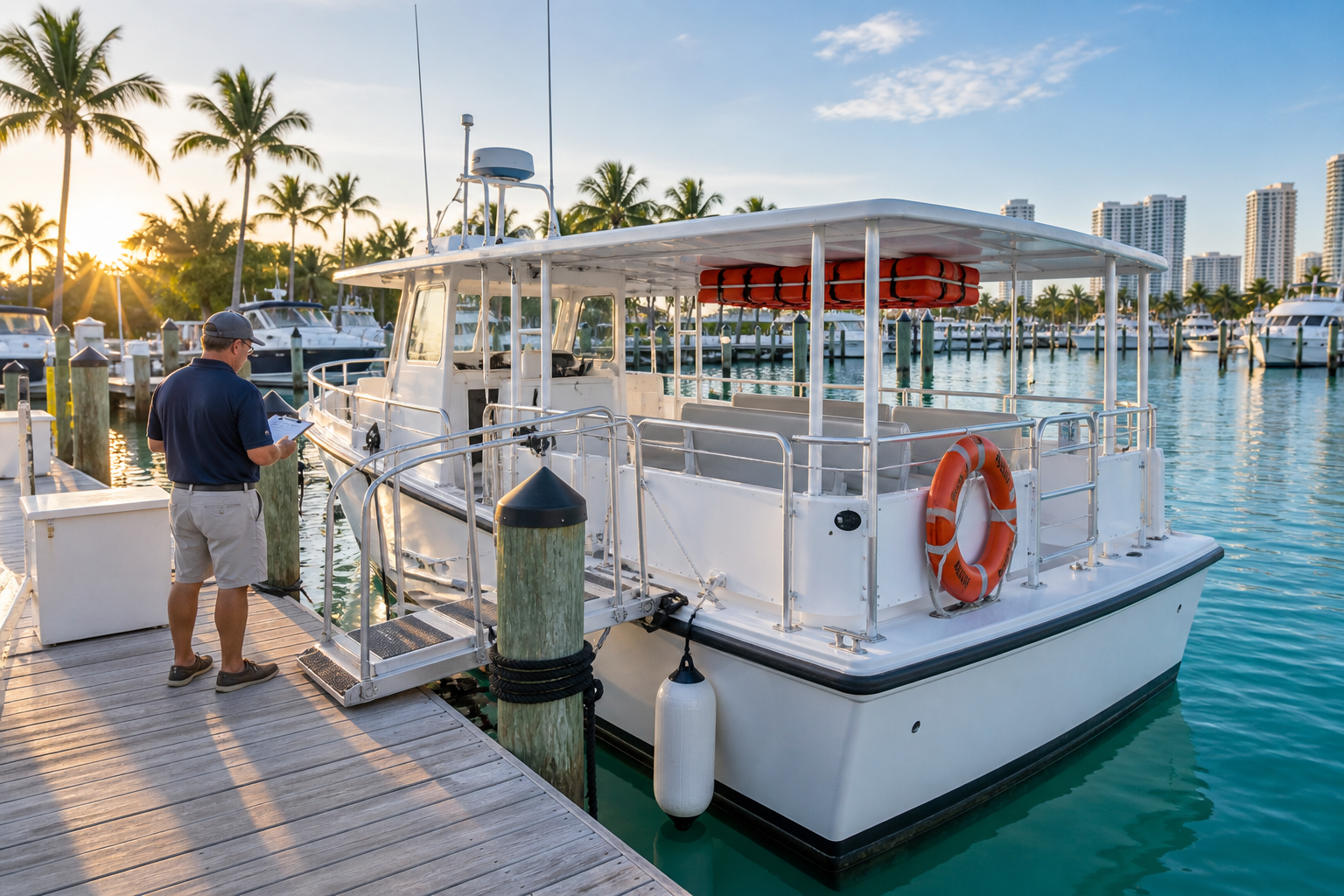
The Boat Came With a Captain. Was the Florida Charter Actually Legal?
A group books a boat online for a birthday trip. The listing promises a captain, fuel, music, and a few hours on the water. Payment is made to one company, the vessel belongs to someone else, and a captain appears at the dock. After a collision or a fall on deck, everyone uses the same word for the trip: “charter.”
Legally, that word is only the beginning.
The paperwork and the way the trip actually operated can determine whether the captain needed a federal credential, whether the vessel needed a Coast Guard inspection certificate, who controlled the boat, and which insurance policy may respond. Those questions have become especially timely in Florida. On August 31, 2026, the U.S. Coast Guard’s Southeast District warned about illegal passenger-for-hire operations and reported that its crews had stopped more than 100 suspected illegal charters across the Southeast since January. Three days later, the Coast Guard announced increased Labor Day enforcement through Operation Safe Voyage.
For an injured passenger, an illegal operation does not automatically establish a civil case. But it can expose facts that matter greatly: who was qualified to operate, what safety rules applied, whether the advertised arrangement was genuine, and who should have prevented the incident.
The first question is not what the document is called
A traditional passenger-for-hire trip and a true bareboat charter are not the same arrangement. On a passenger-for-hire trip, the operator provides transportation for paying passengers. A bareboat charter is supposed to transfer possession and operational control of the vessel to the charterer for the agreed period.
That distinction cannot be created by a heading at the top of a contract. The real-world facts matter. Who selected and paid the captain? Could the customer choose a different qualified captain? Who controlled the route? Who supplied the crew, fuel, food, and safety equipment? Could the owner cancel the voyage or direct how the boat was operated?
The Coast Guard’s August warning tells customers reviewing a purported bareboat contract to ask whether the owner allowed them to choose the captain and crew, and whether the owner was also acting as operator. Those are practical warning signs because an owner cannot retain the substance of control while relying only on the label “bareboat charter.”
After an injury, preserve the advertisement and the booking flow—not merely the final contract. Screenshots may show that the owner marketed a package with a mandatory captain even if the document signed at the dock says the customer selected the crew. Payment records, text messages, emails, platform messages, and crew instructions can reveal how the business actually worked.
Why the captain’s credential and the passenger count matter
The Coast Guard advises anyone paying for a vessel trip to verify that the operator holds an appropriate Merchant Mariner Credential. Federal manning rules address who may operate an uninspected passenger vessel, including through 46 C.F.R. § 15.905. A Florida boating-safety card is not a substitute for the federal credential required to carry passengers for hire.
Passenger count can change the regulatory picture. The Coast Guard’s current Florida-focused warning says that a charter boat carrying more than six passengers should have a Coast Guard-issued Certificate of Inspection. A certificate is not decorative paperwork. Under 46 C.F.R. § 176.103, it describes matters such as the authorized route, manning, required lifesaving and fire-protection equipment, and the maximum number of passengers and persons aboard.
The count is not always as simple as counting heads in a photograph. The governing definitions distinguish passengers, crew, owners, and charterers, and the legal character of the trip can affect the analysis. That is why investigators should obtain the passenger manifest, crew list, credential endorsements, Certificate of Inspection, and the complete charter agreement rather than relying on the operator’s description.
An illegal charter finding is evidence—not a substitute for causation
Suppose a captain lacked the required credential, or the boat carried more paying passengers than authorized. Those facts may support an argument that important safety rules were ignored. They do not, standing alone, answer why the passenger was injured.
The civil case still turns on the chain between conduct and harm. Did the captain travel too fast for the traffic and sea conditions? Was there an inadequate lookout? Did overloading affect stability or safe movement? Were required lifejackets, fire equipment, or emergency procedures missing? Was the captain unfamiliar with the route? Did the vessel depart despite a mechanical defect or dangerous weather?
Florida law requires a vessel operator to act reasonably and prudently in light of traffic, wake restrictions, speed, overloading, and the surrounding circumstances. It also directs operators to follow navigation rules. Those duties appear in Florida Statutes § 327.33. When federal maritime law applies, federal rules and maritime negligence principles may also shape the case. The location of the incident, the vessel’s use, and the activity involved all matter.
This is why a Coast Guard termination or citation can be important without being conclusive. It may identify a regulatory failure, but the injury claim must connect the failure—or some other negligent act—to the collision, fall, fire, grounding, propeller strike, drowning, or other casualty.
The captain may not be the only party whose conduct matters
A paid boat trip can involve a captain, a vessel owner, a charter business, a booking company, a management company, and contractors who maintain the vessel. Their names may appear in different places, and the company that accepted payment may not own the boat.
Florida’s vessel-liability statute contains an important limitation. When Florida law governs, Florida Statutes § 327.32 generally confines liability for reckless or careless operation to the operator in immediate charge, unless the owner was operating or was present when the injury occurred. That makes it risky to assume that ownership alone creates liability in the same way people may expect after a road crash.
It does not end the investigation. An owner or business may have its own alleged acts to answer for, such as knowingly providing an unqualified captain, supplying an unsafe vessel, retaining operational control, failing to maintain equipment, or misrepresenting the nature of the service. Whether such a claim exists depends on the facts and on the law governing the voyage. Federal maritime doctrines may affect duties, damages, procedure, and potential defenses.
The same care is needed with online booking platforms. A platform that merely displays a listing occupies a different position from a company that sets the operational terms, collects the fare, selects the captain, or manages the voyage. Contracts, corporate records, and the actual course of dealing must establish each party’s role.
Legality and insurance are separate questions
A polished listing, large social-media following, or marina departure does not prove that the operation is insured for commercial passenger service. Recreational boat policies may contain business-use or passenger-for-hire exclusions. A policy may cover the vessel in ordinary personal use yet dispute coverage for the very trip on which the injury occurred.
Conversely, a regulatory violation does not necessarily mean every potential policy disappears. Coverage depends on the policy language, the insureds, the use of the vessel, notice, and the facts of the loss. The practical response is to identify all possible policies early: vessel liability, commercial marine coverage, any charter-business policy, umbrella coverage, and policies held by separately involved companies.
Do not let an operator’s statement that “there is no insurance” end the inquiry. Request the policy and the written coverage position. The absence of obvious coverage also makes accurate identification of the captain, owner, contracting entity, and payment recipient especially important.
The best evidence may never appear in the accident report
On the water, the physical scene moves away. Electronic records can become the closest thing to a fixed roadway.
A chartplotter or navigation app may preserve speed, heading, and track. An automatic identification system record may show vessel movements. Engine-control modules can hold operating data. Phones may contain location history, photographs, videos, messages, and weather checks. Marina cameras may record boarding, passenger count, alcohol being loaded, or visible damage before departure. The booking service may retain versions of the listing and documents that are no longer visible to the customer.
The vessel itself should also be inspected before repairs alter it. Depending on the incident, relevant evidence may include railings, nonskid surfaces, ladders, propellers, fire-suppression equipment, flotation devices, bilge systems, lighting, radios, and engine cutoff equipment. Maintenance and repair records can show whether a problem was known before the trip.
Florida requires prompt notice to law enforcement when a boating casualty involves specified events, including an injury requiring treatment beyond immediate first aid, death, disappearance, sinking, or qualifying property damage. The duties are set out in Florida Statutes § 327.30. When the vessel was leased, rented, or chartered, § 327.301 also places reporting responsibility on the person who offered it for lease, rental, or charter.
But an official report is not the whole case. Section 327.301 restricts the use at trial of an involved person’s required accident report and statements made to complete it. Independent witnesses, photographs, electronic data, physical inspections, and an officer’s own observations may therefore become decisive. Tucker Law’s broader guide to what to do after a Florida boating accident explains the immediate safety and documentation steps.
A charter claim can cross legal boundaries quickly
A collision on the Intracoastal, an injury offshore, and a fall while the boat is tied to a dock may raise different jurisdictional questions. The contract may include a forum-selection clause, arbitration provision, liability language, or a notice requirement. Maritime law may govern some issues while Florida law supplies others. A large cruise-ship ticket presents another set of contractual and federal issues; Tucker Law addresses those separately in its cruise ship accident practice.
For a local charter passenger, the immediate goal is not to solve jurisdiction without help. It is to preserve every version of the contract, save the full booking record, identify the vessel and businesses, and avoid signing a release before the legal relationships and available coverage are understood. Do not assume the ordinary deadline for a Florida land-based injury is the only clock that may apply.
The real issue is who controlled the risk
An illegal charter case is not merely about a missing card or sticker. Credentials, inspection status, passenger count, and contract structure help reveal who controlled the voyage and whether required safeguards were bypassed. The most useful investigation compares the documents with what actually happened at the dock and on the water.
If you were injured on a paid Florida boat trip, Tucker Law can investigate the captain’s credentials, vessel status, ownership, charter documents, electronic track data, and potential marine insurance. Learn more through our Fort Lauderdale boating accident practice and Personal Injury Information Center. When a boating casualty results in a death, different parties and damages may be involved under Florida wrongful death law.
To discuss the facts before the booking trail or vessel evidence changes, contact Tucker Law for a free case review. Don’t Just Lawyer Up. Tucker Up®.