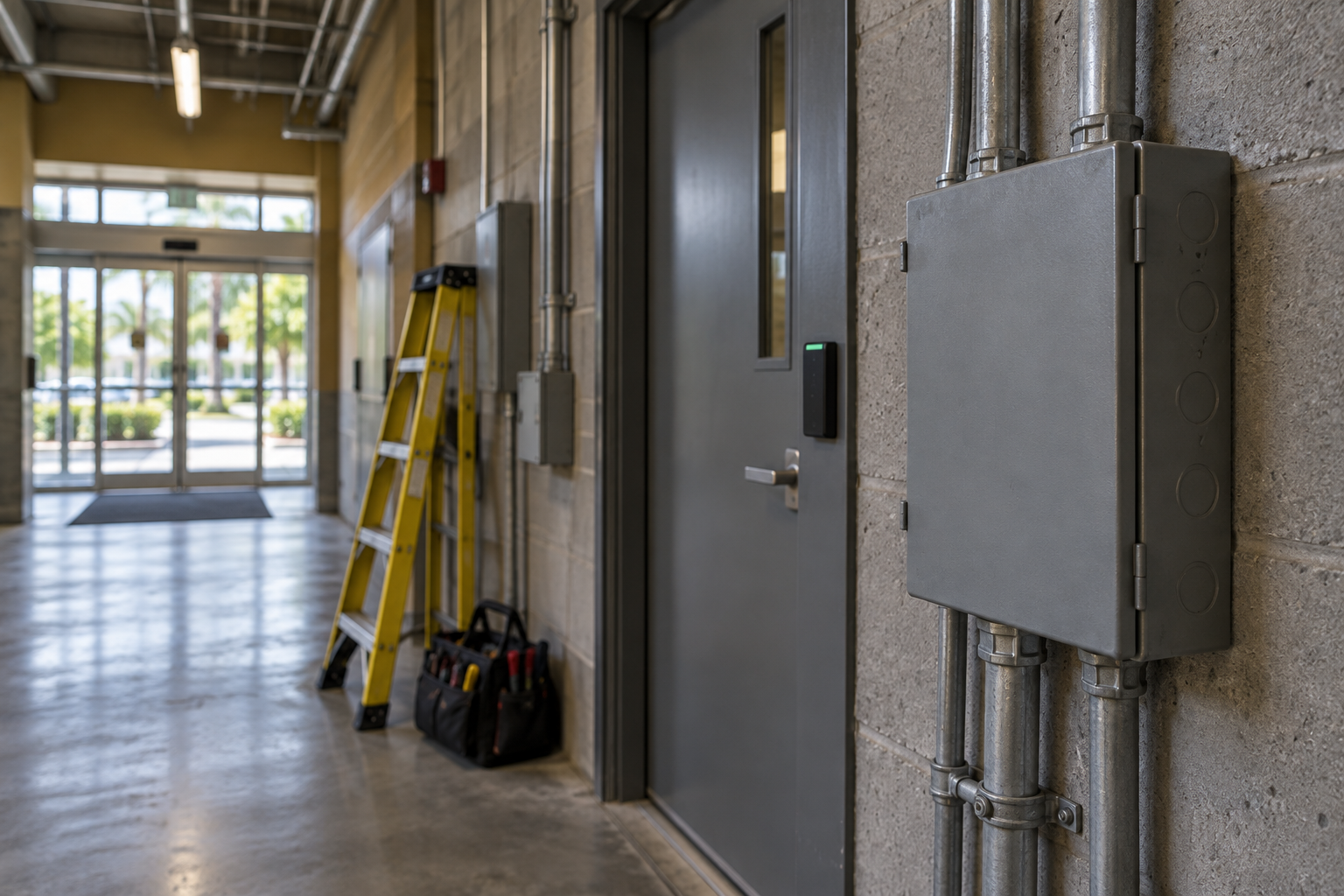
You Came to Fix One Problem. A Different Hidden Hazard Injured You.
A technician arrives to install an automatic door. The assignment sounds narrow: connect the new equipment to the building’s power supply, test it, and leave. But the electrical box is behind a key-card door. Its cover looks ordinary. The danger is not. When the technician touches it, an electrical shock sends him off a ladder.
That is not merely a hypothetical. It is the setting of a 2026 Florida appellate decision that exposes a recurring mistake in injury claims: assuming that anyone hired to work on property accepts every danger found there.
Florida law generally gives a property owner a strong defense when an independent contractor’s employee is injured while doing the contracted work. But that rule is not absolute. The precise hazard, who created or controlled it, what the owner knew, and whether the danger was part of the assigned job can change the result. A separate question—whether workers’ compensation makes another company immune—depends on the actual contracts and insurance relationships, not just the labels the companies use.
The repair assignment does not define every risk on the property
In Wal-Mart Stores East, LP v. Johnson, decided June 24, 2026, an employee of door contractor D.H. Pace went to a Walmart store to install an automatic door. He needed access to an existing electrical junction box in a restricted area. The breaker panel contained roughly 200 breakers that were not labeled. The junction box was ungrounded, uncapped, and not mounted. When the worker touched its cover, he received an electrical shock and fell from his ladder, sustaining a head injury.
Walmart argued that it was protected by Florida’s general independent-contractor rule. The Second District Court of Appeal affirmed a verdict for the worker. The evidence permitted the jury to find that the concealed electrical condition was not an inherent danger of installing an automatic door; it was a dangerous condition of the premises that Walmart had created or approved and knew or should have known about.
That distinction matters. A roofer is hired because roofs involve height. An electrician may be hired to work around energized systems. A pool technician expects to encounter water and chemicals. Those facts can support defenses concerning dangers inherent in the work. They do not automatically excuse an owner for a separate, concealed defect that the worker was not hired to create or correct.
Florida’s general rule comes with two important paths around it
The Johnson court described the general rule this way: an owner who hires an independent contractor ordinarily is not liable for injuries to the contractor’s employee during the contracted work. The court then addressed two established exceptions.
First, an owner may face liability when it actively participates in or directly controls how the work is performed. Merely checking progress or requiring a finished result is not necessarily enough. The evidence becomes more significant when the owner controls access, directs the method, selects the equipment, dictates the sequence, or intervenes in the operational details that produced the injury.
Second, an owner may face liability when it negligently creates or approves a dangerous condition and has actual or constructive knowledge of it. Constructive knowledge can be shown when the condition existed long enough, or under circumstances suggesting the owner should have discovered it through reasonable care.
The worker does not win simply by invoking an exception. Evidence must connect the owner to control, creation, approval, or knowledge. But the owner also does not win merely by producing a service contract bearing the words “independent contractor.”
An object can be obvious while its danger remains hidden
One of the most useful parts of Johnson concerns the phrase “open and obvious.” Walmart pointed out that the junction box was visible. The appellate court focused on a different question: was the dangerous condition of the box obvious?
A worker could see the metal cover without knowing the box was ungrounded. Both experts agreed that the installation violated the applicable electrical code and that the outside of the box did not warn of the danger within. The restricted location and the owner’s responsibility for the original installation also mattered.
This is the same practical divide that appears in many construction and worksite injury claims. A ceiling opening may be visible, while the absence of a required guard is not apparent from the worker’s approach. A floor panel may look secure while its fasteners are missing. A machine may be plainly present while an altered interlock is concealed. The legal analysis should describe the dangerous condition, not stop at the object’s visibility.
Workers’ compensation and third-party responsibility are different questions
An injured employee often receives a quick, confident answer: “This is workers’ comp.” That may be true as to benefits from the employer. It does not by itself resolve whether a property owner, manager, general contractor, equipment company, or another business caused the injury.
Under Florida Statutes section 440.11, workers’ compensation is generally the employee’s exclusive remedy against an employer that has secured the required coverage, subject to narrow statutory exceptions. Claims against other entities require a separate analysis. Our broader discussion of work injuries and potential third-party rights explains why both tracks should be examined early.
Another 2026 decision shows why company labels are not enough. In Teed v. Everest Campus East, LLC, a pool-service worker was injured at an apartment complex and sued the property manager. The trial court granted the manager what is sometimes called horizontal workers’ compensation immunity. The Second District reversed.
Florida’s horizontal-immunity provision, section 440.10(1)(e), can protect a subcontractor from a negligence suit by another subcontractor’s employee when they are working in conjunction with a contractor on the same project, workers’ compensation coverage has been secured, and the statutory gross-negligence exception does not apply. But the word “contractor” has a specific role in that framework. The contractor must have a primary contractual obligation to a third party and must delegate part of that obligation.
In Teed, the property owner separately hired the property manager and the pool-service company. The owner did not have a primary contractual duty to some third party that it then sublet. The parallel service contracts therefore did not create the necessary contractor-subcontractor chain. The record also lacked evidence that the property manager had secured workers’ compensation coverage. On those facts, the immunity defense failed.
The contracts are a map of responsibility
After a serious injury, the jobsite may present a confusing collection of logos, uniforms, supervisors, and vendors. The contracts can reveal relationships that appearances do not.
A useful investigation starts with the property owner’s agreements, then follows every delegation of work. Who promised to maintain the property? Who hired the injured worker’s employer? Was there a general contractor with a primary obligation, or did the owner directly retain several unrelated vendors? Who was responsible for inspections, repairs, permits, utilities, safety coordination, and access to restricted areas? Which entity obtained workers’ compensation coverage, and for whom?
Those questions serve two purposes. They identify who may have created or controlled the hazard, and they test whether a company claiming statutory immunity actually fits Florida’s contractor framework. Indemnity and insurance provisions may also identify policies that should receive prompt notice, although a contractual promise to indemnify someone does not itself decide negligence.
Build the evidence outward from the hazard
The strongest cases begin with a precise description of what caused the injury. “He fell at work” says almost nothing. “He contacted the energized cover of an ungrounded junction box in an owner-controlled, key-card area and fell from a ladder” identifies the instrumentality, dangerous condition, location, access, and sequence.
From there, the evidence should expand outward. Photographs and video can document the condition before repair. Breaker labels, maintenance records, prior work orders, inspection reports, permits, access-control logs, incident reports, and communications can establish control and notice. Contracts and certificates of insurance explain the business relationships. Witnesses may know how long the condition existed or who had attempted earlier repairs. When a code or industry standard is relevant, the specific version in effect and its proper application should be established rather than assumed.
Electronic records disappear quickly. Surveillance systems overwrite footage, key-card logs roll off, and a defective component can be discarded during the repair that follows an accident. Tucker Law’s Personal Injury Information Center offers additional guidance on protecting a claim, but a serious worksite injury often requires targeted preservation demands before the site changes.
The worker’s conduct still matters
Neither decision makes a property owner automatically liable. The defense can still argue that the danger was inherent in the assigned work, that the worker knew or should have known about it, that the owner neither controlled nor created it, or that another company was responsible. Florida’s comparative-fault statute, section 768.81, may also make the worker’s actions and the fault of other participants important.
That is why early statements should be accurate and limited to what the worker actually knows. Guessing about who installed a component, how long a defect existed, or which company controlled the area can create problems once the contracts and records tell a different story. Medical documentation also matters when a fall, electrical shock, or struck-by event produces a catastrophic injury whose full effects are not immediately apparent.
A worksite label should not end the investigation
The central lesson from Johnson and Teed is straightforward: start with the facts and legal relationships, not the shorthand. “Independent contractor,” “open and obvious,” and “workers’ comp immunity” can be valid defenses, but each has elements and limits.
If you were injured while repairing, installing, cleaning, inspecting, or servicing someone else’s Florida property, preserve the condition and the documents before accepting the first company’s description of your rights. Contact Tucker Law to discuss the hazard, the chain of contracts, available coverage, and whether a third-party claim may exist alongside workers’ compensation benefits.