The Other Car Never Touched You. Can a Florida Hit-and-Run Claim Still Exist?
The other car never touched yours.
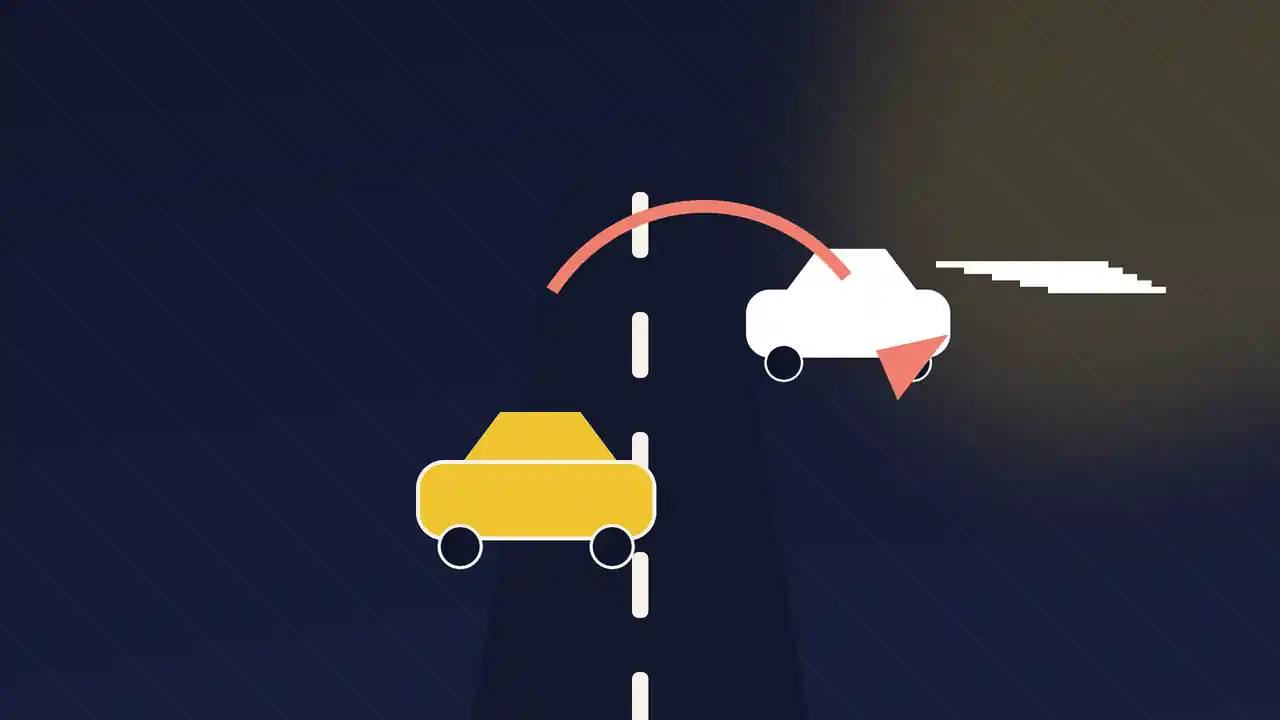
It drifted into your lane, cut across the front of your vehicle, or entered an intersection without yielding. You swerved to avoid it and struck a guardrail, median, tree, or another vehicle. By the time everything stopped moving, the car that caused the emergency was gone.
There may be no paint transfer, no photograph of the driver, and no insurance information to exchange. That does not automatically mean there is no Florida injury claim. It does mean the case will turn on a distinction insurance companies sometimes blur: physical contact is one form of proof, but Florida law does not make it a condition of uninsured-motorist coverage.
A no-contact crash caused by an unidentified driver is often called a phantom-vehicle accident. The legal question is not whether the vehicles touched. It is whether reliable evidence can prove that another driver caused the crash and that the claimant is entitled to damages.
The absence of impact changes the evidence, not the definition of the event
Florida’s hit-and-run law applies to a driver involved in a crash that causes injury or death and requires that driver to stop, remain at the scene, provide identifying information, and render reasonable assistance. The text of Florida Statutes § 316.027 does not say the fleeing vehicle must strike the injured person’s car.
That matters in a common highway scenario. A driver abruptly moves across two lanes. The motorist beside the vehicle reacts to avoid a direct collision, loses control, and crashes. The unsafe lane movement can be the cause of the crash even though the evasive maneuver succeeded in preventing vehicle-to-vehicle contact.
Whether the unidentified driver was actually “involved,” whether the evasive action was reasonable, and whether that conduct caused the injuries are factual questions. The fleeing driver’s violation of a duty to remain at the scene does not by itself prove how the crash began. It also does not relieve the injured driver of proving negligence and causation.
The scale of the problem is substantial. The Florida Department of Highway Safety and Motor Vehicles reports that nearly one-quarter of Florida crashes involve a hit-and-run. Its public data also show that pedestrians and bicyclists make up a large share of hit-and-run fatalities. Tucker Law’s Florida hit-and-run practice page explains the broader duties and risks when a driver leaves the scene.
Florida’s Supreme Court rejected a physical-contact requirement
The leading Florida decision arose from nearly the same problem. In Brown v. Progressive Mutual Insurance Co., 249 So. 2d 429 (Fla. 1971), an unidentified driver ran the insured’s vehicle off the road. It was not known whether the vehicles touched. The insurance policy attempted to define a covered hit-and-run accident by requiring physical contact.
The Florida Supreme Court rejected that limitation. Physical contact, the Court reasoned, was merely one way to prove the accident occurred as described. The truth of the account was a fact question for the judge or jury, not a coverage condition the insurer could use to narrow the protection required by Florida’s uninsured-motorist law.
The statute has since been renumbered, but the protective framework remains in Florida Statutes § 627.727. It generally requires uninsured-motorist coverage with bodily-injury liability policies issued for Florida vehicles unless the named insured rejects UM coverage or selects lower limits in writing. The statute protects insured people who are legally entitled to recover bodily-injury damages from owners or operators of uninsured vehicles.
Brown does not promise payment whenever someone says a mysterious car forced a crash. It removes an artificial contact barrier. The claimant must still prove that the phantom vehicle existed, that its driver was negligent, that the negligence caused the loss, and that the injuries and damages are genuine.
No paint transfer means the proof must come from somewhere else
In a contact collision, dents, paint, debris, and the resting positions of both vehicles can corroborate the account. A phantom vehicle may leave none of those things behind. The evidence must therefore be built from the seconds before the impact and from the immediate aftermath.
Dash-camera footage can be decisive, but only if the original recording is preserved before the device loops over it. Tucker Law’s guide to dash-camera evidence in accident claims discusses authentication and preservation. A phone copy may be useful for quick review, but the original file and memory card can contain metadata and higher-quality frames that a compressed message loses.
Independent witnesses are especially valuable. A driver who saw the lane change, a passenger who observed the approaching vehicle, or a bystander who watched it flee can confirm that the evasive maneuver did not begin in isolation. A witness’s name and number are more useful than a promise to “reach out later,” because people disperse and memories change.
Nearby businesses, homes, buses, and commercial fleets may have cameras facing the road. Traffic-management video may exist even when it was not designed to record crashes. Those systems follow different retention schedules, so a preservation request should identify the exact location, direction of travel, and narrow time window as early as possible.
The insured vehicle can supply other evidence. Event-data recorder information may document braking, steering input, speed changes, and restraint deployment. Telematics, navigation history, and emergency-call data may establish time and location. Tire marks, gouges, displaced objects, and the angle of impact with a barrier can be compared with the driver’s description. None of those items necessarily proves a phantom vehicle alone, but together they can make the account testable.
Your own insurer is not a neutral investigator
When the unknown driver cannot be located, a UM claim may shift the financial dispute to the injured person’s own insurance company. That changes the identity of the opponent, not the elements that must be proved.
The insurer can investigate whether another vehicle caused the crash, whether the insured overreacted, whether a mechanical problem or road condition was responsible, and whether the medical complaints came from the event. It can demand compliance with policy conditions and may request a recorded statement or examination under oath. Tucker Law’s article on insurance-company recorded statements explains why the timing and wording of an early account deserve care.
Coverage must also be identified rather than assumed. A declarations page may show UM limits, but the full policy and any rejection or lower-limit selection forms matter. Depending on the insured’s household, vehicle, and policy structure, more than one layer of coverage may require review. Tucker Law’s overview of Florida uninsured-motorist claims addresses the basic coverage, while the firm’s stacked-versus-non-stacked UM guide explains why two policies with identical-looking limits can respond differently.
A reasonable swerve can still become a comparative-fault dispute
No-contact cases often produce competing reconstructions. The claimant may say an abrupt merge left no safe choice. The insurer may argue there was room to brake, that the driver was speeding, or that steering into a barrier was an unreasonable response. Road geometry, sight distance, traffic density, and the time available to react all matter.
Florida’s current comparative-fault rule makes that dispute consequential. Under Florida Statutes § 768.81, fault is allocated among responsible participants, and a party found more than 50 percent at fault for his or her own harm generally may not recover in a negligence action covered by the statute. The unknown driver’s absence from the courtroom does not prevent an insurer from arguing that the injured driver caused most or all of the crash.
That is why the evidence should capture not only the phantom car, but also the full approach to the emergency. Several seconds of video before the swerve can show traffic flow, following distance, speed, and escape options. A photograph taken only after the vehicle reaches the tow yard cannot do the same work.
PIP and injury proof continue on a separate track
The uncertainty about the fleeing driver does not pause Florida’s no-fault medical-benefit rules. Under Florida Statutes § 627.736, an injured person generally must receive qualifying initial services and care within 14 days to obtain PIP medical benefits. PIP and UM serve different purposes and can proceed at the same time.
PIP addresses a portion of covered medical expenses and disability benefits without first resolving who caused the crash, subject to the statute and policy. UM addresses damages the injured person is legally entitled to recover from the uninsured driver, up to available coverage. For noneconomic damages such as pain and suffering, the threshold in Florida Statutes § 627.737 may also apply.
Medical documentation should describe what changed after the event without exaggeration. Emergency complaints, imaging, follow-up examinations, work restrictions, and a consistent history help connect the crash to the claimed condition. A gap in treatment does not erase an injury automatically, but it gives the insurer another causation argument.
If police identify the driver later, the case changes but does not restart
A partial plate, distinctive vehicle damage, camera footage, or a witness may eventually lead law enforcement to the fleeing driver. Identification can open a direct negligence claim and reveal whether liability insurance existed. It may also turn an uninsured claim into an underinsured-motorist issue if the available liability limits are insufficient.
The later discovery does not make the early evidence less important. The driver may deny being present, claim the injured motorist lost control independently, or repair the vehicle before anyone inspects it. Promptly preserved video, dispatch audio, witness accounts, and vehicle data can connect the identified car to the event.
Leaving the scene is serious and may carry criminal consequences under Florida law. But flight should not be treated as an automatic substitute for proving negligence, damages, or entitlement to punitive damages. Those issues depend on the admissible evidence and the circumstances of the particular case.
The claim begins with the missing seconds
After a no-contact crash, the most important evidence often exists outside the damaged vehicle. The departing car may appear for only a few frames on a camera. A witness may remember a color, body style, company logo, or plate fragment. A 911 caller may describe the event before anyone has time to reshape the story.
If safety permits, the driver should call law enforcement, report the phantom vehicle immediately, describe its direction of travel, identify witnesses, photograph the roadway and point of impact, preserve original recordings, obtain necessary medical care, and notify the appropriate insurer. Those steps are not about manufacturing a claim. They preserve information that allows everyone—including the insurer—to test what actually happened.
Tucker Law handles Florida car-accident cases involving unidentified drivers, disputed coverage, and disappearing electronic evidence. If another vehicle forced you off the road and fled, contact Tucker Law before video is overwritten or the damaged vehicle is released. A case without contact can still be proved, but rarely with evidence collected weeks later.
This article provides general information and is not legal advice for any specific crash, policy, or claim.