The Driver Hit the Pedestrian. Did the Vehicle’s Front End Make the Injuries Worse?
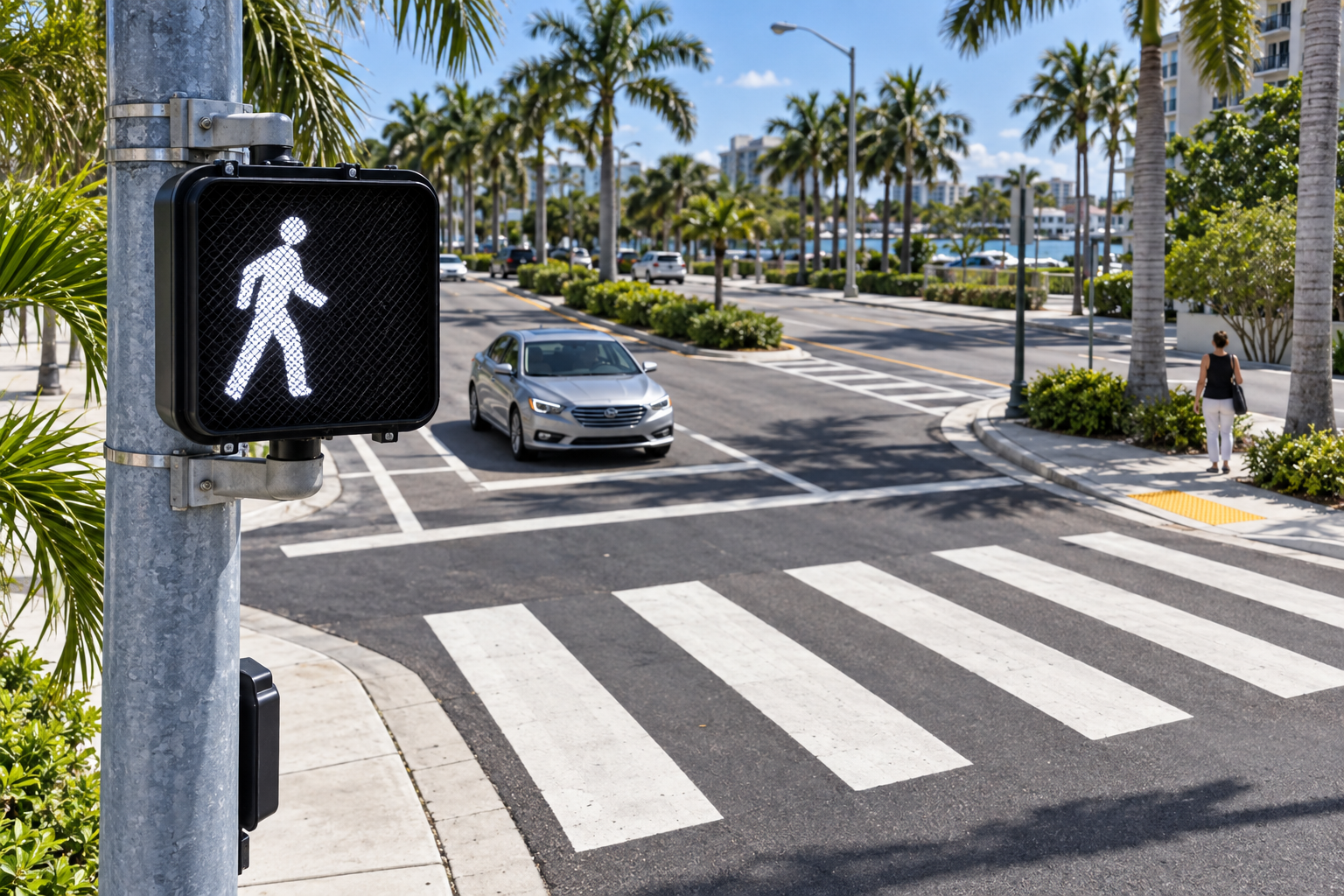
A pedestrian is struck in a crosswalk. The first questions usually concern the driver: Was the light red? Was the driver turning, speeding, or looking at a phone? Did the pedestrian enter with a WALK signal?
Those questions explain why the collision occurred. They do not necessarily explain why the pedestrian suffered a particular head injury, hip fracture, or shattered knee.
On September 18, 2026, the National Highway Traffic Safety Administration released its first pedestrian-protection assessments for model-year 2027 vehicles. The new results draw attention to a second inquiry after a serious Florida pedestrian crash: once contact occurred, did the shape and performance of the vehicle’s front end reduce the harm—or make it worse?
NHTSA is now testing the parts of a vehicle that strike people outside it
Traditional five-star publicity tends to focus on people inside a vehicle. NHTSA’s September 18 announcement adds a different perspective. The agency says 102 models from 10 manufacturers met its new pedestrian-protection performance criteria for model year 2027.
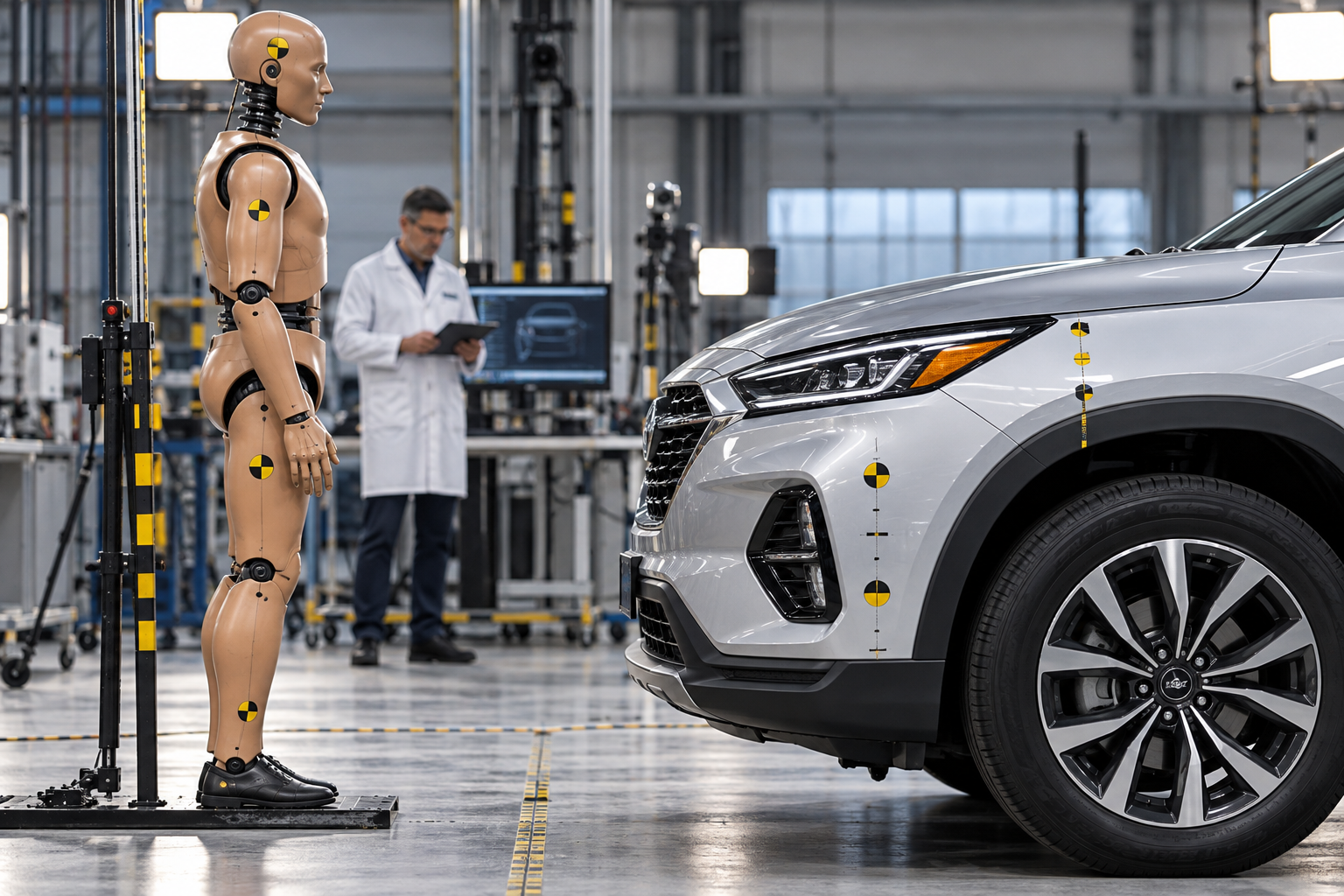
The assessment uses three impact scenarios. Child and adult headforms strike the hood and windshield area. An upper-leg impactor evaluates the leading edge of the hood. A full lower-limb impactor strikes the bumper to measure risks involving the legs and knees. NHTSA says a yellow box on a vehicle’s ratings page will identify the pedestrian-protection result as passed, failed, pending, or not submitted.
That crashworthiness assessment is different from pedestrian automatic emergency braking. One asks whether technology can help avoid contact. The other asks how the vehicle’s front end performs when contact happens. A vehicle can raise questions in either category, and the evidence needed to answer them is not the same.
The new result is consumer information, not a finding of legal fault
NHTSA describes its New Car Assessment Program, or NCAP, as a consumer-information program that permits buyers to compare vehicle safety. A pass is not a judicial ruling that a design is reasonably safe under every circumstance. A failure is not an automatic finding that a vehicle was defective or caused a specific injury.
The limits matter. The announced results concern model-year 2027 vehicles. They should not be projected backward onto an older vehicle merely because it shares a manufacturer or model name. A result marked pending or not submitted is not the same as a failed test. Even for a tested model, the precise model year, body configuration, trim, build date, and equipment may affect whether a published result applies.
The rating can be an investigative lead. A Florida claim still requires evidence connecting the actual vehicle, the alleged design issue, the mechanics of the impact, and the injuries suffered by the actual pedestrian.
One impact can present two different liability questions
Consider a driver who turns through a crosswalk without yielding. Driver negligence may explain why the vehicle hit the pedestrian. But suppose the pedestrian’s head then strikes a rigid hood area, or the bumper geometry concentrates force at the knee. Whether the vehicle’s design increased the resulting injuries is a separate question.
Florida law expressly recognizes that distinction. Florida Statutes section 768.81 defines a products-liability action to include a claim that injuries suffered in an accident were greater than they would have been but for a defective product. These are sometimes called crashworthiness or enhanced-injury claims.
The statute also requires fault to be apportioned among responsible persons in a products case alleging enhanced injuries. That means the driver who caused the impact, the pedestrian’s own conduct when relevant, and an alleged product defect do not have to be forced into a single all-or-nothing story. They may be different parts of the same event. The evidence must still show which conduct or condition caused which harm.
Florida’s standard civil jury instructions separately address product defects, legal causation, and enhanced-injury claims. The existence of those separate instructions illustrates why “the driver caused the crash” does not always resolve the entire case.
The injury pattern may tell a story about the vehicle
A pedestrian collision is not a single contact. The bumper may engage the lower leg. The hood’s leading edge may strike the thigh or pelvis. The torso or head may contact the hood or windshield. The person may then rotate, be carried, or fall to the pavement. Each phase can contribute different injuries.
NHTSA’s new tests focus on the head, hips, legs, and knees for that reason. In an actual claim, medical imaging and treatment records can be compared with vehicle damage, pedestrian height, impact location, roadway marks, clothing damage, and video. A fracture at bumper height may raise a different biomechanical question from a brain injury associated with contact near the windshield or from an injury caused primarily by the later ground impact.
This does not mean every serious injury suggests a defective design. Speed, braking, vehicle mass, body position, secondary impact, and many other variables can change the outcome. For pedestrians who suffer brain, spinal, amputation, or permanent orthopedic injuries, Tucker Law’s catastrophic-injury page discusses the long-term consequences that may need to be evaluated.
Florida traffic law still governs the driver-pedestrian encounter
The new vehicle assessments do not replace ordinary traffic law. Florida Statutes section 316.130 addresses driver and pedestrian duties at signalized intersections, marked and unmarked crosswalks, and other roadway locations. It requires drivers to exercise due care to avoid colliding with pedestrians and imposes duties on pedestrians as well.
Those rules remain central to determining why the collision occurred. Tucker Law’s pedestrian-accident practice page explains why people on foot face uniquely severe risks, while the firm’s discussion of shared fault after a Florida crash addresses how comparative responsibility can affect recovery.
A favorable pedestrian-protection result does not excuse a driver who failed to yield. Conversely, evidence that a pedestrian contributed to the initial collision does not automatically answer whether a product condition increased the injuries. Collision fault and injury enhancement require related but distinct analyses.
The exact vehicle matters more than the badge on its grille
A witness may remember only that the vehicle was a pickup, SUV, or sedan. That is not enough for a design investigation. The vehicle identification number can establish model year, assembly information, and configuration. Police photographs, tow records, repair estimates, insurance appraisals, license-plate searches, and video may help identify the precise vehicle when a pedestrian never had an opportunity to record it.
Even vehicles sold under the same model name can have different front-end dimensions, ride heights, bumpers, hoods, sensors, and option packages. A mid-cycle design change or repair using replacement parts can further complicate the comparison. An NCAP result for one configuration should not be assumed to describe every version.
That is why the yellow-box result is most useful when paired with the underlying test information and the actual vehicle’s specifications. It is a starting point for asking better questions, not a shortcut around product identification.
Repairing the vehicle can erase the geometry of the impact
After a pedestrian crash, an insurer may move quickly to repair, auction, or salvage the vehicle. A hood may be replaced. A bumper cover may be discarded. Windshield glass, embedded fibers, paint transfer, dents, sensor alignment, and crush patterns may disappear. Software may be updated, and diagnostic information may change.
If an enhanced-injury issue reasonably exists, the opportunity for a qualified expert to document the vehicle before alteration can be critical. Measurements and three-dimensional imaging may preserve the height and shape of contact points. Original photographs and video should remain in their native form. The pedestrian’s clothing and shoes may contain transfer or damage patterns that help reconstruct body movement.
The same urgency applies to outside evidence. Traffic-camera footage, doorbell video, vehicle telematics, event data, dispatch records, and witness memories can be lost with time. Tucker Law’s Personal Injury Information Center provides broader guidance on protecting an injury claim, but a potential vehicle-design issue may require a preservation plan tailored to the car and its components.
What the new tests change after a Florida pedestrian crash
For years, a vehicle’s public safety rating could tell consumers much more about the people riding inside than the person struck outside. NHTSA’s model-year 2027 pedestrian assessments begin to close that information gap. They give consumers and investigators a standardized way to ask how a front end treats the head, hip, leg, and knee.
They do not turn every pedestrian case into a product lawsuit. Most claims will continue to focus primarily on driver conduct, roadway conditions, medical causation, and damages. But when the injuries appear disproportionate to the collision, or the vehicle’s contact surfaces raise a genuine design question, the investigation should not end with the traffic citation.
If you or a family member suffered a catastrophic injury in a Florida pedestrian crash, Tucker Law can investigate both sides of the event: why the impact occurred and what may have increased the harm. Contact Tucker Law before the vehicle is repaired, sold, or destroyed.
This article provides general information and is not legal advice. Every pedestrian and product-liability claim depends on its own facts, evidence, and applicable law.