Who May Be Liable After a Golf Cart Accident in Florida?
A golf cart accident claim can be more complicated than it first appears. Golf carts are common in Florida communities, resorts, campuses, and recreation areas, but they offer little protection in a collision. A crash may involve the operator, cart owner, another motorist, an employer, a rental company, or the entity responsible for the property or roadway.
Liability depends on where the cart was operated, how the crash happened, who controlled the cart, and what insurance applies. These eight questions can help organize the investigation after a Florida golf cart accident.
1. Where Did the Golf Cart Accident Happen?
The location matters because Florida law does not allow ordinary golf cart operation on every public road. Florida Statute section 316.212 generally limits golf carts to designated roads and addresses operating hours, required equipment, and operator qualifications. Local governments may adopt additional restrictions.
A crash on a designated neighborhood street may present different questions from one in a resort parking area, private community, golf course crossing, or public highway. Photograph signs, gates, crossings, lane markings, and posted local rules.
2. Was the Operator Driving Carelessly?
Common issues include excessive speed for the conditions, sharp turns, distracted operation, failure to yield, overloading, and driving after alcohol use. Golf carts have a high center of gravity and can tip when turned abruptly. An operator should account for pedestrians, cyclists, traffic, road surface, and the cart’s limited braking and protection.
Statements from passengers and independent witnesses can help show how the cart was being operated before the impact or rollover.
3. Did Another Motorist Cause the Collision?
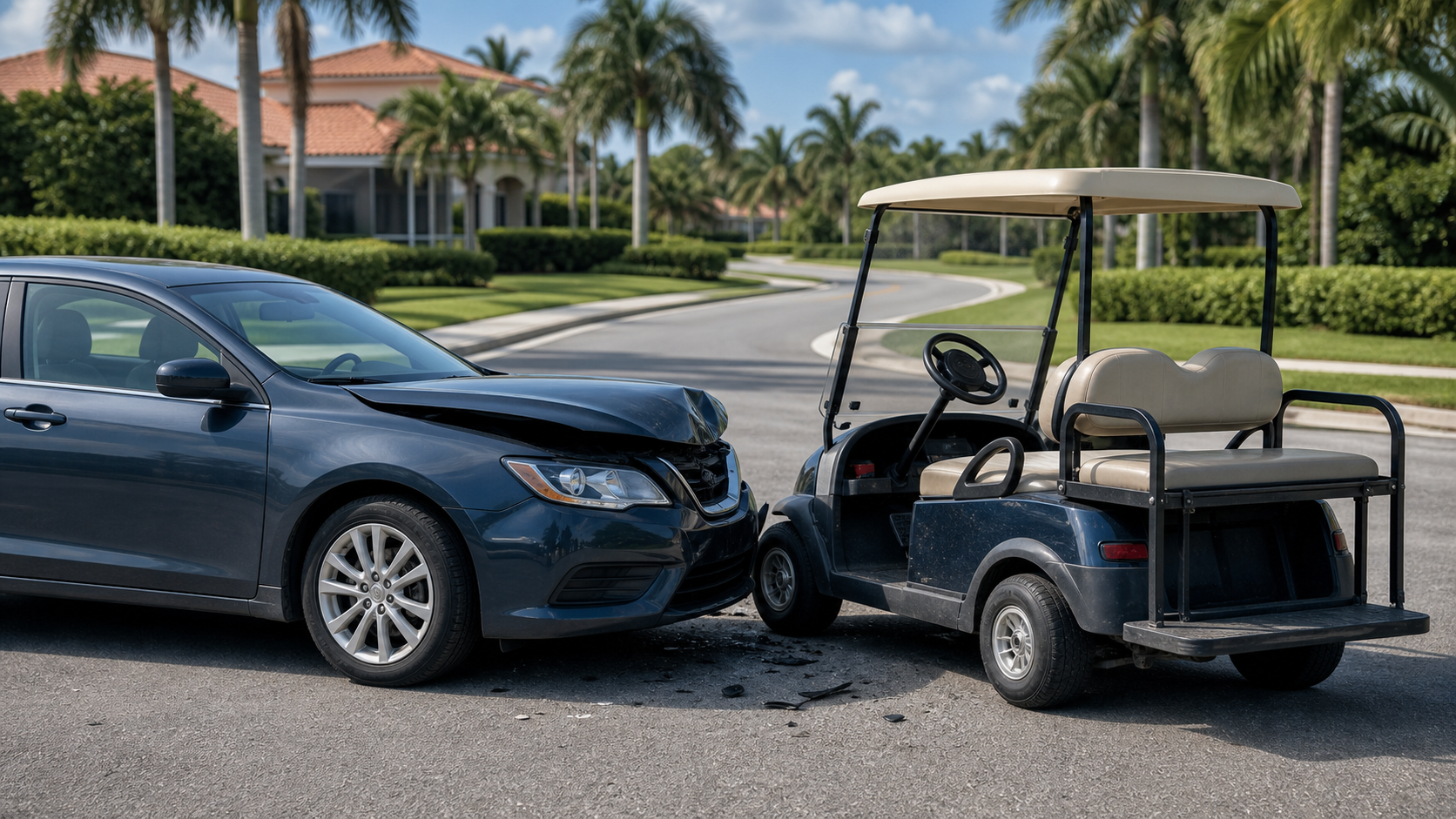
A passenger car, truck, delivery vehicle, or motorcycle may strike a cart after speeding, following too closely, turning across its path, or ignoring a designated crossing. When ordinary vehicles are involved, preserve the same evidence used in other roadway claims: vehicle positions, traffic signals, damage patterns, video, and witness accounts.
Our guides to a left-turn accident claim and a delivery driver accident claim explain related evidence questions.
4. Who Owned or Controlled the Golf Cart?
The operator may not be the owner. A cart might belong to a homeowner, association, rental business, resort, employer, school, or municipality. Ownership alone does not answer every liability question, but it can identify insurance, maintenance records, permission issues, and the people responsible for the cart.
Record the cart’s identification number, rental label, unit number, and any business information. Keep the rental agreement, waiver, receipt, or community registration documents.
5. Was the Cart Properly Maintained and Equipped?
Brakes, steering, tires, lights, turn signals, mirrors, reflectors, seats, and restraints can affect both crash causation and injury severity. Section 316.212 includes equipment requirements for carts operated under the statute, and local ordinances may be more restrictive.
If mechanical failure is suspected, do not allow the cart to be repaired, altered, or discarded before it can be inspected. Maintenance logs, prior complaints, repair invoices, and photographs may show whether a dangerous condition existed.
6. Did the Property or Roadway Create a Hazard?
Poor lighting, hidden crossings, obstructed sight lines, missing signs, potholes, steep grades, or confusing traffic patterns may contribute. The responsible entity could be a private property owner, association, contractor, or government body, depending on the location. Claims involving public entities may have special notice rules and defenses.
A parking-area golf cart crash may share issues discussed in our parking lot accident claim article.
7. What Insurance May Apply?
Potential coverage may come from an auto policy, homeowners policy, golf cart endorsement, commercial general liability policy, rental coverage, or the other motorist’s policy. Coverage is fact-specific and may depend on the cart’s design, location, ownership, and use. Do not assume that an auto or homeowners policy automatically covers the loss.
Give timely notice, provide accurate facts, and keep copies of all correspondence. Ask for any coverage position in writing.
8. What Evidence Should Be Preserved?
Photograph the vehicles, cart controls, seating positions, roadway, signs, lighting, and any visible injury. Obtain witness names, surveillance video, 911 records, incident reports, and medical records. Identify every passenger and determine who had control of the keys.
When a passenger is hurt, our discussion of a Florida passenger injury claim may help frame the coverage questions.
Get the Right Parties and Policies Identified
A golf cart accident claim often requires more than blaming the person behind the wheel. Ownership, permission, maintenance, property conditions, local rules, and insurance can all matter. Tucker Law can investigate the available evidence and evaluate potential sources of recovery.
Learn more about our practice areas or contact Tucker Law to discuss a Florida injury matter.
Passengers may have claims even when they are related to the operator or owner. Document exactly where each person sat, whether the cart had designated seats or restraints, and whether anyone was standing or riding on a rear platform. Those details can affect injury mechanics and insurance questions, but they do not replace a full investigation of the people and conditions that caused the crash.
This article is for general information only and is not legal advice. Results depend on the specific facts, available insurance, and current law.