NHTSA Now Tests Cars for Pedestrian Protection. What That Means After a Florida Crash
For decades, a vehicle’s federal safety rating mostly told consumers how well it protected the people inside the vehicle. In September 2026, that changed in a visible way.
On September 18, 2026, the National Highway Traffic Safety Administration announced the first public pedestrian-protection assessments for model-year 2027 vehicles under its New Car Assessment Program. NHTSA reported that 102 vehicle models from 10 manufacturers met the new pedestrian-protection performance criteria. The assessments examine how the front of a vehicle performs when it strikes a pedestrian—not whether the driver was careful enough to avoid the collision in the first place.
That distinction matters after a serious Florida pedestrian crash. A new safety assessment can add context to the investigation, but it does not answer the central liability questions by itself. It does not establish who had the right of way, whether a driver was distracted, whether a pedestrian entered the roadway unexpectedly, or whether a particular injury was caused by a defective vehicle design.
The better way to understand the new program is as another layer of evidence: useful when it matches the facts, limited when it does not.
NHTSA’s New Pedestrian Assessment Looks at What Happens After Contact
NHTSA’s September 18 announcement explains that the pedestrian crashworthiness assessment measures injury risk to the head, hips, legs, and knees. The agency uses three categories of impact testing: child and adult headform impacts to the hood and windshield area, upper-leg impacts to the leading edge of the hood, and lower-limb impacts to the bumper.
The agency’s earlier final decision adding pedestrian crashworthiness to NCAP explains the purpose more precisely: to evaluate whether the design of a new vehicle can mitigate pedestrian injury when a vehicle-to-pedestrian impact occurs.
That is different from asking whether the vehicle should have hit the pedestrian at all.
A driver may negligently fail to yield even though the vehicle performs relatively well in pedestrian crashworthiness testing. Another driver may act reasonably, yet the geometry and speed of an unavoidable impact may still cause catastrophic injuries. The new assessment speaks to vehicle performance in standardized testing. Civil liability still depends on the facts of the actual crash.
Crashworthiness and Crash Avoidance Are Two Different Questions
NHTSA’s 2027 model information also evaluates crash-avoidance technologies, including pedestrian automatic emergency braking. That system is designed to detect a pedestrian and apply the brakes when the driver does not react in time.
Pedestrian crashworthiness asks a different question: if impact occurs, how does the vehicle’s front structure interact with the human body?
The difference can be important in a real investigation. Consider a vehicle turning right through a crosswalk. One issue is whether the driver saw or should have seen the pedestrian and whether an available pedestrian-AEB system detected the person. A separate issue is what happened once the bumper, hood, windshield, or roofline made contact.
Those questions involve different evidence. Avoidance may turn on camera and radar sensors, braking, steering, driver attention, speed, sight lines, and signal timing. Injury mitigation may turn on the shape and stiffness of the bumper and hood, the point of first contact, pedestrian height, impact speed, secondary contact with the windshield or pavement, and the medical pattern of injury.
Combining those subjects into one generalized statement that a vehicle was “safe” or “unsafe” can obscure more than it explains.
A Yellow Box on a NHTSA Page Is Not a Liability Finding
NHTSA says its vehicle pages will use a yellow box to show whether a model passed or failed the pedestrian-protection criteria, or whether the assessment is pending or was not submitted. That makes the information easier for consumers to find, but the label should not be treated as a courtroom shortcut.
NCAP is a consumer-information program. The standardized tests compare vehicle performance under defined conditions. A Florida negligence case asks what happened under the conditions of the actual collision. A product-liability case asks still more: whether a particular product was defective under applicable law, whether the alleged defect existed when it left the responsible party’s control, and whether that defect legally caused or enhanced the claimed injury.
A passing NCAP assessment does not establish that a vehicle could not have contributed to an injury. A failed assessment does not automatically establish a legal defect. And a model that was never assessed is not thereby unsafe.
The assessment is most useful when an expert can explain how the standardized test relates—or does not relate—to the specific impact being reconstructed.
Florida Fault Rules Still Start With the Driver and Pedestrian
Florida’s pedestrian statute remains the starting point for many roadway cases. Florida Statutes section 316.130 contains duties for both drivers and pedestrians. Among other things, drivers must yield or stop for pedestrians in specified crosswalk situations, and every driver must exercise due care to avoid colliding with a pedestrian. The statute also restricts pedestrians from suddenly leaving a place of safety into the path of a vehicle that is so close the driver cannot yield.
Those rules are applied to evidence from the actual scene. Signal phases, crosswalk markings, vehicle speed, braking, lighting, visibility, witness accounts, surveillance video, dash-camera footage, and vehicle data may all matter.
Florida’s comparative-fault statute can make those factual disputes consequential. Under section 768.81, fault assigned to an injured person ordinarily reduces recoverable damages, and in covered negligence actions a claimant found more than 50 percent at fault for his or her own harm generally may not recover damages.
NHTSA’s pedestrian score does not allocate any of that fault. It may help explain injury mechanics, but it does not replace the liability reconstruction.
The New Testing Makes the Vehicle Itself More Important Evidence
After a severe pedestrian impact, the vehicle should not be treated merely as transportation that happens to have body damage. Its front end may preserve the sequence of contact.
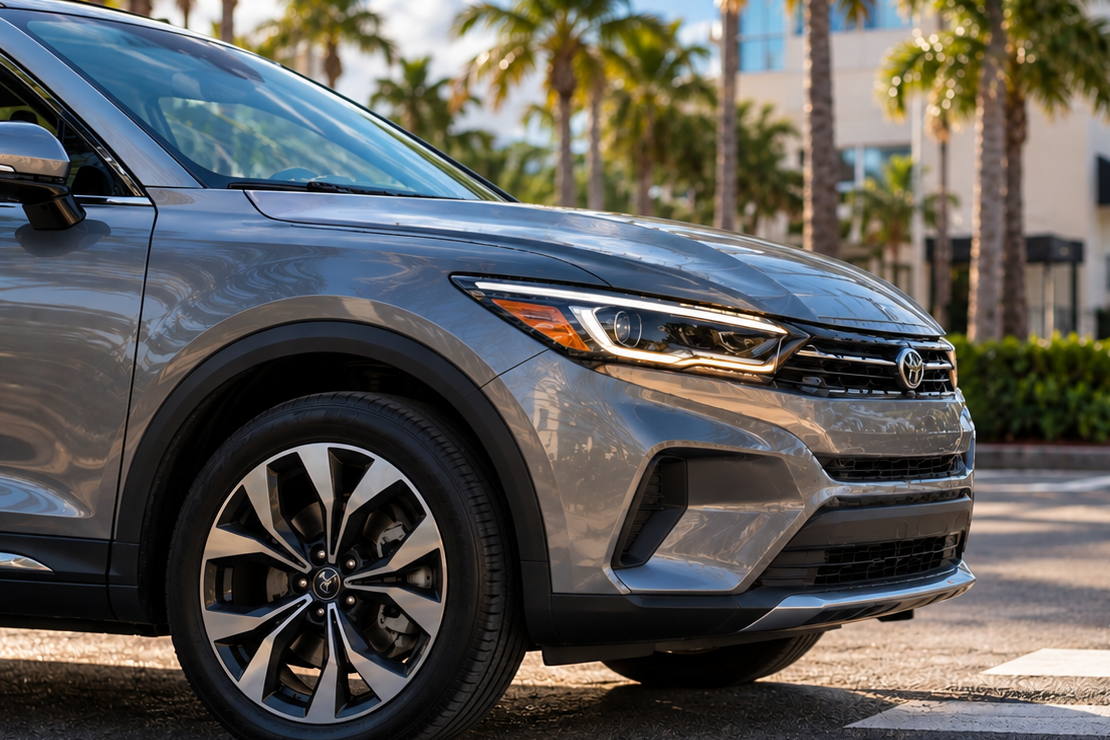
A bumper can show the first strike. The hood may contain dents corresponding to the pelvis or torso. The windshield may show a head-impact location. Paint transfer, biological material, broken trim, displaced sensors, and deformation can help establish where the pedestrian contacted the vehicle and in what order.
That physical evidence should be documented before repair. Measurements and calibrated photographs can preserve the geometry even if the vehicle later must be returned to service. When the injuries are catastrophic, a qualified reconstruction or biomechanical expert may need access to the vehicle before altered parts are discarded.
Electronic evidence can be just as important. Depending on the make, model, and event, a vehicle may retain event data, diagnostic information, camera or radar fault codes, driver-assistance information, braking records, or other electronic traces. The available data is not uniform, and an investigator should not assume that every vehicle stores the same information.
This is one reason Tucker Law’s pedestrian-accident practice focuses on evidence preservation early rather than waiting for an insurance company’s liability decision.
Pedestrian AEB Evidence Can Disappear Even When the Car Is Repaired Correctly
A vehicle with pedestrian automatic emergency braking may create a tempting assumption after a collision: if the system did not stop the vehicle, something must have malfunctioned. That conclusion is too fast.
Pedestrian-AEB systems have operating conditions and limitations. Detection can depend on speed, lighting, pedestrian movement, sensor visibility, weather, road geometry, calibration, and software. A system may warn without braking, brake without preventing contact, or operate differently at different speeds. The correct inquiry is what the particular system was designed to do under the conditions that actually existed.
Repair can change the available proof. Replacing a windshield, bumper cover, camera, radar unit, or control module may erase the physical condition needed to evaluate calibration or damage. Software updates can change the system after the event. Diagnostic codes can be cleared during repair.
That does not mean an unsafe vehicle should remain unrepaired. It means the evidence should be identified and preserved first, then repair can proceed with a record of what was found.
The Injury Pattern Should Be Compared to the Contact Pattern
NHTSA’s testing focuses on the head and lower extremities for a reason. Its biomechanics research identifies the head and lower extremities as frequently injured body regions in pedestrian crashes.
In a real case, however, medical causation cannot be inferred from a federal test category alone. A fractured tibia, pelvic fracture, traumatic brain injury, shoulder injury, spinal injury, or internal injury must be connected to the actual collision through medical and physical evidence.
The sequence can matter. A pedestrian may first be struck in the leg, rotate onto the hood, hit the windshield with the head or shoulder, and then sustain a second set of injuries on the pavement. Another person may be pushed rather than carried onto the hood. Vehicle height, pedestrian height, braking, and impact speed can alter that sequence materially.
For severe injuries, Tucker Law’s catastrophic-injury practice and brain-injury practice address the longer-term medical and financial consequences that can follow a pedestrian collision.
A New Consumer Safety Metric Can Also Identify Better Discovery Questions
The most practical legal effect of the new assessment may be that it gives investigators a more disciplined way to ask about vehicle design and safety systems.
Instead of asking only whether the vehicle had “automatic braking,” the investigation can identify the exact trim, option package, sensor configuration, software version, and pedestrian-AEB capability. Instead of describing the front end generically, the investigator can compare the actual contact location with the hood, windshield, bumper, and leading-edge regions NHTSA evaluates.
If the crash involves a 2027 model, the specific NHTSA vehicle page may show whether the model passed, failed, was pending, or was not submitted for the pedestrian assessment. Older vehicles will often require different research because the new public assessment does not retroactively rate every vehicle already on Florida roads.
None of this replaces discovery from the manufacturer when a genuine product issue exists. It can, however, help distinguish a routine driver-negligence case from one where the vehicle’s design or collision-avoidance system deserves a closer look.
Florida Is Treating Pedestrian Safety as a System Problem, Not One Person’s Problem
The federal testing fits a broader safety approach. Florida’s 2026 Strategic Highway Safety Plan identifies elimination of traffic fatalities and serious injuries as the statewide goal and treats safer vehicles as one part of a system that also includes roadway design, speed, road-user behavior, and post-crash response.
That is also the sensible framework for civil investigation. Serious pedestrian crashes rarely reduce to one data point. A traffic signal may matter. So may vehicle speed. So may lighting, roadway geometry, driver attention, pedestrian movement, braking technology, front-end design, medical causation, and insurance.
The new NHTSA assessment adds information to that system. It should not be asked to do more than the data can support.
After a Pedestrian Crash, Preserve the Evidence Before the Vehicle Changes
The most important takeaway from the new program is not that every pedestrian case now requires a product-liability claim. Most will not.
The takeaway is that modern vehicles contain more potentially relevant physical and electronic evidence than ever before. When a pedestrian suffers a catastrophic injury, the investigation should identify that evidence before the vehicle is repaired, sold, salvaged, or updated.
If you or a family member was seriously injured by a vehicle in Florida, Tucker Law can evaluate the driver conduct, roadway evidence, available insurance, vehicle data, and whether the vehicle’s safety systems or front-end design require expert review. Visit Tucker Law’s car-accident help page or contact the firm before short-lived electronic and physical evidence disappears.
This article provides general information and is not legal advice. Every pedestrian collision depends on its particular facts, vehicle, injuries, evidence, and applicable law.