Florida’s 2026 E-Bike Bill Was Vetoed: What Rules Apply After a Crash?
A rider buys an electric bicycle advertised as street-ready. A parent sees reports about a proposed statewide speed rule. A driver assumes every motorized two-wheeler must be licensed and insured. Then a crash happens, and all three assumptions may be wrong.
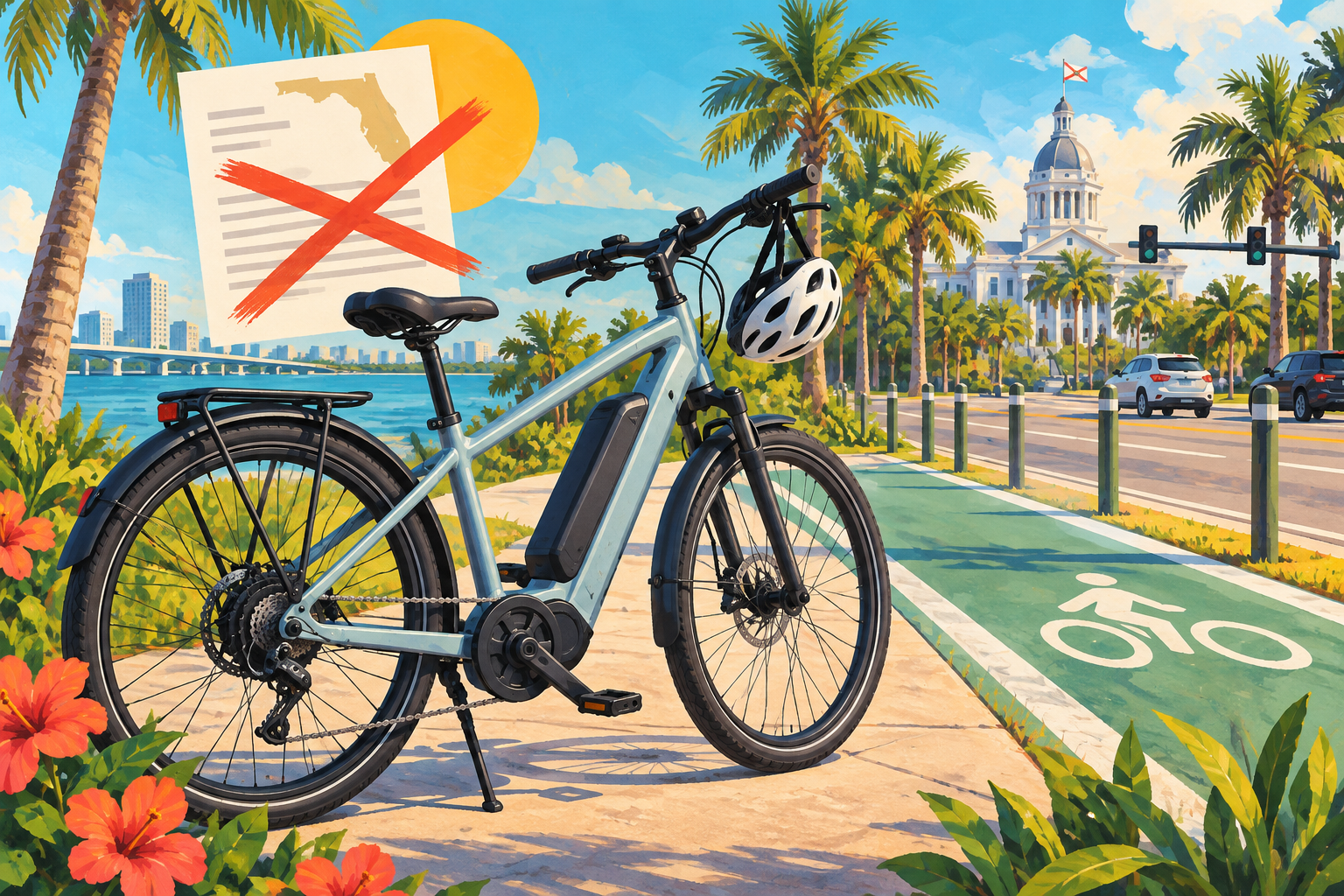
Florida lawmakers unanimously passed a micromobility bill in 2026, but the Governor vetoed it on June 25. The official history for CS/SB 382 confirms that it did not become law. That matters because summaries of the proposal can still circulate online as if they describe current requirements.
They do not. Florida e-bike accident law still begins with the existing statutes, the technical specifications of the device, the place where it was being ridden, and any valid local ordinance. Those details can shape fault, insurance coverage, and the evidence needed after a serious collision.
The 2026 proposal passed, but it did not change the law
CS/SB 382 would have added statewide operating requirements and created a micromobility safety task force and crash-reporting measures. It cleared both chambers without a dissenting vote. Because the bill was vetoed, however, its proposed restrictions never took effect.
The distinction is easy to miss. A news story written while a bill is moving through the Legislature may use phrases such as “Florida will require” or “a new law would prohibit.” After a veto, those descriptions are no longer a reliable statement of the law. A police report, insurance evaluation, or liability argument should be based on the statutes and ordinances in force on the date of the crash—not on a proposal that failed to become law.
The veto did not erase Florida’s existing e-bike framework. Nor did it prevent cities and counties from regulating some aspects of e-bike use within the authority state law gives them.
Before analyzing fault, identify the machine
“E-bike” is a marketing term, but it is also a defined legal category. Under section 316.003, Florida Statutes, an electric bicycle must have fully operable pedals, a seat or saddle, and an electric motor rated at less than 750 watts. It must also fit one of three classes.
A Class 1 motor assists only while the rider pedals and stops assisting at 20 mph. A Class 2 motor may propel the bicycle without pedaling but must stop assisting at 20 mph. A Class 3 motor assists only while the rider pedals and stops assisting at 28 mph.
Those specifications are not trivia after a crash. A device with ornamental or disabled pedals, a motor at or above the statutory wattage, or a modified controller that provides assistance beyond the class limit may not receive the legal treatment its seller or rider expected. Florida law requires manufacturers and distributors to place a permanent label on an e-bike identifying its class, assisted top speed, and motor wattage. It also prohibits modifying the speed capability without replacing the label to reflect the change.
Photographs of the label, motor, display, controls, and pedals can therefore be as important as photographs of the impact damage. The actual machine—not the product name in an advertisement—controls the analysis.
What Florida’s existing statewide rules say
Section 316.20655 generally gives an e-bike operator the rights and duties of a bicycle rider. An e-bike is treated as a vehicle to the same extent as a bicycle, but it is not subject to the laws requiring motor-vehicle registration, a driver’s license, a title certificate, or financial responsibility for the e-bike itself.
An e-bike may generally be ridden where bicycles are allowed, including streets, shoulders, bicycle lanes, and bicycle or multiuse paths. That broad rule has two important qualifications. First, the ordinary bicycle rules in section 316.2065 still apply. Second, local governments and the agencies controlling paths, trails, beaches, or dunes can adopt additional restrictions within their statutory authority.
On the roadway, motorists also have specific duties. Section 316.083 requires a driver overtaking an e-bike in the same travel lane or in a bicycle lane to leave at least three feet. If that cannot be done safely, the driver must remain behind until a safe pass is possible.
On a sidewalk or in a crosswalk, a bicycle rider generally has the rights and duties of a pedestrian, but must yield to pedestrians and give an audible signal before passing them. Riders under age 16 are subject to Florida’s bicycle-helmet requirement. These statewide rules provide a starting point, not a complete answer for every location.
The same collision can look different depending on where it occurred
Consider an e-bike rider traveling beside traffic when a motorist turns right across the rider’s path. The investigation may focus on lane position, turn signals, sight lines, speed, the driver’s duty to yield, and whether the rider was in a bicycle lane or entering a crosswalk.
Move the collision onto a sidewalk outside a shopping center and the questions change. The rider’s duty toward pedestrians becomes central. So may the property owner’s control of visibility, landscaping, driveway design, warning signs, and conflicts between vehicles and sidewalk users.
Move it onto a beach path, park trail, or municipal promenade and a local ordinance may determine whether that class of e-bike was permitted at all, whether an age restriction applied, or whether posted speed and access rules governed the rider. Florida law expressly allows local governments to adopt minimum ages for e-bike operation and identification requirements, and it permits authorities controlling certain paths and beaches to restrict or prohibit e-bikes.
A citation or rule violation can become evidence, but it does not automatically resolve civil liability. The investigation still must connect the conduct to how the crash occurred and the injuries resulted.
A veto makes local-law research more important, not less
After the statewide proposal failed, Florida did not receive one new uniform set of operating restrictions. A rider who lawfully uses an e-bike in one city may encounter a different age, path-access, or identification rule after crossing a municipal boundary.
That is why a crash investigation should identify the exact location rather than relying only on a city name. Jurisdictional boundaries can run through beach corridors, multiuse paths, and neighborhoods. The controlling entity may be a municipality, county, state agency, park authority, private association, or property owner. Posted signs should be photographed before they change, but the ordinance or rule behind a sign must also be located and checked for its effective date.
Florida’s current safety planning recognizes the broader issue. The FDOT 2026 Strategic Highway Safety Plan lists pedestrians and bicyclists as an emphasis area and “evolving transportation modes” as a special emphasis area. E-bikes combine familiar bicycle conflicts with speeds, weights, and electronic systems that may require a different investigation.
Insurance does not follow a single e-bike template
Because Florida does not require registration or financial responsibility for an e-bike itself, there may be no dedicated liability policy attached to the bicycle. That does not mean an injured person has no potential insurance recovery.
If a motor vehicle caused the crash, the vehicle owner’s and driver’s policies may be relevant. Depending on the policy language and the claimant’s circumstances, uninsured or underinsured motorist coverage may also require review. A collision involving a rental operator, delivery rider, defective component, unsafe property condition, or household member can raise questions involving commercial, homeowner, renter, or product-liability coverage.
Coverage turns on policy language, statutory definitions, who was using the device, and how the accident happened. It should not be assumed from the presence or absence of a motor. Tucker Law’s Florida car-accident guidance explains the broader process for claims involving motor vehicles.
The best evidence may be inside the e-bike
An e-bike is both a vehicle and an electronic device. Its display, controller, battery-management system, paired application, rental account, or manufacturer platform may retain information about speed, assist mode, throttle use, battery state, route, error codes, or modifications. A phone or fitness app may contain a second timeline. Nearby vehicles, doorbell cameras, businesses, and transit systems may hold video that is overwritten quickly.
The bicycle should ordinarily be preserved in its post-crash condition. Repairs, firmware updates, battery replacement, factory resets, or continued use can change evidence. The charger, keys, removable display, receipts, manuals, packaging, and screenshots of the product listing may help establish what was sold and how the device was represented. If it was a shared or rented e-bike, trip records, geofencing data, user warnings, maintenance history, and prior defect reports may be held by the operator rather than the rider.
Physical evidence remains equally important: tire marks, debris, roadway defects, lighting, signal timing, sight obstructions, and the final resting positions of the rider and device. Tucker Law’s guide on what to do after a bicycle collision provides additional steps for protecting evidence and responding to insurers.
Fault can be shared—but Florida now has a cutoff
In many e-bike cases, each side accuses the other of causing the crash. A motorist may argue that the rider entered unexpectedly, traveled against traffic, ignored a signal, or used an impermissible path. The rider may point to an unsafe pass, turning violation, distraction, excessive speed, or failure to keep a proper lookout.
Under section 768.81, fault in an ordinary negligence action can be allocated among responsible parties. For negligence claims covered by the statute, a claimant found more than 50 percent at fault generally may not recover damages. That makes the details of device classification, local rules, visibility, speed, and electronic data consequential rather than academic.
Severe e-bike collisions can produce brain injuries, spinal injuries, fractures, and death even when no automobile is involved. Tucker Law’s catastrophic-injury and wrongful-death resources address the additional issues raised by life-changing and fatal injuries.
Current law, not an abandoned proposal, controls the claim
The 2026 veto did not leave Florida without e-bike rules. It left the existing state framework in place, including the three statutory classes, bicycle-equivalent rights and duties, the three-foot passing rule, and significant room for local regulation.
After a crash, the correct analysis begins with four facts: what the device legally was, where it was being operated, which rules were in force there, and what the available physical and electronic evidence shows. Starting with a headline about the veto—or the word “e-bike” on a sales receipt—can miss the rules that actually decide the dispute.
If you or a family member suffered a serious injury in an e-bike collision, Tucker Law can investigate the device, roadway or property conditions, applicable ordinances, available insurance, and disappearing electronic evidence. Contact Tucker Law for a confidential case review.
This article provides general information, not legal advice. E-bike classification, local ordinances, insurance coverage, deadlines, and liability depend on the facts of each incident.