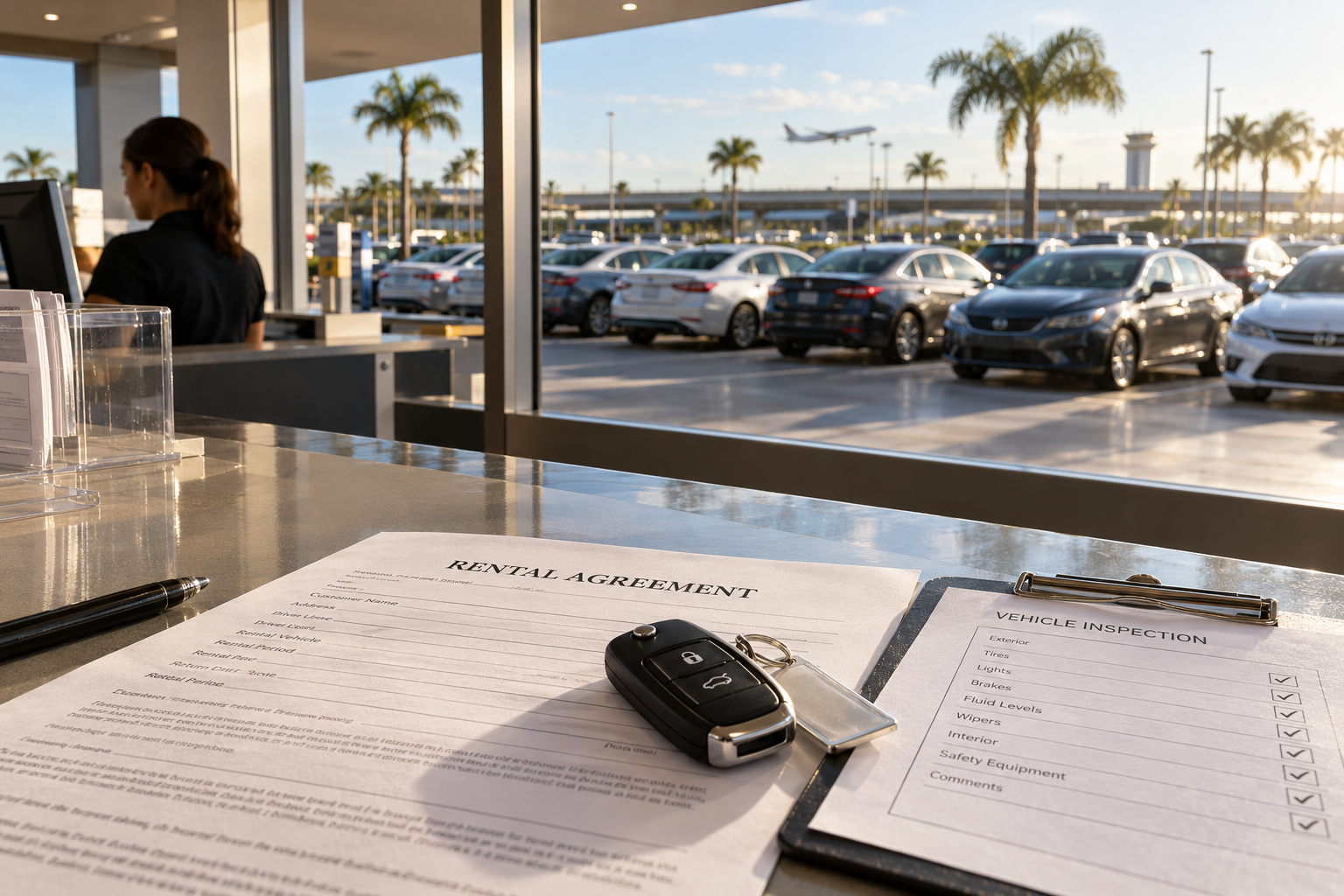
The Rental Company Owns the Car. Why That May Not Make It Liable in Florida.
The rental car carries a national company’s logo, and the company’s name appears on the title. After its customer causes a serious Florida crash, that can look like an obvious path to holding the rental company responsible.
Ownership matters in many Florida vehicle cases. In an ordinary rental-car case, however, ownership alone usually is not enough.
A federal law known as the Graves Amendment blocks many claims that try to make a rental or leasing company liable solely because it owns the vehicle. The law does not excuse the negligent driver, erase every claim against the rental company, or decide which insurance policy pays. It changes the investigation: instead of stopping at the name on the registration, the injured person must separate owner-based liability from the company’s own conduct and from the available coverage.
Florida’s owner-liability rule meets a federal exception
Florida’s dangerous-instrumentality doctrine generally makes a vehicle owner vicariously liable when the owner voluntarily entrusts the vehicle to someone whose negligent driving causes harm. “Vicarious” liability means responsibility based on the relationship between the owner and driver, even if the owner did nothing independently careless.
Congress drew a different line for businesses that rent or lease vehicles. Under 49 U.S.C. section 30106, an owner engaged in the trade or business of renting or leasing motor vehicles generally cannot be held liable under state law merely because it owns the vehicle. The protection applies when the harm arises during the rental or lease and there is no negligence or criminal wrongdoing by the owner or its affiliate.
Each part matters. The defendant must be an owner or qualifying affiliate. It must be in the rental or leasing business. The vehicle must have been in a rental or lease. And the claim must actually depend on ownership rather than the company’s own negligence. A logo on the trunk does not resolve all of those questions.
Vargas shows the kind of claim the Graves Amendment defeats
The Florida Supreme Court confronted the issue in Vargas v. Enterprise Leasing Co. A driver operating a car rented from Enterprise collided with a motorcycle. The injured parties sought to impose liability on Enterprise under Florida’s short-term-lessor liability law. They did not allege that Enterprise had negligently rented, maintained, or otherwise handled the vehicle.
The Court held that the Graves Amendment preempted the Florida provision to the extent it imposed vicarious liability on the rental company. It also rejected the argument that the state provision was preserved as a financial-responsibility law.
The limit of the decision is as important as its holding. Vargas involved an owner-only theory. The Court repeatedly noted that Enterprise was not alleged to have been negligent or at fault. The decision therefore answers one question—whether title alone creates liability—but not whether evidence of the company’s own conduct could support a different claim.
Direct negligence is not disguised owner liability
The Graves Amendment expressly conditions its protection on the absence of negligence or criminal wrongdoing by the rental owner or an affiliate. That language preserves claims based on the company’s own acts or omissions. It does not create automatic liability whenever an injured person adds the word “negligent” to a complaint.
Consider a crash allegedly caused by a tire failure. An owner-only theory says the rental company should pay because it owned the car driven by the negligent renter. A direct-negligence theory asks a different set of factual questions: Did the company receive repeated low-pressure warnings? Did an inspection identify tread damage? Was the tire overdue for replacement? Did the branch rent the car despite a documented defect, and did that defect cause the crash?
The same distinction can apply to brakes, steering, lights, recalls, or other safety conditions. A rental company is not liable simply because something failed. The evidence must support the elements of negligence, including a duty, a breach, and a causal connection to the injury.
Entrustment can also raise a direct-conduct issue, but it requires more than the fact that the renter later drove carelessly. Florida Statutes section 322.38 prohibits renting a vehicle to a person who is not duly licensed, requires inspection and verification of an unexpired license, and requires specified rental records. The statute also provides a method for rental companies using digital or contactless rentals to satisfy the licensing requirements through the enrollment or agreement process.
A valid license does not prove that every renter is a safe driver, and a bad driving record does not by itself establish a rental company’s liability. A supported negligent-entrustment claim would need facts showing what the company knew or should legally have acted upon, what duty applied, and how the alleged failure contributed to the collision. The reservation file, license-verification record, counter communications, and prior interactions may therefore matter more than assumptions based on the driver’s conduct after leaving the lot.
The person behind the wheel remains the first liability question
The Graves Amendment protects qualifying rental owners from owner-only liability; it does not immunize the driver. A renter who runs a red light, follows too closely, drives while distracted, or otherwise fails to use reasonable care may remain personally responsible for the harm caused.
The identity of the actual driver still must be established. Rental agreements often name one or more authorized drivers, but the person operating the car at the time of the crash may be a spouse, coworker, friend, or someone else. That can affect contract rights and insurance coverage without automatically changing who was negligent.
Tucker Law’s earlier article for visitors involved in Florida rental-car crashes explains immediate reporting and insurance steps. A separate discussion of borrowed-car accidents addresses why permission, ownership, and coverage can look different when the vehicle came from a relative, friend, or employer rather than a rental fleet. Those distinctions should be resolved from documents and facts, not from the everyday label placed on the vehicle.
The liability map and the insurance map are different
Even when the rental company is not a tort defendant, insurance connected to the rental, renter, driver, passenger, employer, or injured person may still apply. The Graves Amendment does not answer the coverage question.
Florida Statutes section 627.7263 addresses priority between insurance covering a rental or leased vehicle and an authorized rental or leasing driver. The statute makes valid and collectible liability and personal injury protection coverage on the rental vehicle primary for the required limits unless the rental agreement states otherwise on its face in at least 10-point type. If the authorized driver’s coverage is to be primary, the agreement must contain the statutory notice in at least 10-point type.
That priority rule is a starting point, not a complete policy-limits analysis. The rental contract may offer supplemental liability coverage. The renter’s personal auto policy may extend coverage subject to its definitions, exclusions, territorial limits, and other-insurance provisions. A work trip may implicate an employer’s policy. The injured person’s uninsured or underinsured motorist coverage may become critical when the liability insurance is absent or inadequate. Credit-card benefits commonly focus on damage to the rented vehicle and should not be assumed to provide bodily-injury liability coverage.
The documents should be read together: the face of the rental agreement, full terms and conditions, optional-coverage acceptances or rejections, the renter’s declarations page and policy, employer travel records, and every reservation or app screen used to complete the transaction. Asking only whether the renter “bought the insurance” can miss multiple policies and multiple kinds of coverage.
A rental company’s records can prove what ownership cannot
A police report usually identifies the vehicle, driver, registered owner, and insurers reported at the scene. It rarely contains the maintenance history or digital transaction trail needed to evaluate a direct-negligence theory.
The most useful rental-company evidence depends on what allegedly caused the crash. A mechanical-defect investigation may require inspection checklists, repair orders, tire measurements, warning-light history, recall notices, vehicle-location data, prior customer complaints, branch transfer records, and communications with vendors. A disputed entrustment claim may turn on the reservation, driver-license scan, verification result, rental counter video, employee notes, authorized-driver list, app audit log, and the exact agreement version accepted.
The vehicle itself may be the best evidence. Tires are replaced, fault codes cleared, software updated, and fleet vehicles repaired, transferred, or sold. A preservation request can identify the vehicle by VIN and ask the relevant companies and insurers not to alter it or discard associated electronic and paper records. Safety should come first—a vehicle should not remain in hazardous service merely to preserve evidence—but its condition can often be documented before necessary repairs occur.
Evidence about the crash remains equally important: nearby surveillance, dash-camera video, event-data-recorder information where available, phone records obtained through proper process, witness identities, scene photographs, and measurements. The goal is to test the driver-conduct and vehicle-condition theories independently before either is accepted or discarded.
“Rental car” is a factual and legal classification, not just a description
Not every temporary vehicle arrangement is identical. A conventional airport rental, a peer-to-peer vehicle, a long-term lease, a dealership service loaner, a corporate fleet vehicle, and a car supplied informally by a host may involve different owners, contracts, business relationships, statutes, and insurance provisions.
The Graves Amendment applies to an owner engaged in the trade or business of renting or leasing vehicles and to qualifying affiliates. Whether an arrangement is a rental or lease can depend on its substance, not merely the word printed across the agreement. The ownership chain can also include a titleholder, fleet company, brand operator, franchisee, and maintenance contractor. Each entity’s role should be identified before assuming federal protection applies to all of them.
Two years is not an evidence-preservation period
Under the 2026 version of Florida Statutes section 95.11, an action founded on negligence is generally subject to a two-year limitations period. Other parties, claims, notices, or jurisdictions can create different deadlines, so the correct period must be determined from the particular facts.
Waiting for the filing deadline is especially risky in a rental-car case. The car may leave Florida within days. A branch video may be overwritten. An app interface can change. A maintenance vendor may follow a short retention cycle. The agreement and policy available online today may not be the versions in force on the rental date.
People facing catastrophic injuries also need time to identify every viable coverage layer and document future medical and financial losses. Tucker Law’s Florida car-accident practice, Personal Injury Information Center, and catastrophic-injury guidance provide additional context for those issues.
Start with conduct, contracts, and coverage—not the logo
A rental company’s name on the vehicle is not a promise that it will answer for the renter’s negligence. The Graves Amendment often removes that owner-only theory. But it does not protect a negligent driver, eliminate a fact-supported claim based on the company’s own wrongdoing, or decide which insurance policy pays first.
If you were seriously injured in a Florida crash involving a rental or leased vehicle, contact Tucker Law. An early review can identify the legal relationships, preserve the vehicle and rental records, and trace the available insurance before routine fleet operations make the evidence harder to recover.
This article provides general information and is not legal advice for any particular crash, rental agreement, insurance policy, or claim.