The Turo Car Had a Warning Light. What Records Decide a Florida Injury Claim?
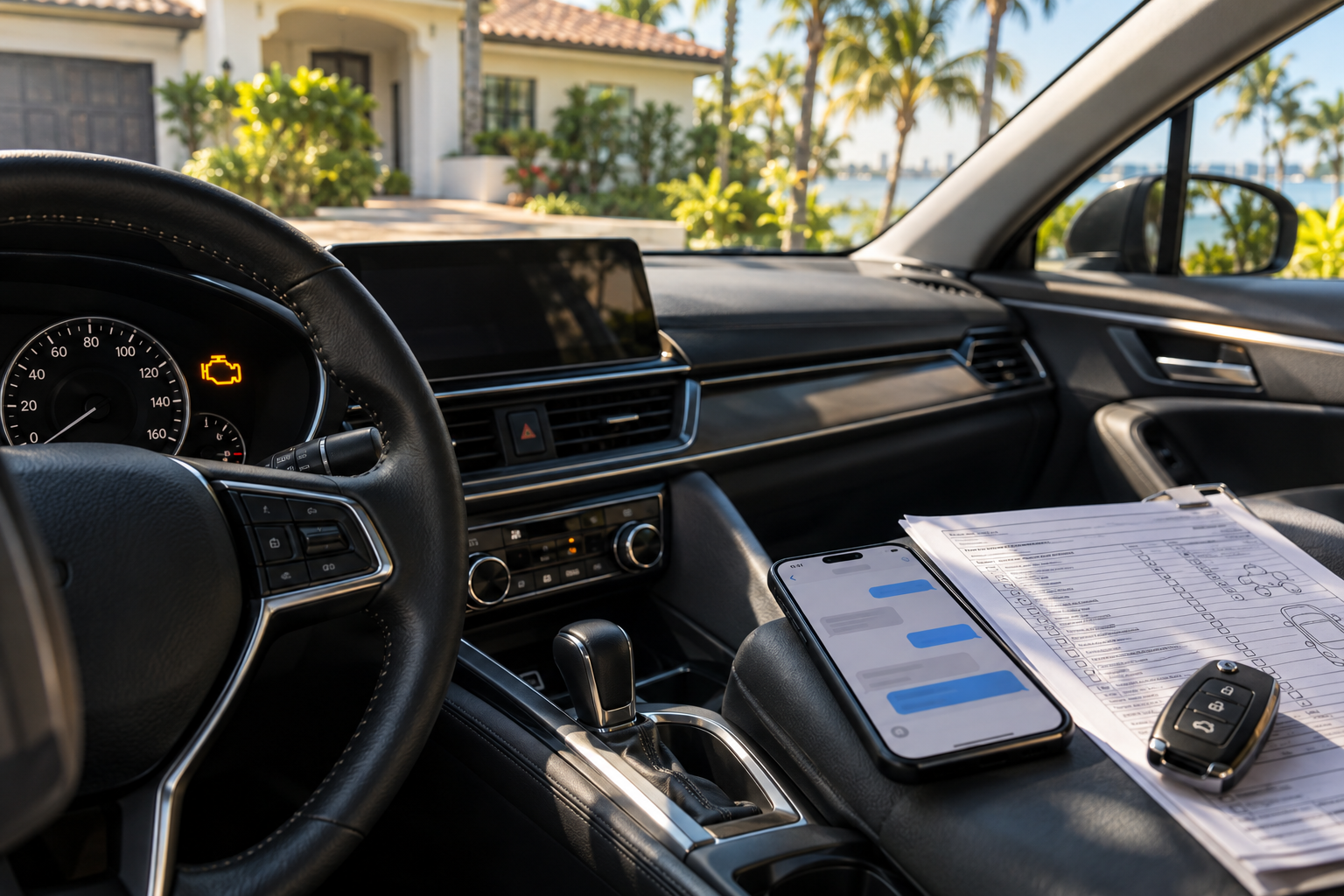
A warning light glows on the dashboard of a car booked through Turo. The driver photographs it and messages the vehicle owner through the app. The owner replies that the sensor is bad but the tires are fine. Soon afterward, a tire blows, the vehicle leaves the road, and a passenger dies.
That is not a hypothetical. It is the setting of Turo, Inc. v. Mobley, a Florida Sixth District Court of Appeal decision filed on January 30, 2026. The opinion did not decide who ultimately owed compensatory damages. It addressed whether the plaintiffs had made the required preliminary showing to add punitive damages against Turo. But the record described by the court exposes the evidence questions that can drive a Florida Turo accident claim long before anyone discusses settlement.
A peer-to-peer car-sharing crash may involve the driver, the individual who listed the car, the platform, and several possible insurance policies. It is not legally identical to an accident in an ordinary rental car, and it is not governed by the same framework as an Uber or Lyft trip. The first work is to reconstruct the trip, the vehicle’s condition, and the flow of information inside the platform.
The Warning Light Was Visible. The Harder Question Was Who Knew.
According to the Mobley opinion, the vehicle had been rented through Turo 79 times before the crash. Dozens of pre-trip photographs showed the tire-pressure warning light illuminated. Several renters had also selected structured feedback indicating low tire pressure. Turo’s corporate representative testified, however, that the company did not ordinarily review the pre-trip photographs, that the structured data did not itself amount to a complaint made to Turo, and that the platform’s annual-inspection review was limited to whether the submitted form said pass or fail.
The appellate court reversed the order allowing a punitive-damages claim against Turo. In its view, the plaintiffs’ proffer did not establish the actual knowledge or corporate misconduct required at that procedural stage. The court also distinguished information captured somewhere in the platform from a report actually directed to Turo.
That holding is narrow. It does not establish that warning-light evidence is irrelevant, that the owner maintained the vehicle properly, or that no one may be liable for negligence or wrongful death. It shows that the phrase “the app had the information” is only the beginning. A case may turn on who received the information, how it was categorized, whether anyone or any automated system reviewed it, what platform rules required, and whether the information should have triggered a restriction.
Florida Treats Peer-to-Peer Car Sharing as Its Own Category
Florida’s peer-to-peer car-sharing statute, section 627.7483, expressly separates this arrangement from a rental-car company, a for-hire vehicle, ridesharing, and certain other car-sharing services. The statute defines the platform as a business that connects vehicle owners with drivers for financial consideration.
That classification matters. Someone injured in a shared vehicle should not assume that the familiar rules for a traditional rental-car accident claim answer every coverage or liability question. The agreement, the app’s trip records, and section 627.7483 have to be read together.
The Insurance Analysis Starts With the Car-Sharing Period
Under section 627.7483, the “car-sharing period” generally begins when the driver takes control at or after the reserved start time—or during a documented delivery period—and ends at the statutorily defined termination time. The distinction can be decisive because the statute’s special insurance requirements apply during that period.
The platform must ensure that the owner and driver are insured during the car-sharing period for the required property-damage liability, bodily-injury liability, personal injury protection, and uninsured or underinsured motorist coverages. The qualifying insurance may be maintained by the owner, the driver, the platform, or a combination of them. The policy satisfying the statute is primary during the car-sharing period.
If qualifying insurance maintained by the owner or driver has lapsed or does not provide the required coverage, the statute generally requires the platform’s insurance to provide coverage from the first dollar and defend the claim. There is a statutory exception involving an owner’s intentional or fraudulent material misrepresentation or omission, so the listing history and the representations made when the car entered the platform can matter. At the same time, Florida law allows an owner’s personal automobile insurer to exclude claims arising from peer-to-peer sharing. A declarations page alone therefore does not answer the coverage question; the full policies, endorsements, trip timestamps, and platform agreement are needed.
For an injured passenger, the insurance investigation may extend beyond the shared vehicle. Depending on the facts, PIP and UM coverage from other household policies may also deserve review. Tucker Law’s discussion of Florida passenger injury claims explains why a passenger is not limited to simply accepting the driver’s account of available insurance.
Ownership Alone Is Different From Negligent Maintenance
Florida’s statute gives a peer-to-peer program and shared-vehicle owner protection from vicarious liability imposed solely because of vehicle ownership, consistent with the federal Graves Amendment, 49 U.S.C. § 30106. That is an ownership-only rule. It does not automatically dispose of claims based on a person’s or company’s own conduct.
Section 627.7483 specifically says it does not limit a program’s liability for its own act or omission that results in bodily injury through peer-to-peer car sharing. Likewise, evidence that an owner ignored a tire problem, concealed a defect, failed to make a promised repair, or gave an unsafe assurance is different from arguing that the owner should pay merely because a name appears on the title.
That distinction is especially important in a defect-related crash. The proper question is not simply, “Who owned the car?” It is, “What did each participant do with the information available before the trip?” A serious car accident claim may require separate theories against the person who drove, the person responsible for maintenance, and a platform whose own systems or conduct are alleged to have contributed.
App Data Can Preserve Notice—or Obscure It
A Turo trip creates more than a booking receipt. Potentially relevant material can include pre-trip and post-trip photographs, direct messages, structured ratings, free-text reviews, support tickets, cancellation history, roadside-assistance contacts, vehicle restrictions, inspection submissions, internal escalation records, and the exact time the driver took and returned control.
The Mobley opinion demonstrates why those categories should not be lumped together. A dashboard photograph exchanged between an owner and driver is not necessarily processed like a complaint sent to platform support. Structured feedback may be stored as data without being routed to a safety team. A public review can be visible without proving that a particular employee read it. Establishing notice may therefore require more than screenshots; it may require evidence about system design, data routing, retention, review practices, and the rules in force on the date of the trip.
Florida law supplies an additional reason to identify the records quickly. Section 627.7483 requires a peer-to-peer program to collect and verify records concerning use of the vehicle, including trip times, pickup and drop-off locations, and owner revenue; retain them for at least the applicable personal-injury limitations period; and provide them to specified owners, drivers, and insurers to facilitate a coverage investigation, settlement, or litigation. If the platform lacks required control records when coverage is disputed, the statute can place primary responsibility for the claim on the insurer or program providing the statutory coverage.
A Recall Check Does Not Replace a Maintenance Investigation
Florida also requires a program to verify, when an owner registers a vehicle for sharing, that it has no unrepaired safety recall. Owners who later receive actual recall notice have duties to remove the vehicle or notify the program, depending on who possesses it. A VIN search through the National Highway Traffic Safety Administration’s recall database can help determine whether an open recall existed.
But a recall search answers only one question. A tire can be unsafe because of age, underinflation, internal damage, tread separation, an unrepaired puncture, or poor maintenance without being covered by a vehicle recall. The physical tire, wheel, sensor, valve stem, repair records, purchase date, DOT tire code, inflation history, and post-crash photographs may be far more important. Once the vehicle or tire is discarded, some of the most probative evidence may be impossible to recreate.
When a crash causes a death, brain injury, spinal injury, or other life-changing harm, that loss of evidence can affect both liability and damages. Families facing those consequences can also review Tucker Law’s resources on catastrophic injuries and Florida wrongful death claims.
The First Preservation Request Should Reach Beyond the Car
After a serious peer-to-peer car-sharing crash, preserving the vehicle is necessary but incomplete. The trip reservation, host profile, listing description, protection plan, messages, photographs, reviews, support contacts, inspection forms, and trip-start and trip-end records can change the identity of the primary insurer and the proof of notice. A prompt preservation request should identify those categories with enough precision to capture both user-facing material and the underlying platform records.
The driver and passengers should retain their own screenshots and downloaded receipts rather than assuming the app will always display the same material. The VIN, license plate, tow yard, tire positions, and every known policy number should be recorded. Investigators can then compare what the vehicle owner said, what the driver saw, what the platform stored, and what its systems were designed to do with that information.
A Shared Car Creates a Shared Record—but Not a Simple Claim
The lesson from Mobley is not that platform data never matters. It is that a successful claim must connect the data to a legally relevant person, process, or duty. Florida’s peer-to-peer statute then adds a second layer: the precise car-sharing period can control which insurance is primary and which exclusions apply.
If a Turo or other peer-to-peer vehicle caused a serious injury in Florida, Tucker Law can examine the trip records, preservation issues, maintenance evidence, and available insurance as one coordinated investigation. Visit the firm’s Personal Injury Information Center or contact Tucker Law to discuss the specific facts.